
Reading path: Octopuses, jellies and other invertebrates →
A closer look at the evidence
| Question or feature | Explanation | What it does not establish |
|---|---|---|
| Polyp | Animal unit with mouth, tentacles, digestive cavity and stinging structures used in prey capture. [1] | A nematocyst is an organelle within a specialized stinging cell; it is not the entire cell. [2] |
| Calcium carbonate | Stony corals deposit skeleton that can accumulate into reef framework. [3] | Not every coral builds a tropical reef or forms a colony. [3] |
| Photosynthetic partnership | Many shallow reef-building corals host algae that provide photosynthetic products in exchange for shelter and materials. [5] | This partnership does not describe all corals, including deep-water corals. [4] |
| Bleaching and color | Bleaching involves loss of the photosynthetic partnership and does not by itself mean the animal is dead. [3] | Natural pale color in deep-water coral is not automatically bleaching. [4] |
Start with the polyp
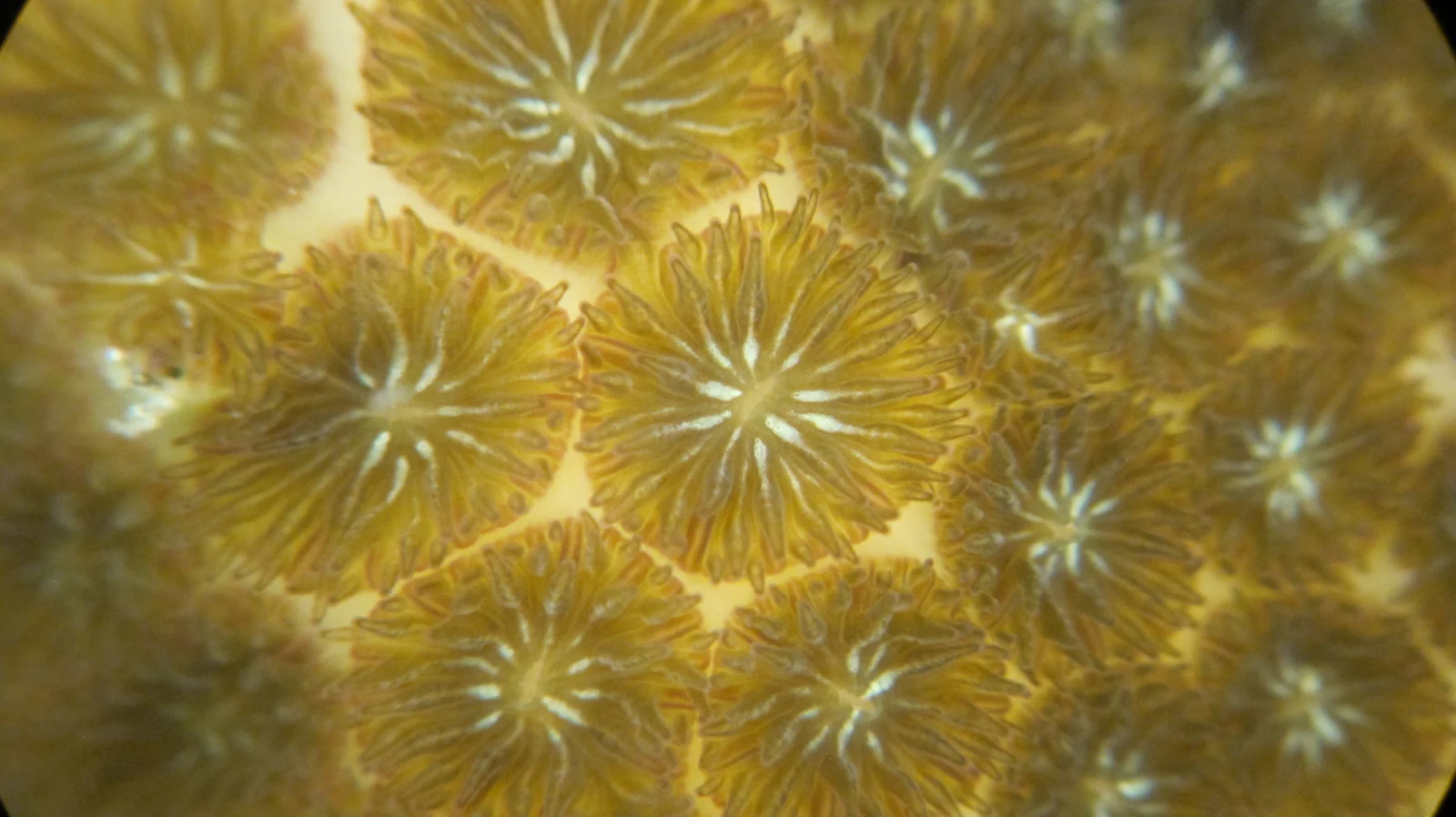
A coral is an animal. Its living unit is a polyp, with a mouth surrounded by tentacles and an internal digestive cavity. Stinging structures in tentacle tissue help capture prey. [1] More precisely, a nematocyst is a subcellular organelle with a pressurized capsule and coiled thread, built inside a specialized stinging cell. A 2022 microscopy study documented its operation in the sea anemone Nematostella vectensis. That was an anemone experiment; the shared anatomical distinction is between the animal, one of its cells and the stinging organelle inside that cell. [2]
Some corals consist of a single polyp; others form colonies. That distinction matters when identifying what is being described: “coral” can refer to a solitary animal or to a group of polyps living together. [3]
When skeleton becomes reef framework
Stony corals deposit calcium carbonate skeletons. As skeleton accumulates, it can provide the framework of a coral reef. The skeleton is mineral structure made by the animal; it is not the living polyp, and a coral colony is not simply a rock. [3]
Corals do not all build tropical reefs. Some are solitary, and the broader group also includes corals that live in cold, dark deep water. Reef-building is one important mode of coral life, not a universal description of every coral. [3] [4]
A partnership in many shallow reefs
Many shallow reef-building corals house photosynthetic algae in their tissues. The symbionts provide products of photosynthesis, while receiving shelter and materials from the coral animal. This exchange helps explain the partnership without confusing the algae with the polyp or treating the whole coral as a plant. [5]
The partnership is not universal. Deep-water corals can live in cold, dark conditions without photosynthetic symbionts; they capture food particles that pass by. A pale deep-water coral may therefore have its normal appearance rather than being bleached. [4]
An evidence-reading exercise: what does white mean?
Compare two hypothetical observations. One is a shallow reef-building coral known to host photosynthetic algae; it has lost color. The other is a naturally pale deep-water coral. The first could be showing bleaching, which involves loss of the photosynthetic partnership. The second’s pale color alone does not establish bleaching. [5] [4]
Even for the shallow coral, bleaching does not by itself prove that the animal has died. Loss of symbionts can cause nutritional stress and starvation, but it is not an immediate death certificate. The observation needs context about coral type and condition. [5] [3]
Keep the components distinct
A useful description separates the animal, its partners and its structure: polyps capture food; photosynthetic algae support many shallow reef-building corals; stony coral polyps deposit calcium carbonate skeleton. Those pieces interact, but they are not interchangeable. [1] [5] [3]
For identification, note whether the coral is solitary or colonial and whether the setting is shallow and light-exposed or deep and dark. Neither observation alone settles every biological detail, but together they prevent two common errors: assuming every coral needs sunlight and treating every white coral as bleached. [3] [4]
Sources & further reading
Have a correction or a source to suggest? Send a note →