
Reading path: Octopuses, jellies and other invertebrates →
A closer look at the evidence
| Question or feature | Explanation | What it does not establish |
|---|---|---|
| Rear legs | The last pair is flattened into swimming paddles. [1] | This feature identifies an adaptation, not a migration route. |
| Molt | A crab sheds its hard external skeleton to grow; the new crab is soft and vulnerable. [1] | Soft shell is a temporary stage, not a separate species. |
| Female movement | Mated females move toward higher-salinity spawning waters and carry eggs beneath the abdomen. [1] | Routes and timing depend on location and conditions; one tagging study is not a universal map. [2] |
A swimming crab built for changing water
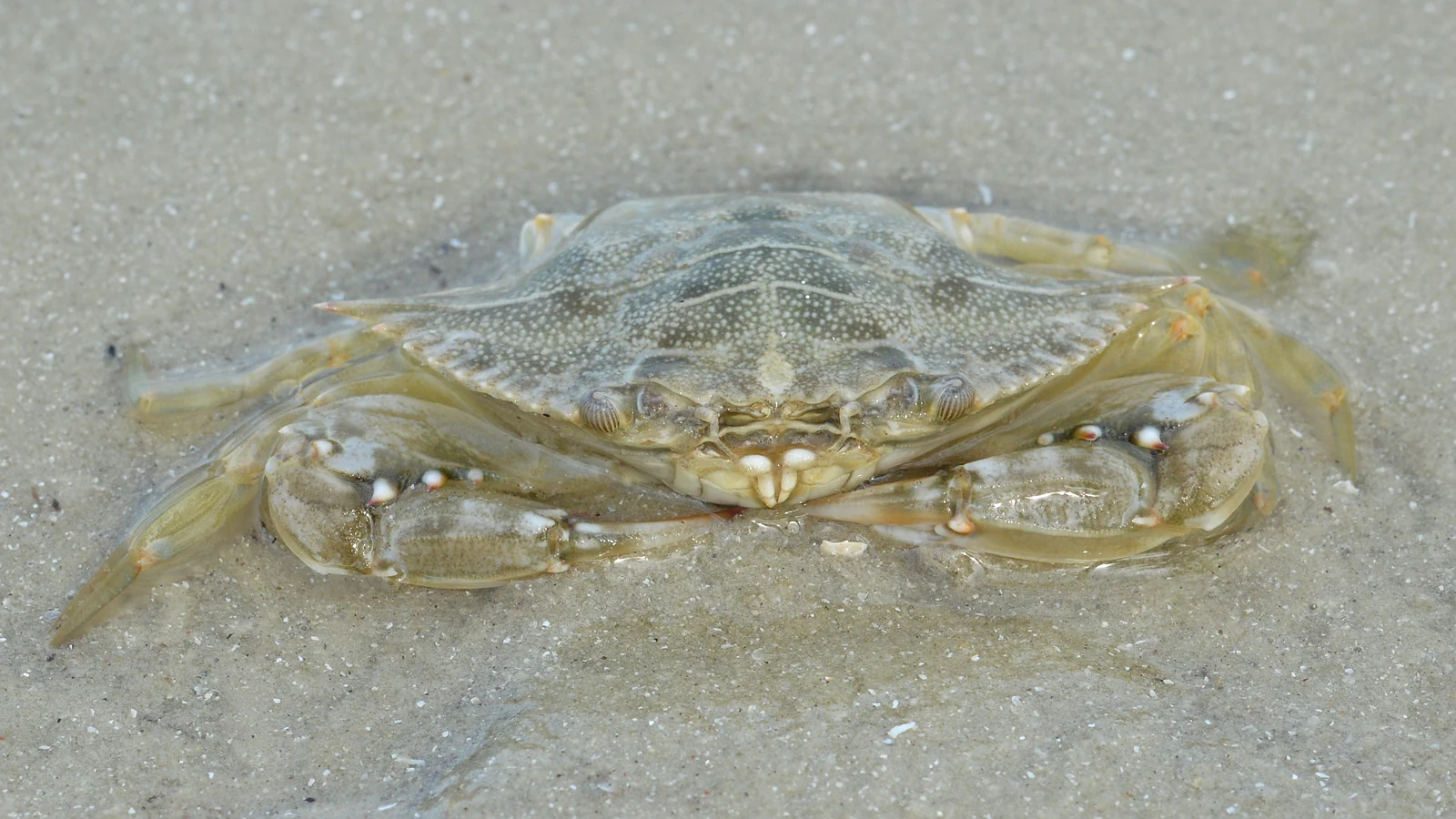
The blue crab, Callinectes sapidus, is a swimming crab with five pairs of legs. Its last pair is flattened into paddles, a visible adaptation that distinguishes it from crabs whose rear legs are not shaped for swimming. The paddle identifies a locomotor feature; it does not by itself tell you where a particular crab is in its life cycle. [1]
The estuary is not one uniform habitat. Blue crabs use changing parts of it as they grow and reproduce. A crab caught at one location offers a snapshot of its position, not a map of every habitat it has used. Distinguishing that snapshot from a movement pattern is essential when interpreting both field observations and tagging studies. [1]
Sex can be assessed from the abdominal flap. A male’s is narrow and T-shaped, while a mature female’s is broadly rounded. An external egg mass beneath the abdomen establishes that a female is carrying eggs at that moment; its absence does not by itself establish that she is immature or has never mated. [1]
Growth means leaving the shell behind
A blue crab’s hard external skeleton cannot expand continuously as the animal grows. Growth requires molting: the crab sheds that skeleton, leaving a newly molted individual with a soft shell. That soft period is especially dangerous because the crab is more vulnerable to predators before the new shell hardens. [1]
A soft-shell crab is therefore a blue crab at a vulnerable growth stage, not a separate species. The distinction is useful when looking at an image or market label: shell condition describes a temporary stage, whereas species identity comes from the animal’s anatomy. A photograph of a soft crab also cannot tell you how long it will remain soft. [1]
Consider a hypothetical comparison: two crabs have the same paddle-shaped rear legs and the same sex-specific abdominal form, but one has a hard shell and the other has just molted. The shared features support identifying both as blue crabs; the shell difference indicates different molt condition, not different species or necessarily different age. [1]
From estuary to spawning water
After mating, females move toward higher-salinity spawning waters and carry developing eggs beneath the abdomen. The eggs hatch into zoeal larvae, followed by a megalopal stage and then juveniles. The swimming larvae look different from the familiar crab form; development and movement together connect the estuary with saltier spawning waters. [1]
A North Carolina tagging study followed mature female movement from upper-estuary sites toward Oregon Inlet. The study used mark-and-recapture observations collected in 2008 and 2009. Its publication date was March 30, 2023, but that is not the date of the field observations and does not make the study a 2026 population census. [2]
Tagging evidence depends on where animals are released, where they are later encountered, and which encounters are reported. The North Carolina study supports a documented movement pattern in its study setting; it cannot establish that every mature female follows an identical route or that all estuaries have the same migration geography. [2]
How to read local timing claims
Molt rates and spawning dates vary with location, crab size and environmental conditions. South Carolina guidance describes the biology and local patterns of blue crabs, but its timing examples should not be converted into a coast-wide calendar. A date that fits one location does not automatically predict the timing in North Carolina or another estuary. [1]
In the North Carolina study, many recaptures occurred near the junction of Albemarle, Currituck and Croatan sounds. The researchers linked that concentration to both narrowing waterways and fishing effort. This illustrates why a recapture map reflects the animals’ movement and the places where people encountered and reported them; it is not a complete map of every tagged crab’s route. [2]
For a practical evidence-reading exercise, separate four questions: what crab was observed, at what life stage, where and when it was observed, and how the observation was collected. “Mature female,” “upper estuary,” and “tagged in 2008–2009” each constrain the claim. A capture site alone cannot reveal the entire route, and a local calendar cannot establish a species-wide schedule. [1] [2]
Sources & further reading
Have a correction or a source to suggest? Send a note →