
Reading path: Octopuses, jellies and other invertebrates →
A closer look at the evidence
| Question or feature | Explanation | What it does not establish |
|---|---|---|
| Chambered shell | The animal lives in the outermost chamber; inner chambers are connected by tissue called the siphuncle. [1] | A shell alone does not show the living animal’s swimming behavior. |
| Buoyancy regulation | Regulating chamber fluid and gas contributes to buoyancy. [1] | This is distinct from the water jet used for movement. [1] |
| Maturity and eggs | For N. pompilius, NOAA reports maturity around 10–15 years and egg development of about a year or longer. [2] | These are estimates, not a guaranteed individual schedule or lifespan. |
Body chamber and buoyancy chambers
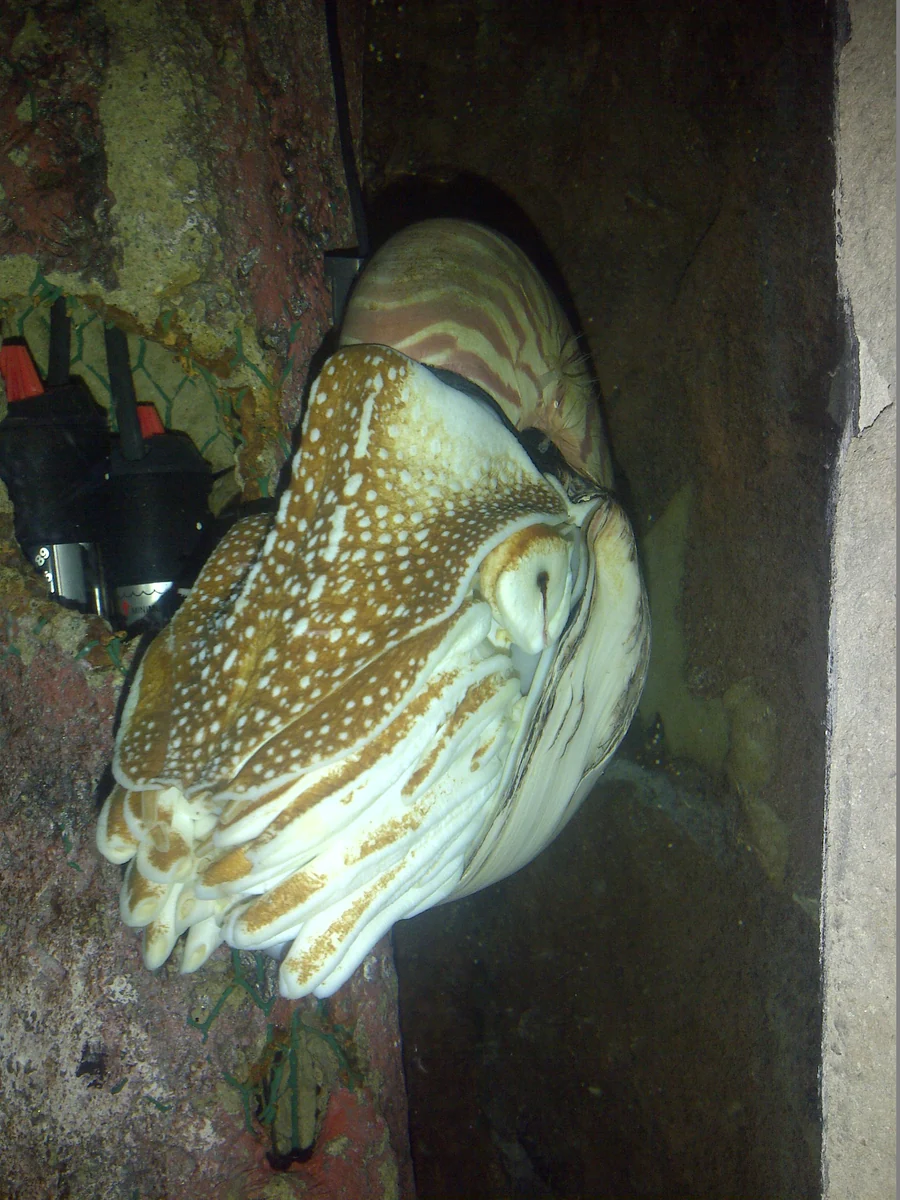
A chambered nautilus is a cephalopod mollusk, related to octopuses and squids, but its external coiled shell makes its body plan immediately distinctive. The animal occupies the shell’s outermost chamber. The older inner chambers are not extra rooms filled with the animal; they form part of a buoyancy system. [1]
A living tissue connection called the siphuncle passes through the chambers. By regulating fluid and gas in those compartments, the animal adjusts the shell’s buoyancy. The mechanism is gradual support and balance in water, not a motor that pushes the nautilus forward. [1]
This distinction matters when interpreting a shell. A cut shell can show the sequence of chambers and the path of the siphuncle, but it cannot by itself demonstrate how the animal swims. Treating every chamber as a propulsion chamber confuses internal buoyancy control with movement through surrounding water. [1]
Buoyancy is not the swimming jet
Nautiluses move by jet propulsion, a function separate from chamber buoyancy. In a useful comparison, imagine a small vessel whose sealed compartments help it float while a pump-driven jet changes its position. The compartments support the vessel; the jet supplies movement. In a nautilus, the siphuncle-linked chambers contribute to buoyancy, while water expelled for jet propulsion moves the animal. [1]
That comparison is conceptual rather than a claim that a nautilus has a boat’s hardware. The key is to ask what each structure does: the siphuncle connects shell chambers and helps regulate their contents; the propulsion system expels water to move the body. A shell diagram can establish chamber arrangement, but not the timing or force of a swimming burst. [1]
The head is ringed by numerous slender appendages around the mouth. Unlike the familiar arms of an octopus, these appendages lack suckers. The eyes also differ from those of octopuses and squids: they do not have a lens. These are anatomical distinctions, not evidence that nautiluses are simply primitive versions of other living cephalopods. [1]
Reading anatomy without overclaiming
When identifying a nautilus, combine features rather than relying on a single image detail: the external chambered shell, the outer chamber occupied by the animal, and many suckerless appendages provide a more informative description than the word “tentacles” alone. The lensless eye is another contrast with octopus and squid eyes. [1]
Chemical sensing also helps nautiluses find food. Sensors on their slender appendages detect food-related odors, and a beak processes animal material such as fish or crustaceans. The shell, appendages and mouth therefore serve different tasks: buoyancy support, finding or handling food, and feeding. A cut shell shows only part of that living system. [2] [1]
Species labels also matter. Nautilus pompilius is one species, not a stand-in for every nautilus; family-wide generalizations and descriptions of newly separated island species require appropriate qualification. The facts here about appendages and eye structure describe the animal in the museum guide, while the maturity estimates below specifically concern N. pompilius. [2] [1]
Slow development changes the risk calculation
Nautilus pompilius grows slowly and matures late compared with many familiar cephalopods. NOAA reports maturity at around ten to fifteen years and eggs that take about a year or longer to develop. These are reported estimates, not a schedule guaranteed for every individual, and they do not establish a precise lifespan. [2]
Low egg production, late maturity and slow growth make heavy collection difficult to offset quickly. Nautiluses are harvested for ornamental shells and shell products, removing living animals whose replacement takes years. The reproductive pattern therefore matters when assessing collection pressure; an attractive shell is also the remains of an animal with a slow life history. [2]
A hypothetical evidence-reading exercise makes the distinction clear: if a report says an animal matured at twelve years and its eggs developed for more than a year, those figures support the description “slow to reproduce.” They do not prove that every nautilus matures at twelve, that each egg takes the same time, or that a captured shell reveals the animal’s age. Keep the species, estimate and measurement question attached to each number. [2]
Sources & further reading
Have a correction or a source to suggest? Send a note →