
Reading path: Octopuses, jellies and other invertebrates →
A closer look at the evidence
| Question or feature | Explanation | What it does not establish |
|---|---|---|
| Eight arms and suckers | Arms bear suckers that contribute both grip and sensory information. [1] | Contact and gripping can be observed; a photograph cannot reveal every sensory cue detected. [1] |
| Camouflage | Chromatophores change visible color, and skin texture changes help blending with uneven surroundings. [3] | Camouflage does not guarantee invisibility or identify a particular mood. [3] |
| Brooding | A female attaches egg strings in a den, guards and cleans them, ventilates them with water, and fasts. [2] | Brooding duration varies with conditions; a single observation is not a universal schedule. [3] |
| Lifespan and young | Typical lifespan is estimated at three to five years; hatchlings begin as planktonic paralarvae before settling. [3] | The lifespan is an estimate; the planktonic phase lasts weeks to months and varies with conditions. [3] |
Eight arms that sense as well as hold
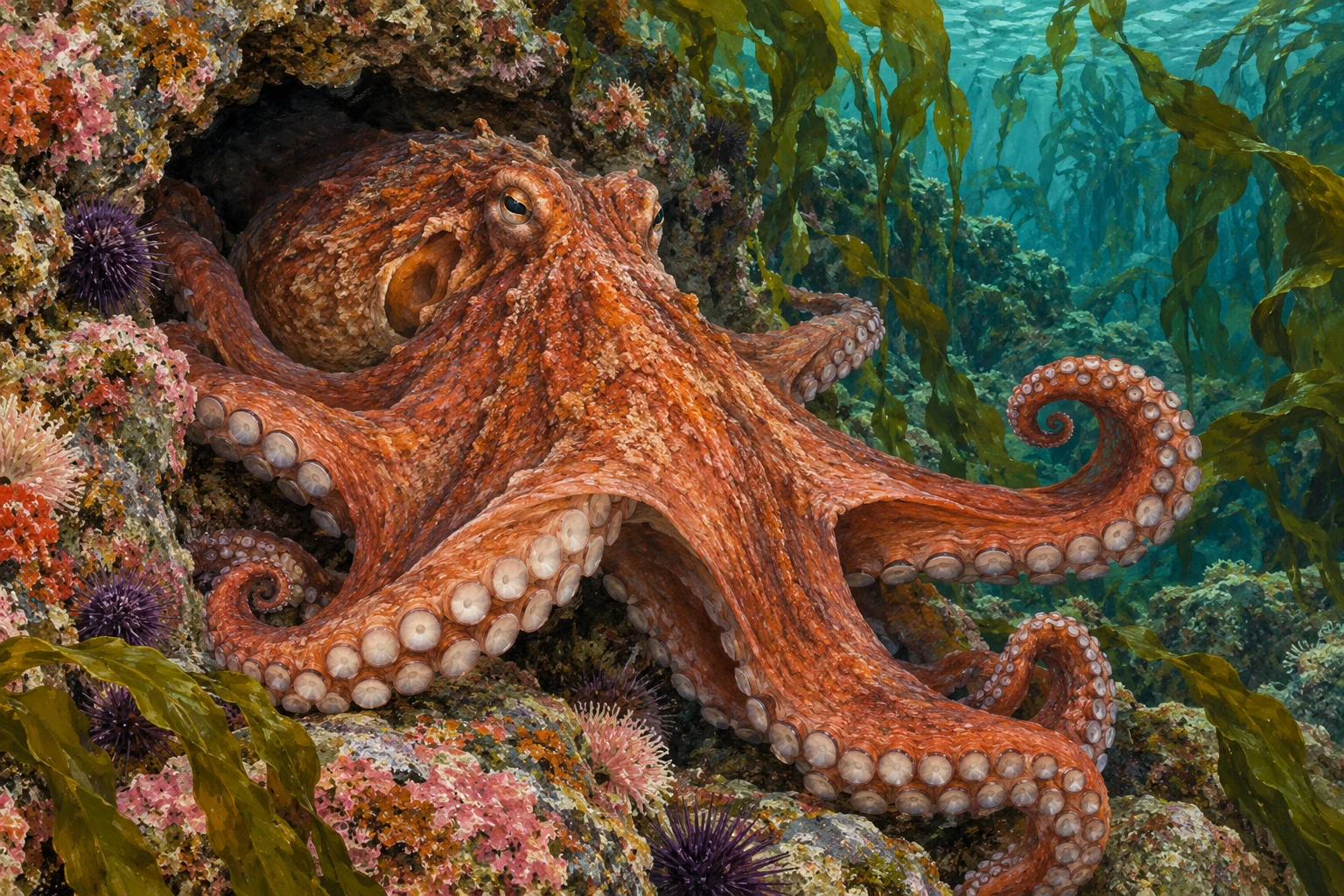
The giant Pacific octopus, Enteroctopus dofleini, is a cephalopod mollusk with eight arms. They are arms, not squid-like feeding tentacles. Their suckers help grip surfaces and prey, and they also contribute sensory information. That dual role makes an arm more than a simple appendage for pulling an object closer. [1]
Imagine an octopus moving across uneven rock. Its suckers provide contact and grip while also supplying sensory information. The same arm can therefore participate in movement, exploring a surface and securing food. These functions complement one another, although a photograph of contact alone cannot reveal exactly what information the animal detected. [1]
The animal eats crabs, clams, fishes and other marine animals. A crab presents a hard protective shell, whereas many fishes present a different gripping and handling problem. This variety helps explain the usefulness of strong, flexible arms with many suckers; it does not mean every individual eats the same mixture of prey. [2]
Camouflage changes color and texture
Chromatophores change the visible coloration of the octopus’s skin. Changes in skin texture can also help it blend with an uneven background. These are distinct parts of camouflage: coloration alters the visual pattern, while texture alters the surface appearance. [3]
A hypothetical comparison makes the distinction clearer. Against mottled rock, changing color could reduce a strong visual contrast; changing skin texture could make a smooth-looking outline less conspicuous against irregular surroundings. This example illustrates the two documented mechanisms, not a measured test or guarantee that an octopus becomes invisible. [3]
Color changes can contribute to camouflage, communication and warning displays. A single visible pattern therefore cannot be translated reliably into one emotional label. The setting, preceding behavior and other animals present help establish context, while the color and texture themselves describe observable changes at the skin surface. [1] [3]
Egg strings and a fasting parent
A female attaches strings of eggs inside a den. During brooding, she guards and cleans the eggs and directs water over them to ventilate the clutch. She does not feed during this period. The den is therefore an active site of parental care, not just a shelter where eggs happen to be left. [2]
Consider a hypothetical den with egg strings attached to the roof and an adult repeatedly directing water across them. The strings and the adult’s care are evidence consistent with brooding; observing the adult nearby once, without eggs or repeated care, would not establish the same sequence. This distinction avoids inferring reproduction from proximity alone. [2]
The mother usually dies near the end of brooding or after hatching. “Usually” matters: this is a general pattern, not a guarantee that every female dies at the same stage. Brooding duration can change with conditions, so a dated aquarium observation should not be turned into a universal countdown. [3] [2]
From a den into the plankton
Tiny hatchlings initially enter a planktonic paralarval stage before settling to the seafloor. Thus, the offspring do not simply emerge as miniature adults and remain with the mother in the den. The described sequence moves from protected eggs, to small drifting paralarvae, and later to a seafloor-associated life stage. [3]
Alaska’s species account describes the planktonic phase as lasting weeks or several months, with water temperature affecting its duration. The contrast is substantial: the mother remains with attached eggs in a den, while hatchlings enter the water column before settling. A range of durations is more useful than a fixed countdown for every brood. [3]
The species’ typical lifespan estimate is three to five years. It is an estimate for the species, not a known lifespan for every individual, nor evidence that every octopus spends a fixed number of years in each life stage. Captive observations and caretaker accounts can illustrate behavior, but they do not establish universal timing or a record longevity. [3]
Sources & further reading
Have a correction or a source to suggest? Send a note →