
Reading path: Octopuses, jellies and other invertebrates →
A closer look at the evidence
| Question or feature | Explanation | What it does not establish |
|---|---|---|
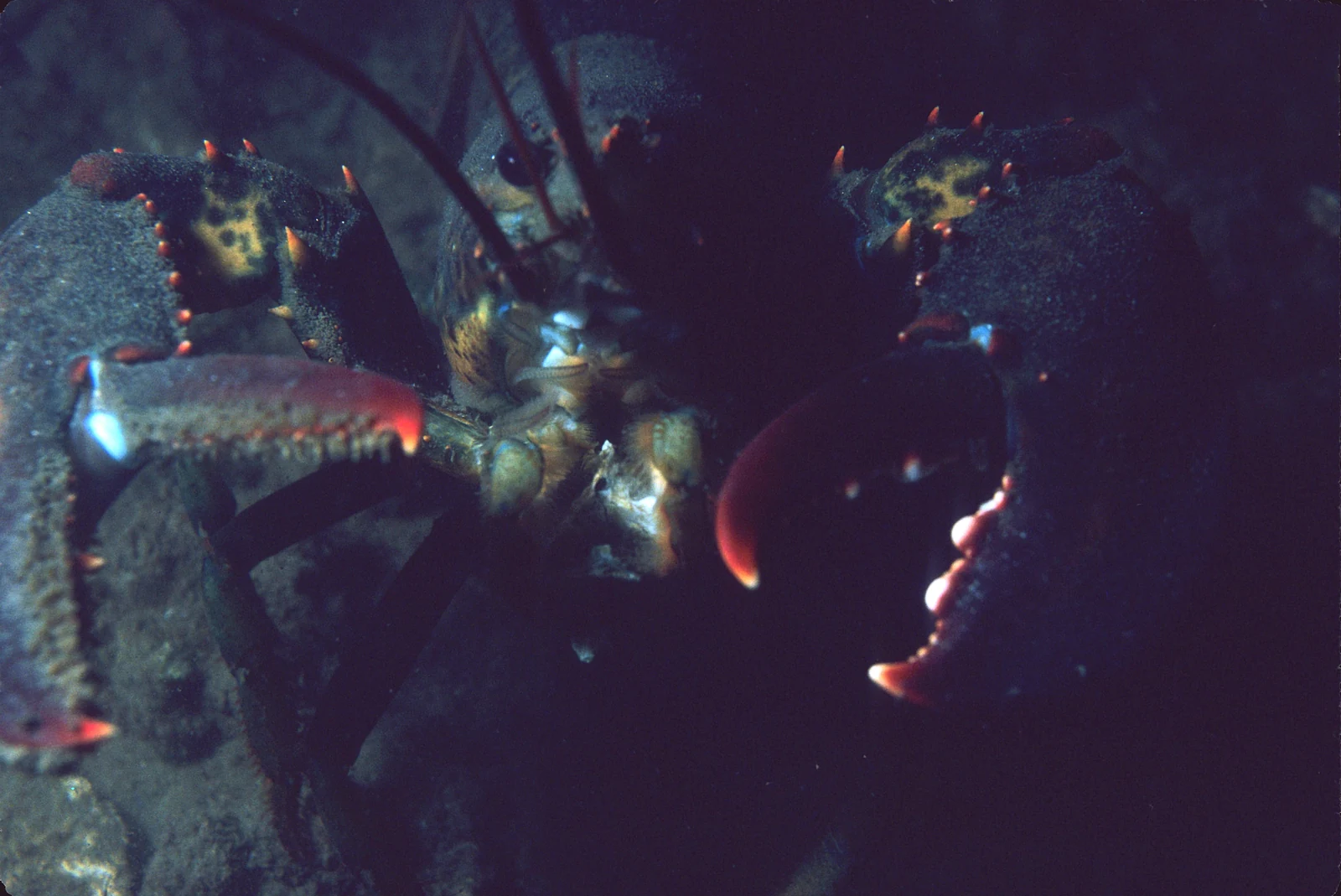
| Crusher and finer claw | The crusher has substantial teeth for breaking shells; the other major claw has finer edges for gripping or tearing. [1] | Claw form does not establish a particular meal or behavior. |
| Molting | The lobster leaves its old external skeleton, expands, and hardens a new shell; it may eat the cast shell for calcium. [2] | Adult molt rates vary, and shell condition does not provide an exact age. |
| Age estimates | NOAA says exact age is difficult to determine; size-based estimates are approximate. [2] | Possible century-scale longevity is not a verified lifespan for an individual. [1] |
Claws that divide the work
The American lobster, Homarus americanus, is a crustacean of the northwestern Atlantic. It has ten legs, including an enlarged pair ending in claws. The claws are not interchangeable tools: one is a crusher with substantial teeth for breaking shells, while the other has finer edges suited to gripping or tearing prey. [1]
A useful comparison is a tool with one sturdy jaw for cracking a hard casing and another finer edge for holding or pulling material apart. In a hypothetical meal, the crusher could break a shell while the finer claw grips or tears the prey. This illustrates the documented claw differences; it does not establish that every lobster uses the same claw for every prey item. [1]
Most living American lobsters are olive or brownish, rather than the bright red associated with a cooked shell. Color can help correct a familiar misconception, but it is not enough by itself to identify an animal or determine its age, sex or condition. [1]
A rigid shell sets the growth schedule
The external skeleton protects the lobster but cannot simply stretch as the animal grows. Growth requires molting: the lobster leaves its old shell and expands before the new one hardens. NOAA describes the animal absorbing water as it expands and notes that it may consume the shed shell, recovering calcium. [2]
The transition creates an important distinction between a large lobster and a recently molted lobster. One describes body size; the other describes a temporary shell condition. Adult molt rates vary, so a single size observation cannot reveal when the last molt occurred or predict exactly when another will happen. [2]
Two lobsters with similar shell lengths need not have hatched in the same year. NOAA’s aquarium-based examples treat age at a given size as an estimate rather than an exact birthday. A careful comparison reports the measured length or mass, identifies an age as estimated, and keeps the uncertainty attached to the number. [1] [2]
Eggs beneath the tail; age is harder to read
Female American lobsters carry developing eggs under the tail. That placement is a useful biological fact, but an image that does not show the underside may not establish whether eggs are present. Sex, reproductive condition and body size are separate observations and should not be collapsed into one claim. [1]
NOAA cautions that exact age is difficult to determine. Size-based age estimates are approximate, so a large animal cannot be assigned a precise birthday from length alone. The sources mention possible century-scale longevity as an estimate; that does not prove that an individual lobster lived exactly one hundred years or establish a measured maximum lifespan. [1] [2]
This is especially important for dramatic captions about unusually large lobsters. A sound evidence note would distinguish the observed measurement from the inferred age: “shell length measured” is a measurement claim; “more than a century old” is an estimate that needs its method and uncertainty stated. Without those details, size does not settle age. [2]
Keep the species and the stock in view
The American lobster is not the clawless spiny lobster. Their visible anatomy differs, and a photograph of a spiny lobster cannot illustrate the American lobster’s distinctive crusher and finer claw pair. Species identity should be checked before interpreting the animal’s claws, range or fishery information. [1]
Fishery condition also should not be reduced to a generic claim about all American lobsters. NOAA’s species account notes differences between stocks in current assessments. A finding about one stock is not automatically a finding about every part of the species’ range; a broad statement needs the stock and assessment context attached. [1]
When reading a report or photograph, separate what is directly visible from what is inferred. Claw form and shell color may be described from an image, but an exact age, previous molt date or stock status requires evidence beyond appearance. If a measurement is supplied, preserve what was measured—length, mass or another dimension—rather than silently converting it into an age. [1] [2]
Sources & further reading
Have a correction or a source to suggest? Send a note →