
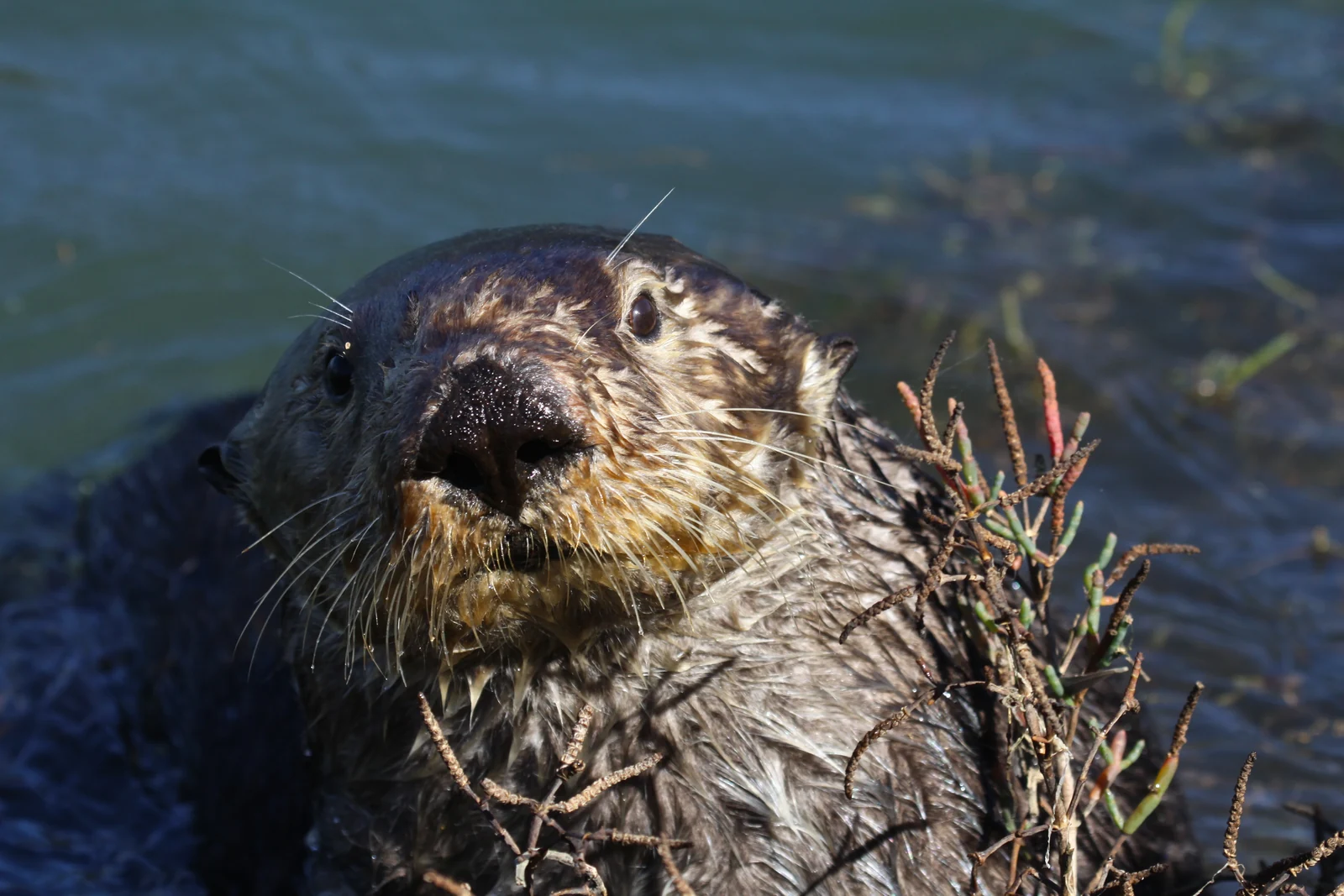
Reading path: Sea otters and coastal mammals →
A closer look at the evidence
| Question or feature | Explanation | What it does not establish |
|---|---|---|
| Prey | Benthic prey include clams, mussels, crabs and sea urchins; fish also occur in parts of the range. [1] | Diet varies by place and individual; urchins do not dominate every population. |
| Forelimb pouch | Loose skin beneath a forelimb can hold prey collected during a dive. [2] | A pouch does not indicate which prey an otter prefers. |
| Rock tools | Hard objects can act as hammers or anvils against resistant shells. [1] | Not every otter uses a tool on every meal. |
| Specialization | Big Sur and Monterey studies found substantial individual diet differences. [4] | One filmed meal cannot establish a long-term diet. |
A menu built around the seafloor
Sea otters (Enhydra lutris) often feed on benthic animals: clams, mussels, crabs and sea urchins live on or near the bottom and make up important prey. Fish and other prey also occur in parts of the species’ range, so “sea otters eat urchins” is too narrow as a general description. Diet depends partly on which prey an otter can find and capture locally. [1]
An otter dives to collect prey, then commonly returns to the surface to handle the meal with its forepaws. Loose skin beneath a forelimb forms a pouch where prey can be carried during a dive. This makes the feeding sequence more than a quick bite underwater: collection, transport and processing can happen at different stages. [1] [2]
A useful comparison is between a mussel and a fish. A mussel’s shell presents a hard mechanical barrier, while a fish does not have that same shell to crack. The animal’s menu and the way it handles a meal therefore depend on prey structure as well as prey presence. The available evidence supports a broad menu, not a single standard diet for every otter or coast. [1]
How paws, teeth and rocks open resistant prey
Crushing teeth help sea otters process hard-shelled prey. A rock or other hard object can also act as an anvil or hammer: the otter positions prey against it or strikes the shell, using an external surface to overcome resistance. Tools supplement what teeth and paws can do; they are not involved in every meal. [1]
The distinction matters because repeated forceful biting can damage teeth. A USGS study of southern sea otters analyzed longitudinal information from 196 radio-tagged animals. Tool users accessed larger or harder-shelled prey, particularly females in that study, and tool use was associated with reduced tooth damage during processing. The study links behavior with access to prey and tooth condition; it does not establish that every tool use has the same benefit. [3]
Consider a clearly hypothetical comparison: one otter encounters a hard-shelled snail and uses a rock to crack it, while another finds easier-to-open prey nearby. Both can obtain food, but the first behavior may reduce the need to bite directly through resistant shell. This illustration explains a possible mechanical advantage; it is not a report of two observed animals or proof that tool users always eat more. [3]
Why individuals can eat differently
Research at Big Sur and Monterey documented substantial diet specialization among individual sea otters at both sites. In a population sharing the same broad habitat, individuals can repeatedly find and handle different prey. Competition for resources can favor learning profitable ways to locate or process particular foods. [4]
Specialization can shape exposure as well as feeding success. Different preferred prey may expose otters to different pathogens or toxins. That is a possible consequence of diet differences, not evidence that every specialized diet causes illness. The Big Sur and Monterey findings are site-specific; they should not be assumed to describe all populations or all subspecies. [4]
A single meal cannot establish an individual’s lasting preference. To infer specialization, researchers need repeated observations over time, since a filmed feeding event only records what that otter ate on that occasion. In a hypothetical evidence exercise, seeing one otter open a crab with a rock supports “used a tool for this meal.” It does not support “always eats crabs” or “keeps this rock for life.” [4] [1]
Reading tool use without overgeneralizing
Tool use can help an otter meet energy needs when preferred prey are scarce, but that possibility does not mean every tool-using animal is starving. The costs and benefits vary with prey availability, energy intake and tooth condition. A tool may make a difficult food accessible or reduce mechanical strain, while the value of that behavior depends on the particular feeding context. [3]
The evidence also has boundaries. The 196-animal analysis concerned southern sea otters, and its stronger sex-related finding for females is not a rule for every female or male, much less every subspecies. Likewise, the observation that tool users accessed harder prey does not imply that non-tool users cannot eat shellfish or that all tool users choose the same prey. [3]
When evaluating a diet claim, separate three questions: what foods the species is known to eat, what an individual repeatedly eats, and how it processes a particular meal. Species profiles provide the broad menu; long-term individual records establish specialization; and a feeding observation records one handling event. Measuring local prey availability requires additional sampling, rather than inference from a general food list. [1] [4]
Sources & further reading
- Northern Sea Otter Species Profile | Alaska Department of Fish and Game ↗
- Southern Sea Otter | US Fish and Wildlife Service ↗
- Tool use increases mechanical foraging success and tooth health in southern sea otters | US Geological Survey ↗
- Southern Sea Otter Population Biology at Big Sur and Monterey, California | US Geological Survey, 2019 ↗
Have a correction or a source to suggest? Send a note →