
Reading path: Sea otters and coastal mammals →
A closer look at the evidence
| Question or feature | Explanation | What it does not establish |
|---|---|---|
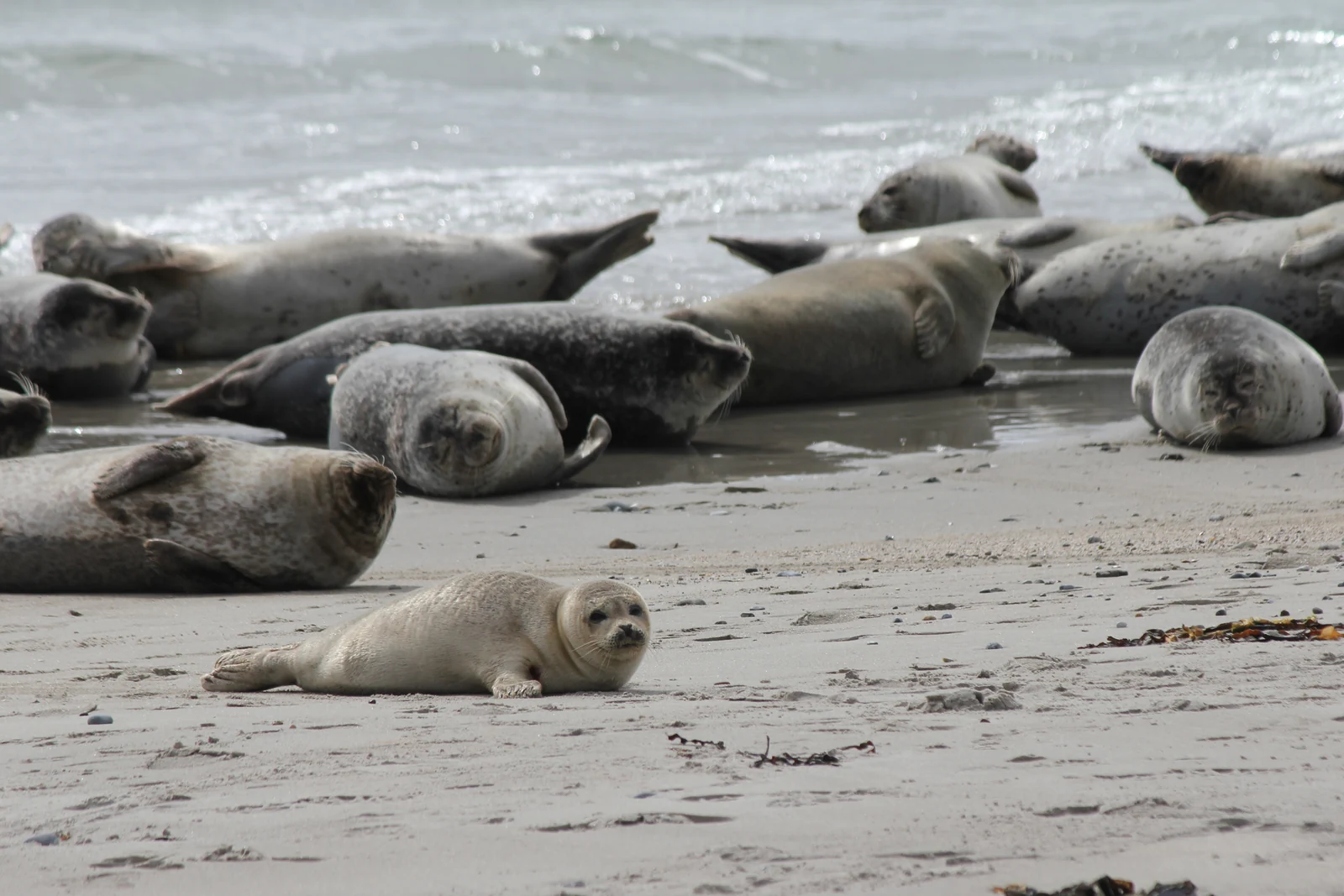
| Haulouts | Rocks, beaches, reefs and glacial ice support rest, temperature regulation, molting, birth and nursing. [1] | A seal ashore is not automatically stranded. |
| Whisker sensing | Blindfolded trained seals followed miniature-submarine wakes in a controlled experiment. [2] | The trial does not prove perfect tracking in every wild hunt. |
| Pup swimming | Pups can swim within minutes of birth. [1] | Swimming ability does not establish abandonment or justify moving a pup. |
| Pup encounter | NOAA advises the public not to handle, feed or push pups into water; report apparent injury to authorized responders. [3] | Local viewing distances and pupping dates vary. |
True seals on land and in water
The harbor seal, Phoca vitulina, is a true seal in the family Phocidae. It hauls out on rocks, beaches, reefs and glacial ice. Leaving the water supports several needs: rest, temperature regulation, molting, birth and nursing. A seal on shore is therefore not automatically sick or stranded; the setting is part of its normal life history. [1]
Harbor seals differ from sea lions in how they move on land. Their hind flippers do not rotate beneath the body for sea-lion-like walking. This anatomical difference helps explain why a seal moving awkwardly on land should not be judged by the movement expected of an animal with a different flipper arrangement. [1]
Harbor seals eat fish, shellfish and crustaceans. Local prey availability affects their dives, so a regional diet should not be treated as a fixed menu everywhere. Females may forage while nursing, and nursing lasts about four to six weeks according to the cited species account. Those figures describe reported life-history patterns, not a precise schedule for every mother and pup. [1]
What whisker research demonstrates
Harbor seal whiskers can detect hydrodynamic trails: disturbances left in water by a moving object. In a controlled experiment, trained seals were blindfolded and followed wakes produced by a miniature submarine. This showed that seals could use whisker sensing to follow a water trail without relying on vision in that trial. [2]
The experiment’s design sets its boundary. It involved trained animals following a miniature submarine’s wake under controlled conditions; it does not show that every wild seal can perfectly track every fish in every sea. It supports a sensory capability, not an unrestricted claim about how every hunt unfolds. [2]
For example, imagine an observer sees a seal following a moving object underwater. The wake-following experiment makes it plausible that whiskers could contribute to tracking a hydrodynamic trail. But the observer cannot infer from that movement alone that the seal used whiskers, caught prey or followed a particular species of fish. The mechanism and the observed outcome are separate claims. [2]
Pups can enter the water quickly
Harbor seal pups can swim within minutes of birth. That ability does not mean a pup encountered on shore is ready to be moved or that it has been abandoned. Females nurse for about four to six weeks and may forage during lactation, so a mother can be away while her pup remains on land. [1]
NOAA guidance says a pup alone is not automatically abandoned. Disturbance can prevent a mother from returning, which is why approaching to inspect or move a pup can worsen the situation. A person at the beach cannot diagnose abandonment simply because no adult seal is visible at that moment. [3]
A concrete decision example: you see a pup alone on a beach, with no obvious wound from where you are standing. The appropriate interpretation is uncertainty, not abandonment. Do not touch, feed, carry or push it into the water. Keep your distance and allow trained responders to assess a case if injury or entanglement appears evident. [3]
Responding to an encounter safely
For beachgoers in the United States, NOAA advises leaving a seal pup alone: do not handle or feed it, and do not force it into the water. Apparent wounds or entanglement should be reported to authorized responders, who can assess the animal. A photograph or a brief encounter cannot replace that individual assessment. [3]
Viewing instructions and pupping seasons vary geographically. Follow local instructions and closures, keep people and pets away, and avoid repeated approaches that could prevent a mother from returning. A general description of harbor seal biology should be combined with the official viewing guidance for the particular shoreline. [1] [3]
A useful evidence-reading exercise is to separate what you can see from what you cannot know. You may see a pup lying alone; you may not know whether its mother is foraging nearby, whether the pup is injured, or how long it has been there. Because trained responders evaluate individual cases, report apparent injury or entanglement rather than attempting to handle the animal yourself. [3]
Sources & further reading
Have a correction or a source to suggest? Send a note →