
Reading path: Sea otters and coastal mammals →
A closer look at the evidence
| Question or feature | Explanation | What it does not establish |
|---|---|---|
| Insulation | Dense underfur and guard hairs retain groomed, trapped air that helps keep water from the skin. [1] [3] | Coat density and condition vary; no single density applies everywhere. |
| Daily food need | Typical adult estimate is roughly 20–30% of body mass per day. [2] | Approximate range, not an individual fixed ration. |
| Limbs | Webbed hind feet aid swimming; forepaws handle prey and grooming. [1] | Does not by itself identify age, sex, or region. |
| Coastal habitat | Central California examples include kelp, seagrass, and harbors; northern populations occur along several northeastern Pacific coasts. [2] [1] | Regional examples do not describe every population or trajectory. |
Fur does the insulating work
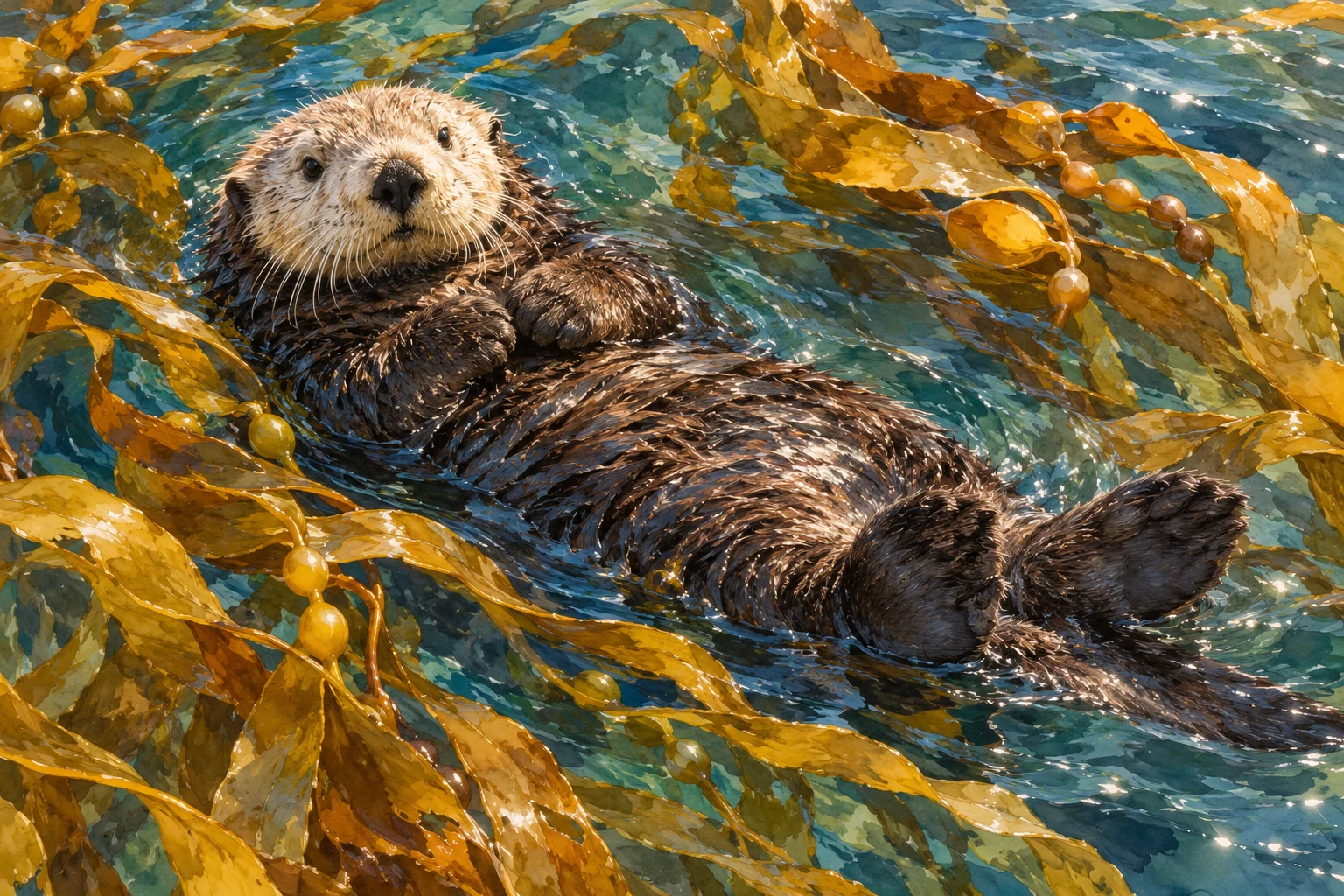
Sea otters, Enhydra lutris, are marine members of the weasel family. Unlike many marine mammals that rely on a thick insulating layer of blubber, sea otters depend on their coat. Dense underfur and longer guard hairs form a water-resistant covering; grooming traps air in the fur and helps keep water away from the skin, reducing heat loss. [1] [2] [3]
The mechanism links anatomy to behavior: grooming is part of maintaining insulation, not simply tidying the coat. Hair density and coat condition vary among individuals and body regions, so one figure should not be treated as an identical count everywhere on every otter. The useful explanation is functional: well-maintained fur holds an insulating layer of air, while damaged or fouled fur can lose that performance. [3]
A high-energy budget
Maintaining body heat also requires energy from food. A high metabolic rate supplies heat, and the U.S. Fish and Wildlife Service gives a typical adult food need of roughly 20–30 percent of body mass per day. It is an approximate energetic range, not a fixed ration for every individual: age, reproductive state, habitat, and other conditions affect needs. [2] [3]
As a clearly hypothetical arithmetic example, an adult weighing 25 kilograms at the stated range would need about 5 to 7.5 kilograms of food in a day: 25 × 0.20 = 5 and 25 × 0.30 = 7.5. This illustrates the percentage, not a measured intake for a particular otter or a prediction for every day. [2]
Coastal habitats and regional distinctions
Southern sea otters occupy nearshore central California, including kelp forests, seagrass areas, and busy harbors. Northern sea otters occur along the coasts of Alaska, British Columbia, and Washington. These regional examples show that sea otters use varied coastal settings; they do not describe the entire species range or imply identical population trajectories in each area. [2] [1]
Their bodies divide tasks between limbs. Broad, webbed hind feet provide swimming propulsion, while forepaws manipulate prey and groom the coat. Sea otters often rest in groups and may hold position in kelp. A quiet animal resting at the surface may be conserving energy, so interpreting stillness as an invitation to approach would miss the energetic role of rest. [1] [2]
Why fouling can become dangerous
The coat’s insulation depends on its condition. Oil or other fouling can disrupt the fur’s insulating performance, allowing heat loss that can lead to hypothermia. The problem is compounded by energy costs: an otter may need to groom, and the animal already has high food demands to support heat production. This is why coat contamination is not merely a cosmetic issue. [2] [3]
A comparison clarifies the difference in design. A seal’s blubber and an otter’s carefully groomed air-trapping fur address the same general heat-loss problem through different structures. If oil compromises the otter’s coat, the insulation mechanism itself is impaired; no equivalent inference about a seal’s insulation should be made from the otter example. [2] [3]
Observing without adding energy costs
Sea otters spend much of life in water, but they can come ashore; water use is not an inability to use land. At the same time, repeatedly interrupting rest adds energetic demands. The Fish and Wildlife Service advises keeping distance and never feeding sea otters. Observers should use those current agency recommendations rather than approaching a resting group for a closer look. [1] [2]
The practical picture is a linked system: coat structure traps air, grooming maintains that structure, metabolism supplies heat, and food provides the energy. The sources support this mechanism and approximate adult intake, but not a fixed daily menu, identical fur density across individuals, or a single trend for all regional populations. [2] [3]
Sources & further reading
Have a correction or a source to suggest? Send a note →