
Reading path: Sea otters and coastal mammals →
A closer look at the evidence
| Question or feature | Explanation | What it does not establish |
|---|---|---|
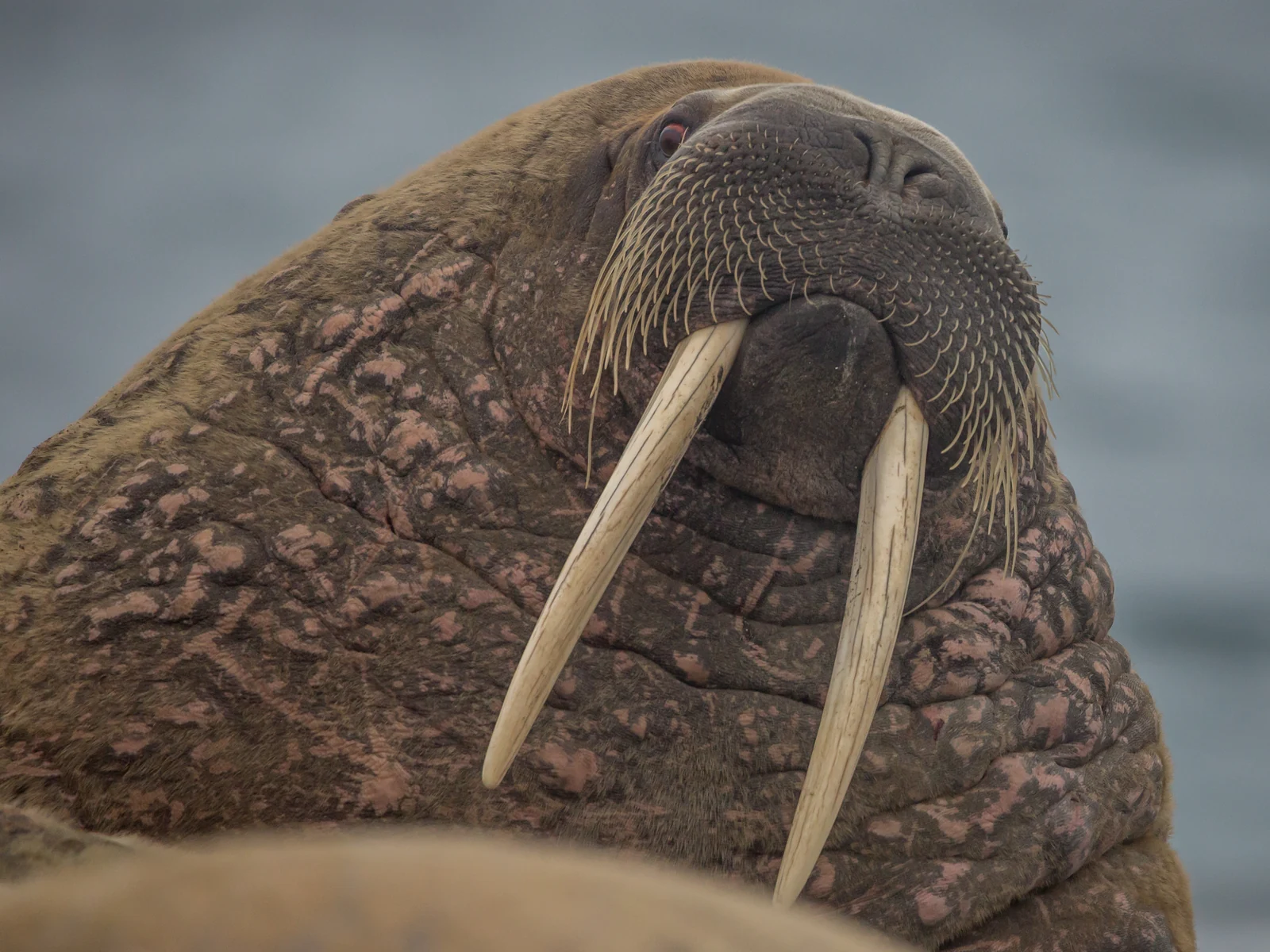
| Tusks | Both sexes have elongated upper canine teeth that continue growing. [2] | Tusks do not demonstrate that clams are stabbed during feeding. |
| Vibrissae | Hundreds of sensitive whiskers help locate prey on or beneath the seafloor. [2] | A whisker-searching posture alone does not prove a prey capture. |
| Suction feeding | Rapid tongue retraction creates suction that draws soft prey into the mouth. [2] | The mechanism does not mean every prey item is taken identically. |
| Pacific range | Pacific walruses inhabit the Bering and Chukchi seas and haul out on ice or coastal land. [2] | Do not apply Pacific distribution details automatically to Atlantic walruses. |
Species and Pacific range
The walrus is a pinniped whose scientific species name is Odobenus rosmarus. The Pacific subspecies, Odobenus rosmarus divergens, inhabits the Bering and Chukchi seas. Those geographic details describe Pacific walruses; they should not be casually applied to Atlantic walruses. [1] [2]
Pacific walruses rest on sea ice and on coastal land in Alaska and Russia. A haulout is a place where animals leave the water to rest, but a photograph of a crowded haulout cannot reveal the total population size or establish that every visible animal is feeding. A resting group is evidence of animals at a place, not a census or a feeding record. [2]
Adult males are generally larger than females and develop prominent bosses around the neck and shoulders. Both sexes have tusks, so the mere presence of tusks does not distinguish a male from a female. A clear view of several features is more useful than treating one conspicuous tooth as a complete identification test. [2]
Tusks are upper canine teeth
Both male and female walruses have tusks. Each tusk is an elongated upper canine tooth that continues growing through life; it is not an ordinary lower-jaw tooth. This anatomy helps correct a common visual assumption: the tusks project dramatically, but their size alone does not tell us how the animal gathers its usual food. [2]
A practical identification exercise is to distinguish the tusk from the feeding structures. The tusk is a conspicuous tooth, while the whiskers are the sensory equipment used to locate prey. If an image shows a walrus near the seafloor, the presence of tusks does not prove that it is stabbing clams. The documented feeding mechanism instead involves whisker sensing and suction. [2]
Continued tusk growth does not turn a photograph into a precise age measurement. The visible part of a tusk is only one anatomical feature, and an observer may not know an animal’s history. For a feeding observation, record what the whiskers and mouth are doing instead of assuming that the most conspicuous teeth perform every task. [2]
Whiskers find prey; the tongue draws it in
Walruses have hundreds of sensitive whiskers, or vibrissae, that help locate prey on or beneath the seafloor. Their menu includes clams, snails, worms, sea cucumbers and tunicates. The whiskers are therefore central to finding food in a habitat where prey may be partly buried or difficult to see. [2]
After finding soft prey, a walrus can retract its tongue rapidly to create suction and draw the prey into its mouth. This is a different mechanical action from cracking a shell with teeth or using a tusk as a spear. The prey list includes several kinds of seafloor animals, and the stated suction mechanism explains how soft prey is taken in; it does not mean every item is acquired in exactly the same way. [2]
Compare two imagined observations. A walrus sweeping its whiskers over the bottom is consistent with sensing for prey. A walrus with tusks visible above the water may simply be resting or moving. Neither sighting alone proves a meal. Evidence for feeding would need to show the behavior itself, and even then it would describe that observation rather than every walrus’s diet. [2]
Resting, size differences and evidence boundaries
Sea ice and coastal land both serve as resting places for Pacific walruses in Alaska and Russia. These alternatives are important context for interpreting where animals are seen: a group hauled out on land is not necessarily displaced in a way that can be diagnosed from the image alone, and a group on ice is not necessarily feeding. The species profile documents both kinds of haulout. [2]
Males are generally larger than females, and prominent neck and shoulder bosses are reported for males. Calves may remain with their mothers for roughly two years. The word “may” matters: this is an approximate Pacific life-history detail, not a precise timetable for each calf or a basis for calculating an individual’s age from a brief sighting. [2]
The strongest reading keeps anatomy, behavior and geography distinct. A tusk is an upper canine; vibrissae help locate benthic prey; tongue movement creates suction; and the Pacific subspecies’ stated range is the Bering and Chukchi seas. A photograph or isolated encounter can illustrate one feature, but it cannot establish population size, a full diet, or a species-wide behavior on its own. [2] [1]
Sources & further reading
Have a correction or a source to suggest? Send a note →