
Reading path: Sea otters and coastal mammals →
A closer look at the evidence
| Question or feature | Explanation | What it does not establish |
|---|---|---|
| Tail | Sea otter: relatively short and flattened; North American river otter: longer and tapering. [1] | Tail may be hidden or foreshortened in a photograph. |
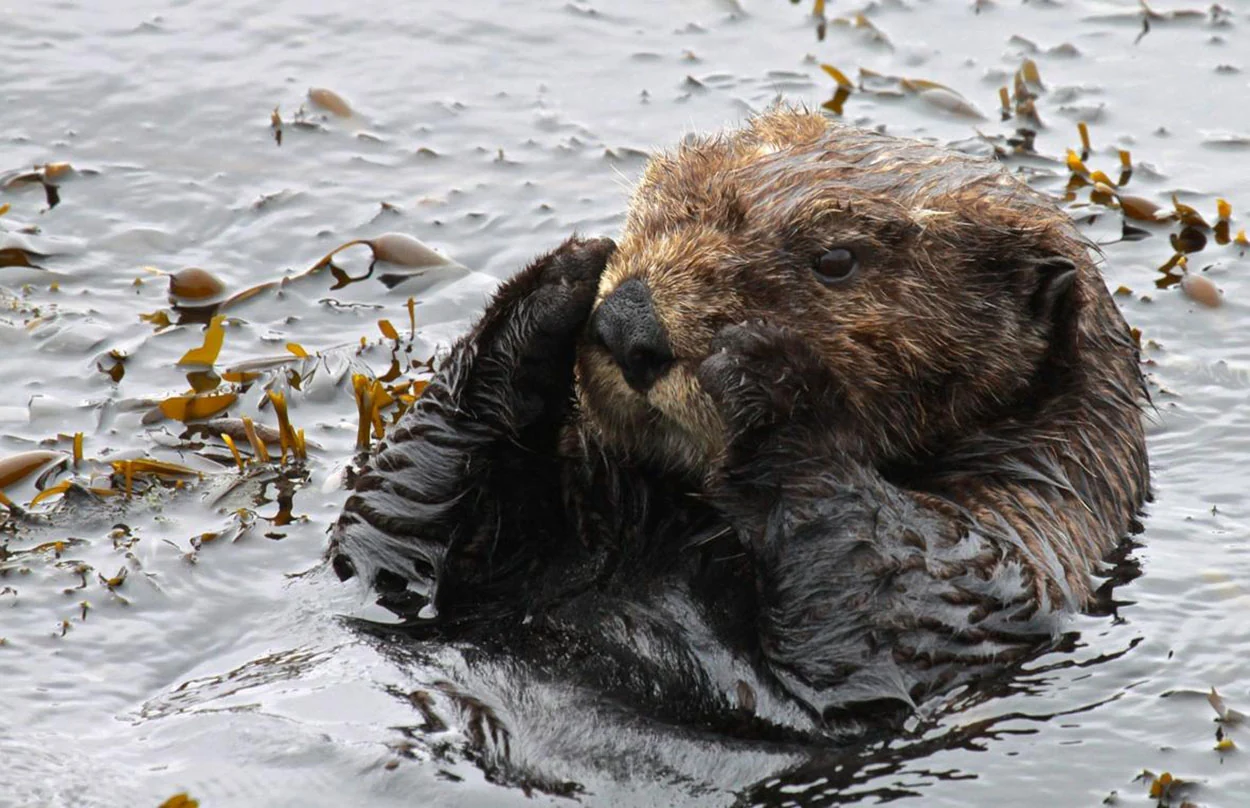
| Water posture | Sea otters often float on the back; river otters commonly swim belly-down. [2] [1] | Behavior is a clue, not a single-observation diagnosis. |
| Habitat context | River otters use inland waters; both types can occur in coastal Alaska. [1] [2] | Salt water alone does not decide identity. |
| Food clues | River otters eat fish, frogs, and crayfish; sea otters are known for bottom invertebrates and shellfish. [1] [3] | Observed prey may be difficult to identify at distance. |
Set the comparison’s boundaries
This comparison is between the sea otter, Enhydra lutris, and North American river otters, not every animal called a river otter worldwide. Both occur in coastal Alaska habitats, so seeing an otter in salt water does not settle the identification. North American river otters also use freshwater streams, lakes, marshes, and other inland settings. [1] [2] [3]
A sea otter is generally bulkier in appearance, has a relatively short, flattened tail, and has broad webbed hind feet associated with strongly aquatic movement. A North American river otter has a longer, tapering tail, commonly swims belly-down, and moves readily between land and water. These are useful combinations of traits, not measurements that can be applied reliably to every distant or partly hidden animal. [1] [3]
Watch posture and movement
Floating on the back to rest, groom, or handle prey is strongly characteristic of sea otters. River otters more commonly swim belly-down and make ready transitions between water and land. A sequence of behavior can therefore add evidence that a single still image cannot provide. [2] [1]
Still, back-floating is a clue rather than a complete diagnosis. A partial photograph may hide the tail or feet, and one moment may not show what the animal does most often. Sea otters can haul out, while river otters can enter salt water. Treat the observed behavior as one point in a combined assessment rather than a rule that excludes the other species. [1] [2]
Read location as supporting evidence
Geography can sharpen an identification when interpreted at the right scale. In Puget Sound, sightings commonly involve river otters, while northern sea otters are concentrated along Washington’s outer coast. That makes a Puget Sound location useful context, but it cannot replace visible traits or prove species from location alone. [1]
For example, imagine a dark otter seen beside a Puget Sound dock. If it has a long tapering tail, travels belly-down, and readily moves ashore, those observations together support river otter more strongly than the dock’s coastal setting does. This is a hypothetical evidence-reading exercise, not a claim about a particular sighting. [1]
Use diet and anatomy as corroboration
Diet can reinforce—but rarely settle—a field identification. River otter foods include fish, frogs, and crayfish; sea otters are well known for bottom invertebrates and shellfish. A prey item seen at a distance may be hard to identify, so diet is more useful as background knowledge than as a one-observation test. [1] [3]
The sea otter’s broad webbed hind feet reflect strong adaptation to aquatic locomotion. North American river otters, by contrast, use dens and substantial time on land as part of their life. These differences align with the body and behavior clues, but body size is difficult to judge without a scale and also differs with age and sex. A silhouette, scale-free photograph, or single trait can leave uncertainty. [3] [1]
A practical identification sequence
Start by recording what is actually visible: tail length and shape, overall bulk, posture in the water, and whether the animal moves between shore and water. Add location as context, then note whether prey handling or grooming behavior is clear. Several agreeing clues are more persuasive than one dramatic feature. If the key traits are obscured, keep the identification tentative rather than filling gaps with assumptions. [1] [2]
The limits are important: this is a North American two-species comparison, not a worldwide otter key; salt water and land use do not independently exclude either species; and a single back-floating observation is not conclusive. A distant animal without a scale cannot be sized confidently. The strongest answer may be a careful likelihood judgment, not certainty. [1] [2]
Sources & further reading
Have a correction or a source to suggest? Send a note →