
Reading path: Types of whales →
A closer look at the evidence
| Question or feature | Explanation | What it does not establish |
|---|---|---|
| Echolocation | Returning click echoes provide information about objects and prey in dark water. [2] [3] | Click patterns also have social functions; they are not a single decoded language. [2] |
| Rapid buzzes | Accelerated clicks are associated with close-range prey capture attempts. [2] | A buzz alone does not prove prey was swallowed. [2] [3] |
| Representative dives | NOAA describes dives around 2,000 feet and 45 minutes as representative. [1] | These are not maximum depth or fixed dive-length claims for every whale. [1] |
| Diet and distribution | Squid are important prey alongside deep-water fishes and other prey; females and young commonly stay in warmer-water social units. [1] | Diet and movement vary; adult males range farther toward high latitudes. [1] |
A distinctive head and an angled blow
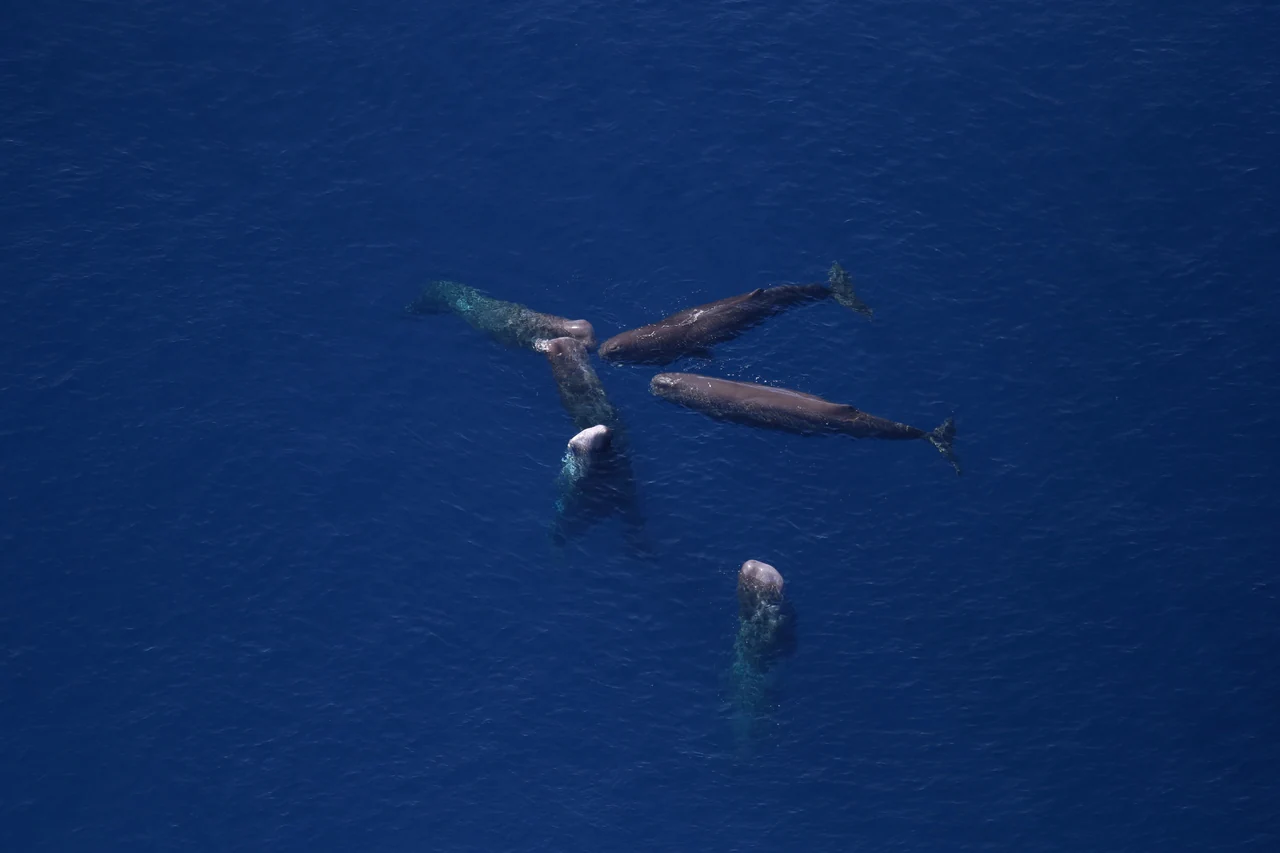
The sperm whale, Physeter macrocephalus, has a huge block-shaped head, a narrow lower jaw, and wrinkled skin behind the head. Its single blowhole sits toward the left side of the head, producing an angled blow. Large teeth occur in the lower jaw; upper teeth usually do not erupt through the gums. These features help distinguish its profile and mouth anatomy. [1]
The visible blow is a surface clue, while much of the whale’s foraging happens below. A surface observer can see the animal breathe, but cannot directly see its deep-water prey search or determine from that moment alone what it is eating. [1]
Clicks turn echoes into information
Sperm whales are toothed whales that use echolocation. A click travels through the water and returning echoes provide information about objects and prey in dark conditions. As a whale approaches prey, ordinary click trains can accelerate into rapid buzzes associated with capture attempts. [2] [3]
A buzz is evidence of a close-range foraging attempt, not visual proof that prey was swallowed. Clicks also do not all serve one function: prey echolocation and social click patterns should not be collapsed into a decoded language. The acoustic record can show behavior patterns without revealing a word-for-word message. [2] [3]
Deep dives have a surface interval
Sperm whales routinely make deep foraging dives. NOAA describes dives around 2,000 feet and 45 minutes as representative examples, not records or fixed durations for every individual. After a dive, whales remain at the surface to breathe and recover before diving again. [1]
These figures provide an approximate scale for a routine dive. They are not a maximum depth or a guaranteed underwater duration. Surface recovery is part of the same cycle: after prolonged foraging below, the whale spends several minutes breathing before its next dive. A brief surface encounter reveals only that portion of the animal’s activity. [1]
Squid and other prey in deep water
Squid are important food, alongside deep-water fishes and other prey. This diet fits the whale’s use of deep foraging dives and echolocation, but the evidence does not justify describing every dive as a squid hunt or treating squid as the only food. [1]
A hypothetical evidence-reading example makes the point: if a sound-recording tag captured a click train followed by a buzz during a dive, that sequence would support a close prey approach or capture attempt. Without direct evidence of ingestion, it would not establish exactly which prey was taken or prove a successful meal. [2] [3]
How researchers connect sound to hunting
Sound-recording suction tags and hydrophone arrays let researchers connect acoustic behavior with dives and foraging. A surface sighting records breathing and recovery; an acoustic tag can capture search clicks and a buzz underwater. Linking those records can reveal hunting attempts that a surface view would miss. [2] [3]
The methods have distinct limits. A buzz marks an attempt rather than confirmed swallowing, and sound patterns do not all mean the same thing. Recordings paired with dive data make hidden behavior more interpretable, but they do not turn every click into a translated message or every detected attempt into a known meal. [2] [3]
Different movements across the life cycle
Females and young commonly maintain social units in warmer waters, while adult male movements extend farther toward high latitudes. That pattern means a sperm whale’s location can depend on sex and age class; a description of adult male movement should not automatically be applied to females and young. [1]
Together, anatomy, sound, dive behavior, and diet provide a workable identification and feeding picture: a left-positioned blowhole and block-shaped head at the surface, echo-producing clicks underwater, and important prey that include squid. Each line of evidence answers a different question, and none alone supplies a complete view of an individual whale’s hunt. [1] [2]
Sources & further reading
Have a correction or a source to suggest? Send a note →