
Reading path: Types of whales →
A closer look at the evidence
| Question or feature | Explanation | What it does not establish |
|---|---|---|
| Feeding apparatus | Expandable throat pleats take in prey-bearing water; baleen filters water out and retains prey. [1] | Baleen filters; it does not chew. Krill are principal prey, but other small prey have occasionally been recorded. [1] |
| Prey-density response | In the California study, whales fed less often in sparse prey and made more lunges per dive in denser krill. [2] | A local study does not establish worldwide feeding rates or daily ration. [2] |
| Size and appearance | Long slender body and individual mottling aid recognition; females and Antarctic forms tend to be larger. [1] | One maximum or comparison does not represent every sex or form. [1] |
How to recognize a blue whale
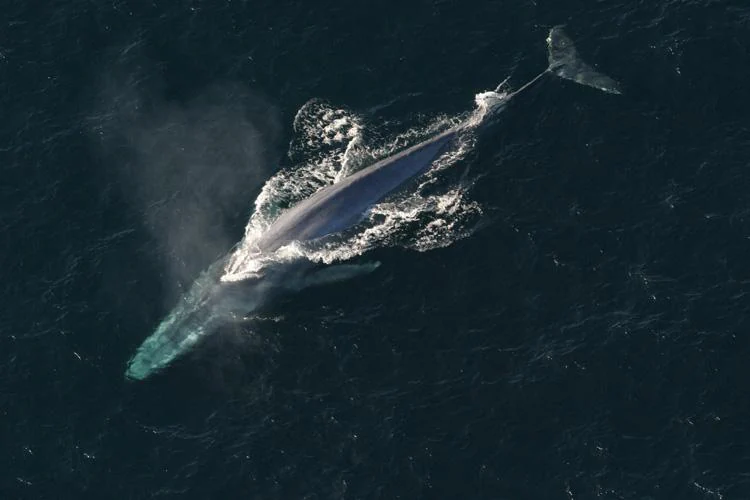
The blue whale, Balaenoptera musculus, has a long, slender body and mottled blue-gray skin. The mottling varies among individuals and can help researchers identify whales in photographs. Females are generally larger than males, and Antarctic blue whales tend to be larger than other forms, so a single size figure should not be treated as typical of every adult. [1]
Sex and population form matter when comparing size: females are generally larger than males, and Antarctic blue whales tend to be larger than other forms. Photo-identification asks a different question. It compares an animal’s distinctive mottling with earlier photographs, allowing researchers to recognize an individual when sufficiently clear views of its markings are available. [1]
A filter-feeding mouth built for small prey
Krill are the principal prey, although other small prey have occasionally been recorded. During a feeding lunge, expandable throat pleats let the whale take a large volume of prey-bearing water into its mouth. It then forces water out through baleen, retaining prey. Baleen functions as a filter; it does not chew or grind the food. [1]
The mechanism is a sequence: engulf water and prey, close the mouth, expel water through the baleen, and swallow the retained food. A small prey item can contribute to a large meal when many are concentrated in the water taken up by a lunge. But the amount captured depends on prey availability, not simply on the whale’s body size. [1]
Why patch density changes feeding effort
A 2015 study combined data from 14 newly tagged and 41 previously tagged blue whales off California with acoustic measurements of krill density. The whales fed less frequently where prey was sparse and made more lunges per dive in denser krill. Dense patches can yield more energy for the costly effort of feeding, helping explain how tiny prey can support a very large predator. [2]
Consider a clearly hypothetical comparison: if two lunges each take in the same water volume, but one occurs in a dense krill patch and the other in sparse water, the dense-patch lunge should retain more prey. The study’s pattern is consistent with that reasoning: whales adjusted effort with prey density rather than lunging at a constant rate. This example illustrates the relationship, not a measured universal meal size. [2]
The dive is also an oxygen budget
Feeding decisions take place within a dive. A whale has finite oxygen stores before it must return to the surface to breathe, so the opportunity to feed must be balanced against the time and energy used underwater. More lunges in a prey-rich patch may be worthwhile, while sparse prey can make repeated feeding effort less rewarding. [2]
The California tagging and acoustic work supports conclusions about those observed whales and measured prey conditions. It does not give a worldwide daily ration: prey density and behavior vary among places and times. Nor does a record-size comparison describe every blue whale, given differences among sexes and forms. [2] [1]
What sound can and cannot tell us
Blue whales produce sound, but the proposed navigational role of their vocalizations is not proof that they use toothed-whale-style prey echolocation. Their feeding mechanism described here is baleen filtration: lunging into prey-bearing water and retaining small prey as water passes out. Sound production alone cannot establish how a whale navigates or locates food. [1]
Reading the evidence carefully means keeping mechanisms separate. Baleen, throat pleats, prey-density measurements, tags, and oxygen constraints describe feeding behavior and its costs. They do not support a fixed diet beyond krill as the principal prey, a universal daily intake, or a single size for all blue whales. [1] [2]
Sources & further reading
Have a correction or a source to suggest? Send a note →