
Reading path: Types of whales →
A closer look at the evidence
| Question or feature | Explanation | What it does not establish |
|---|---|---|
| Baleen feeding | Coarse baleen retains food while sediment-bearing water is expelled; bottom-associated invertebrates include important prey. [1] | Diet is flexible; the evidence does not give a universal prey share or feeding rate. |
| Mud plume | A plume can accompany sediment expulsion after a whale feeds along the bottom. [1] | It is compatible with bottom feeding, not a stand-alone species identification or proof of prey. |
| Eastern routes | Many eastern whales travel between northern feeding waters and wintering or calving areas off Mexico; some feed along the Pacific coast in summer. [2] | A coastal summer sighting need not indicate a lost migrant, and routes vary. |
| Population evidence | Photo-identification, genetics, and satellite tags document some cross-North-Pacific movement. [1] | Population labels do not imply complete isolation; abundance estimates require year and method. |
A whale built to strain a mouthful of seafloor
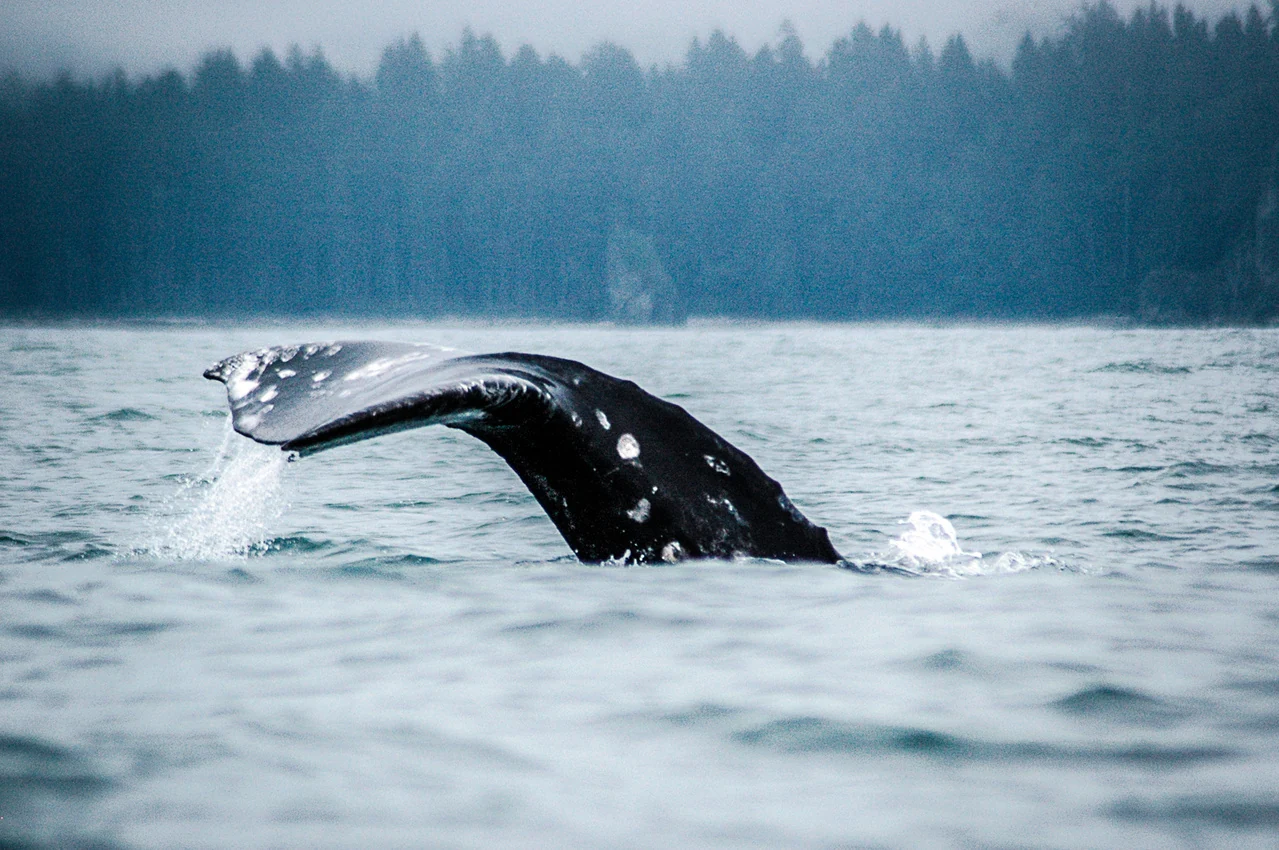
The gray whale, Eschrichtius robustus, has a mottled gray body that may carry barnacles and whale lice. Its back lacks a true dorsal fin: a low hump and a row of knuckles lead toward the tail. These features help describe the species, but they do not by themselves reveal what a whale is doing at a particular moment. [1]
Many gray whales feed by rolling onto one side and drawing sediment and invertebrates into the mouth. Coarse baleen plates then retain food as the whale expels sediment-bearing water. The expelled material can form a visible mud plume. The mechanism is a filter-feeding sequence: take in a mixture, hold prey on the baleen, and discharge much of the water and sediment. [1]
Amphipods and other bottom-associated invertebrates are important prey, but gray whale feeding is flexible. Bottom feeding is a characteristic behavior, rather than a rule that every whale always takes the same food. Different habitats offer different prey, so a species-wide account needs room for individual and regional variation. [1]
Reading a mud plume without overreading it
A mud plume is consistent with bottom feeding because sediment can be taken up and expelled during the process. It is a clue to behavior, not a diagnostic identification on its own. A distant observer should combine it with the whale’s visible form and the broader context; the plume alone does not establish species, prey, or location on a migration route. [1]
Consider a clearly hypothetical observation: a gray-looking whale rolls to one side, then leaves a plume as it surfaces. The sequence supports the interpretation that it may have taken sediment into its mouth. It does not prove that the plume contains amphipods, nor does it show that the whale is migrating or that all nearby gray whales are feeding. The source describes the behavior and possible sign, not a field test that makes the plume conclusive. [1]
The animal’s coarse baleen explains how it separates prey from a sediment-bearing mouthful. Baleen filters rather than biting or chewing food. A visible plume therefore fits the mechanics of taking in and expelling sediment, but the plume alone does not measure the amount of food retained or how quickly the whale is feeding. [1]
One eastern population, more than one seasonal pattern
Eastern North Pacific gray whales commonly move between northern feeding waters and wintering or calving areas off Mexico. That broad route is useful for understanding the population, but it does not describe every whale’s seasonal movements. Some individuals feed in coastal Pacific waters during summer rather than completing the journey to Arctic feeding grounds. NOAA describes these animals as the Pacific Coast Feeding Group. [2]
A practical comparison makes the difference clear. An Arctic-feeding eastern whale may pass a coastal viewpoint during spring migration and again while traveling south in autumn. A Pacific Coast Feeding Group whale may remain in regional feeding waters during summer. A summer sighting near the coast therefore need not mean that a whale has become lost or that the usual migration has failed; it may reflect a different documented pattern. [1] [2]
These route descriptions also have a population-label caveat. Eastern and western population labels should not be read as complete isolation: photo-identification, genetic work, and satellite tags show that some whales associated with western feeding areas cross the North Pacific and use eastern migration routes. Movement across basins means that a simple map with two sealed groups would misrepresent the evidence. [1]
What surveys and sightings can establish
NOAA monitors migrating eastern gray whales from shore during the southbound season to estimate population abundance. A shore-based count is a survey method aimed at estimating abundance, not a complete census of every whale in every feeding area. A number from such work must be tied to its survey year, method, and uncertainty; an older estimate should not be presented as the current population. [2]
When interpreting a sighting, separate three questions: what species features are visible, what behavior is happening, and what route the animal might be following. Mottled skin, a low hump, and tailward knuckles support a gray whale description; a side roll and sediment plume support a bottom-feeding interpretation; a single coastal location cannot settle the animal’s full seasonal route. The evidence answers each question at a different level. [1] [2]
For a coastal observer, the useful distinction is between recognizing a whale, interpreting a feeding sign and documenting a migration route. Gray whales can filter bottom-associated prey from sediment, while eastern animals show more than one seasonal movement pattern. A coastal summer sighting is compatible with the documented feeding group, rather than requiring every whale to follow one compulsory Arctic-to-Mexico itinerary. [1] [2]
Sources & further reading
Have a correction or a source to suggest? Send a note →