
Reading path: Types of whales →
A closer look at the evidence
| Question or feature | Explanation | What it does not establish |
|---|---|---|
| Callosities | Raised skin patches appear pale largely because of resident cyamids and can form individual patterns. [2] | They are skin structures, not simply attached barnacles; a poor image may not show a match. |
| Feeding | Long baleen filters small zooplankton, especially copepods, from water. [1] [2] | Dense prey patches make feeding possible; a prey list alone does not establish an individual whale’s intake. [1] |
| Detection | Low visibility at or just below the surface can make whales difficult for vessels to detect. [1] | Large body size does not guarantee visibility or collision avoidance. |
| US vessel distance | In US waters, vessels must not approach or remain within 500 yards; vessels inside should leave at a safe slow speed. [1] | This is US guidance; check applicable Canadian and local measures elsewhere. |
A profile that helps, but does not settle every sighting
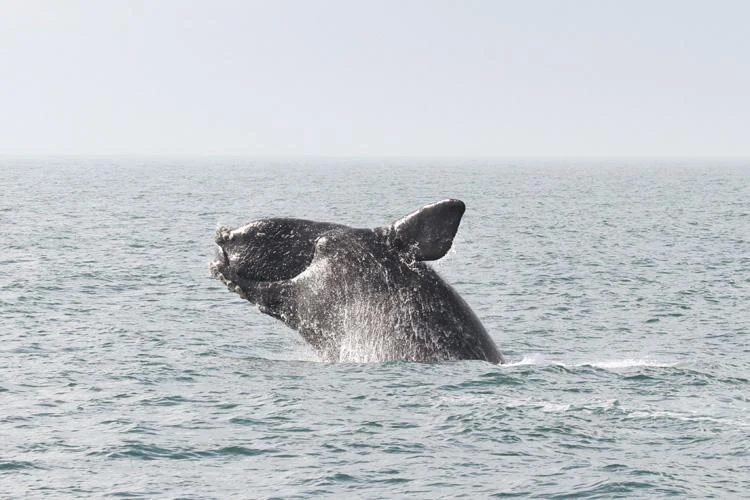
The North Atlantic right whale, Eubalaena glacialis, has a dark, stocky body, no dorsal fin, and an arched jawline. These traits provide a first visual profile, especially when a clear photograph shows the head and back. At a distance, however, no single outline feature should be treated as a guaranteed identification; visibility at or just below the surface makes detection difficult even though the whale is large. [1]
The most useful head markings are callosities: raised patches of hardened skin. They appear pale largely because small cyamids live on them. Callosities are part of the whale’s skin, not simply barnacles stuck to the surface. Their placement and shape, together with lasting scars, give researchers patterns that can be matched across photographs to identify individual whales. [2]
This is individual identification, not merely counting sightings. In a hypothetical example, a clear distant image of a whale’s head may show a callosity pattern that can be compared with a catalogued whale. Counting blows at the same location, by contrast, could count one animal repeatedly if it surfaces more than once. Photograph-based identification offers a way to recognize individuals, but the image needs enough detail; an indistinct glimpse cannot reliably supply the same evidence. [2]
Filter feeding and a coastal range
Right whales feed by moving through concentrations of small zooplankton, especially copepods. Long baleen plates act as filters, retaining prey as water passes through the mouth. The whale does not use teeth to capture large fishes: its feeding system collects many small organisms from dense prey patches. [1] [2]
The remaining population mainly uses the western North Atlantic, including coastal waters of the United States and Canada. Some pregnant females migrate to the southeastern United States to calve, while many other animals remain farther north. These patterns mean that a whale’s location can be informative, but one sighting does not establish its sex, pregnancy, or intended destination. [2]
A location comparison helps avoid a common inference error. A whale seen in southeastern US waters may fit the documented calving migration of some pregnant females, but location alone cannot tell an observer that it is pregnant. Likewise, a sighting farther north is compatible with the many animals that remain there; it does not show that the whale will never move south. The evidence describes population patterns, not a definitive itinerary for every whale. [2]
Why pressure affects both survival and condition
Entanglement in fishing gear and vessel strikes can kill North Atlantic right whales. Chronic injury and stress can also impair condition and reproduction, so surviving an immediate encounter does not necessarily end its consequences. Matching callosity patterns and lasting scars across photographs lets researchers follow individuals over time and connect later observations with their histories. [1] [2]
The whale’s size does not remove the detection problem. A large animal can be hard to see when visibility is poor or when it is at or just below the surface. That limitation matters for vessels: a person may not see a whale in time to avoid risk simply because the whale is physically large. Observation distance, water visibility, and surface position affect what can be detected. [1]
Population figures need both a reference year and a method. For example, NOAA’s October 2025 estimate was 384 whales, with a reported range of +10/−9, alive at the start of 2024. That dated model estimate is different from counting calves first observed in a calving season or deaths documented during an interval. It should retain its reference date rather than being presented as a live count. [1]
A US distance rule, with a jurisdiction boundary
In US waters, federal protection prohibits approaching or remaining within 500 yards of a North Atlantic right whale. Vessels already inside that distance should leave at a safe slow speed. This is practical guidance for a vessel operator who encounters a whale: do not linger for a closer photograph, and move away safely if already within the protected boundary. [1]
The jurisdiction is part of the rule. The 500-yard distance described here is US guidance; Canadian requirements and local vessel measures must be checked in their own jurisdiction. Do not assume that the US rule is a complete summary of requirements everywhere the species occurs. The same restraint applies to photography: researchers’ ability to identify a whale from an image does not justify approaching inside protected distances. [1] [2]
Identification combines body shape and individual marks while respecting the limits of the view. A stocky body without a dorsal fin and an arched jawline support an initial identification; callosity patterns and scars can support an individual match when photographs are adequate. Those details should be assessed from a lawful distance, rather than obtained by approaching inside the protected boundary. [1] [2]
Sources & further reading
Have a correction or a source to suggest? Send a note →