
Reading path: The seven sea-turtle species →
A closer look at the evidence
| Question or feature | Explanation | What it does not establish |
|---|---|---|
| Shell identification | Olive to gray-green, broadly heart-shaped upper shell; NOAA gives five to nine lateral scute pairs, with variation and possible asymmetry noted in the identification key. [1] [2] | Counts overlap and can be asymmetric; one count alone is not definitive. [2] |
| Nesting modes | Both solitary nesting and synchronized arribadas occur; one female may use both in the same season. [1] | Arribadas occur on a small subset of beaches, and their trigger remains unresolved. [1] |
| Ocean travel | Tracked males and females from Costa Rica moved into offshore Pacific waters after breeding. [1] | Offshore location does not establish seabed diving or a specific depth, and the tracking example is population-specific. [1] |
| Diet and threats | Omnivorous diet includes algae, crustaceans, mollusks, and tunicates; bycatch and harvesting are major threats. [1] | Diet proportions and U.S. listing categories vary by population; these facts do not give universal status or loss totals. [1] |
A shell pattern with built-in variation
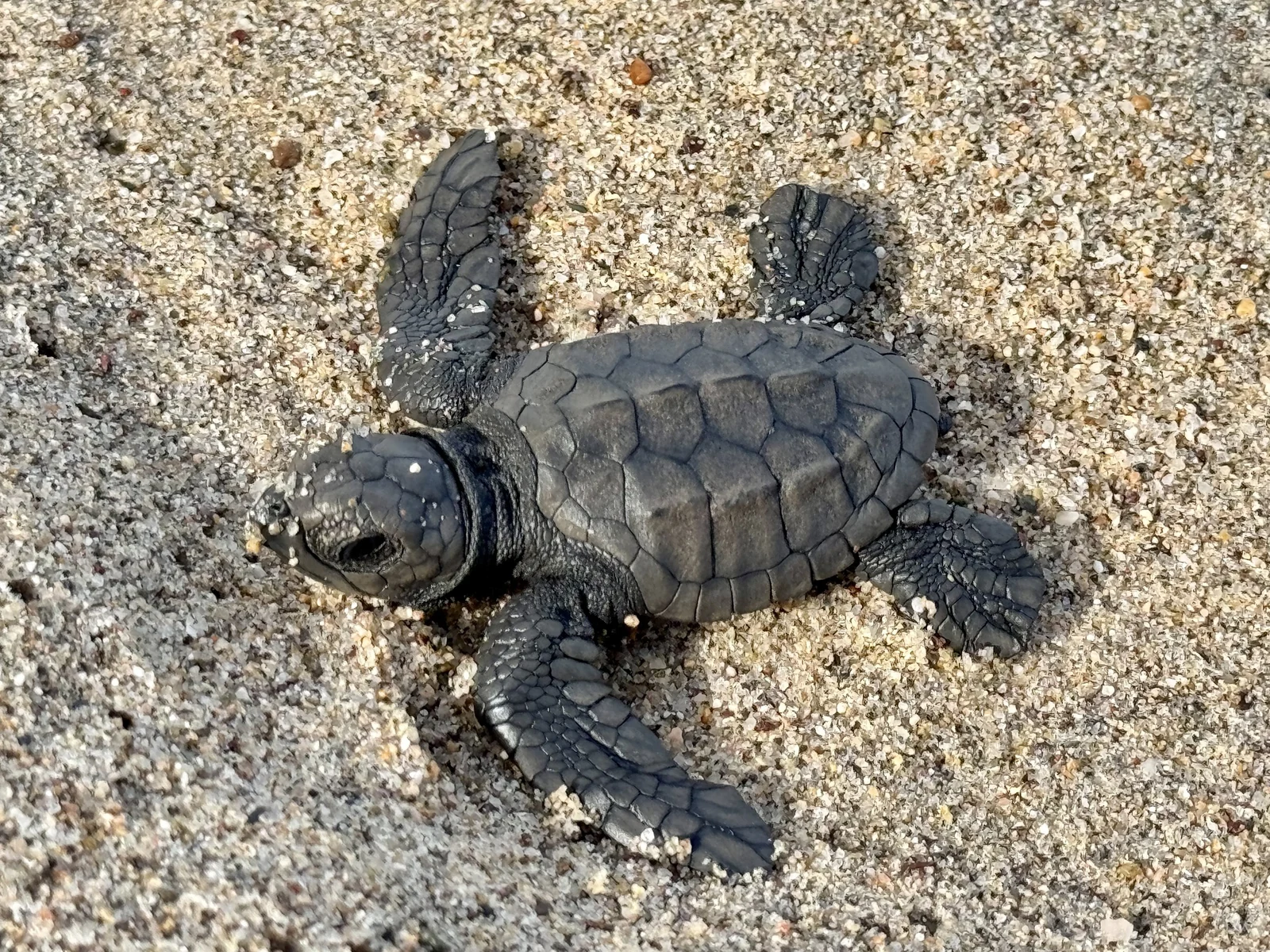
The olive ridley (Lepidochelys olivacea) is a small sea turtle with an olive to gray-green shell. Its upper shell is broadly heart-shaped, and the number of costal, or lateral, scute pairs varies unusually widely. NOAA describes five to nine pairs; the identification key emphasizes the usual higher count and notes that counts can be asymmetric. These descriptions overlap rather than provide a single fixed plate number. [1] [2]
For an identification exercise, suppose one side of a turtle’s shell appears to have a different number of lateral scutes from the other. That observation is not automatically evidence against olive ridley: asymmetry is possible, and the count itself varies. A robust description records the visible pattern and considers other identifying traits and context. It would be unsound to identify every turtle from one scute count or to assume both sides must match. [2] [1]
Two nesting strategies, sometimes in one season
Olive ridleys occur mainly in tropical regions of the Atlantic, Pacific, and Indian oceans. Their nesting behavior includes both solitary nesting and synchronized mass nesting known as arribadas. Arribadas take place on only a small subset of the beaches used by the species worldwide, so the dramatic group event is not a description of every nesting beach or every female. [1]
The two strategies do not divide the species into permanently separate kinds of female. One female may nest solitarily and also take part in an arribada during the same season. This is a more accurate way to understand the variation than imagining one set of turtles that always nests alone and another set that always nests together. At crowded sites, later females may excavate and destroy earlier clutches while digging. That consequence follows from crowding and nest placement; it should not be generalized to every nest or beach. [1]
The cause of synchronized nesting is not settled. Lunar cycles, winds, and pheromones have been proposed as possible influences, but no single trigger is established. A report that simply names a cause as fact would overstate the available explanation. The behavior is documented; the mechanism behind its timing remains uncertain. [1]
Following turtles beyond the nesting coast
Tracking of olive ridleys from Costa Rica has shown both males and females moving into offshore Pacific waters after breeding. This evidence supports a post-breeding offshore movement by tracked animals. It does not, by itself, establish how far every olive ridley travels, where all members of the species go, or that an animal reached the ocean floor. [1]
The distinction between horizontal location and diving depth is important. “Offshore” tells us that an animal was away from the coast; describing a deep-water or offshore setting does not prove a turtle descended to the seabed or reached a particular depth. Nor does a track of animals from Costa Rica represent all populations across three ocean regions. Tracking results answer questions about the monitored animals, route, and period, not every individual’s behavior. [1]
Diet and threats across a wide range
Olive ridleys are omnivorous. Their diet includes algae as well as animals such as crustaceans, mollusks, and tunicates. This broad list indicates that feeding is not restricted to one prey type, but it does not specify a universal menu or fixed proportions across populations and habitats. The species’ wide tropical distribution also should not be collapsed into a single local feeding pattern. [1]
Bycatch and the harvesting of turtles or eggs are identified as major threats. These pressures affect different stages and settings: fishing gear can capture turtles at sea, while harvesting can remove animals or eggs. U.S. listing categories differ among breeding populations, so a broad statement about status must preserve that population-specific distinction rather than imply one identical category everywhere. These facts identify threats and variation in listing; they do not provide a current count of losses or a universal legal rule for every country. [1]
What a nesting record can and cannot say
Imagine a female nesting alone on one occasion and joining a synchronized group later in the same season. That hypothetical pattern is supported by the documented ability of an individual female to use both strategies; it is not evidence about a dated event or a particular turtle. Similarly, the fact that arribadas occur at a small subset of beaches means that seeing one site cannot establish the behavior at all beaches. [1]
A dated update to a species account is not a forecast or an observation date for an arribada. To verify a claimed event, one would need evidence that identifies the place and date of the nesting observation. General knowledge that olive ridleys form arribadas cannot establish that one happened on a particular day. The science supported here is still informative: the species has variable shell scutes, uses both solitary and mass nesting, and some tracked Costa Rican turtles move offshore after breeding. [1] [2]
Sources & further reading
Have a correction or a source to suggest? Send a note →