
Reading path: The seven sea-turtle species →
A closer look at the evidence
| Question or feature | Explanation | What it does not establish |
|---|---|---|
| Crevice feeding | A narrow, pointed beak can reach food in reef cracks; sponges are important in many populations. [1] | The wider diet includes several other foods; Hawaiian turtles forage more opportunistically where sponges are limited. [1] [3] |
| Identification | Usually two prefrontal pairs, four costals per side, overlapping scutes, and a serrated rear outline. [2] | Traits can vary; juvenile color and anomalies mean identification should combine features. [2] |
| Habitat range | Uses oceanic and nearshore habitat; eastern Pacific mangrove estuaries are important too. [1] | A reef setting is neither required nor sufficient to identify a hawksbill. [1] [2] |
| Tortoiseshell trade | Historical tortoiseshell products used patterned scutes from killed hawksbills. [1] | The term does not establish the material in a modern patterned object. [1] |
A beak for narrow spaces
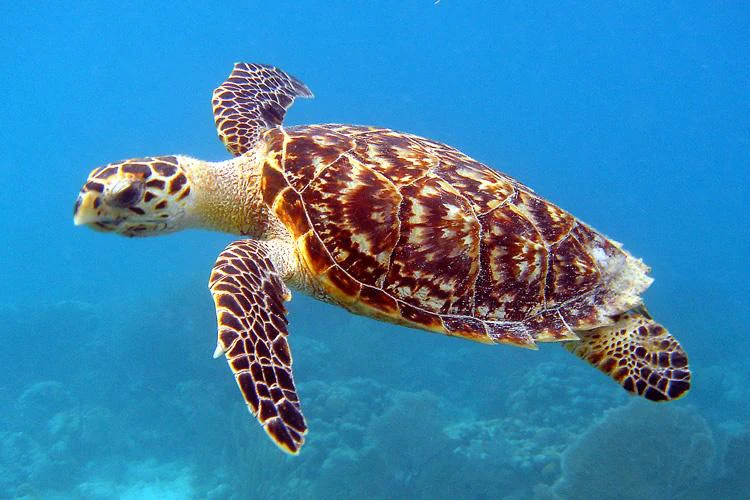
The hawksbill turtle, Eretmochelys imbricata, lives in tropical and subtropical oceans. Its narrow, pointed beak can reach food in reef cracks and crevices, an anatomical fit for foraging where prey may be tucked into tight spaces. The shell is typically mottled amber, brown, and darker colors, with overlapping scutes and a serrated rear outline. [1] [2]
Sponges are important foods in many hawksbill populations, connecting the turtle’s feeding ecology with reef communities. But a sponge-focused description is not a universal species menu. The wider reported diet includes algae, mollusks, tunicates, crustaceans, and other animals. Hawaiian hawksbills forage more opportunistically in habitats where sponges are relatively limited. [1] [3]
A hypothetical comparison helps separate anatomy from local diet: a pointed beak reaching a sponge in a reef crevice illustrates access and a common food relationship; a Hawaiian turtle eating other available prey illustrates flexibility where sponges are limited. Neither example means every hawksbill eats the same proportions, or that a photograph of a reef meal describes the full diet of a population. [1] [3]
Use several traits to identify the turtle
Hawksbills usually have two pairs of prefrontal scales between the eyes and four costal scutes on each side of the central vertebral row. Green turtles usually have one prefrontal pair and four costals per side. Thus, the costal count alone may not separate these two species; the scale pairs and shell features add useful evidence. [2]
In a worked identification exercise, first count the scale pairs between the eyes. Then examine whether the shell plates overlap and whether the rear outline is serrated. Two prefrontal pairs combined with overlapping scutes support hawksbill identification; one pair with four costals is more consistent with the usual green turtle pattern. [2]
These are usual traits, not guarantees. Juvenile coloration and individual anomalies can complicate identification, so a single plate count or a mottled shell color should not settle the question. A reef setting is not sufficient evidence either: hawksbills use other habitats, and a reef photograph does not represent the species’ complete ecological range. [2] [1]
Reefs are part of a wider habitat range
Young hawksbills use oceanic habitat before recruiting to nearshore areas. Resting animals can shelter under ledges and in caves. In the eastern Pacific, mangrove estuaries are important habitat, so the species is not confined to coral reefs. [1]
This broader geography changes how habitat clues should be read. A nearshore sighting might fit a recruited juvenile or another life stage, but habitat alone does not establish age or identity. A mangrove estuary is not an implausible setting for an eastern Pacific hawksbill merely because familiar images often show coral. [1]
For a hypothetical field note, “turtle resting under a ledge” gives a behavior and shelter clue, not a species identification. The observer would still need to record the beak, scale pairs, and scute arrangement. Similarly, “seen in mangroves” establishes a habitat context, not a full diet or a confirmed hawksbill. [1] [2]
What tortoiseshell refers to
Historically, tortoiseshell products used the patterned shell scutes of killed hawksbills, creating substantial harvest pressure. In this context, “tortoiseshell” names a material associated with the animal’s scutes. It does not prove that any modern patterned object contains animal shell. [1]
Illegal trade, fishing bycatch, and loss of marine and nesting habitat continue to impede recovery. These pressures are distinct: historical shell harvest removed turtles for their patterned scutes, while bycatch and habitat loss affect survival and the places turtles use. The evidence supports naming these pressures without assuming that any one explains every local population trend. [1]
Sources & further reading
Have a correction or a source to suggest? Send a note →