
Reading path: The seven sea-turtle species →
A closer look at the evidence
| Question or feature | Explanation | What it does not establish |
|---|---|---|
| Adult identification | Adults have a broad, nearly circular olive-gray carapace, pale underside, and usually five costal scutes on each side of the central row. [2] [1] [3] | The shell description is for adults; do not treat one feature as a complete identification in every context. [1] |
| Nesting range | Most nesting occurs in Tamaulipas, Mexico; Texas is an important secondary area. [2] [1] | Juvenile occurrence extends farther along Atlantic coasts than the main adult breeding concentration. [2] |
| Arribada | Females may gather offshore and come ashore to nest synchronously; Kemp’s ridleys nest primarily during daylight. [2] [1] | Not every female nests in a group every time; the synchronization trigger is unresolved. [2] |
| Diet and habitat | Nearshore Gulf sandy or muddy bottoms are important adult feeding areas; crabs dominate the diet described in Texas. [2] [1] | The Texas diet description does not establish identical prey proportions across all regions. [1] |
A compact turtle with a broad, rounded shell
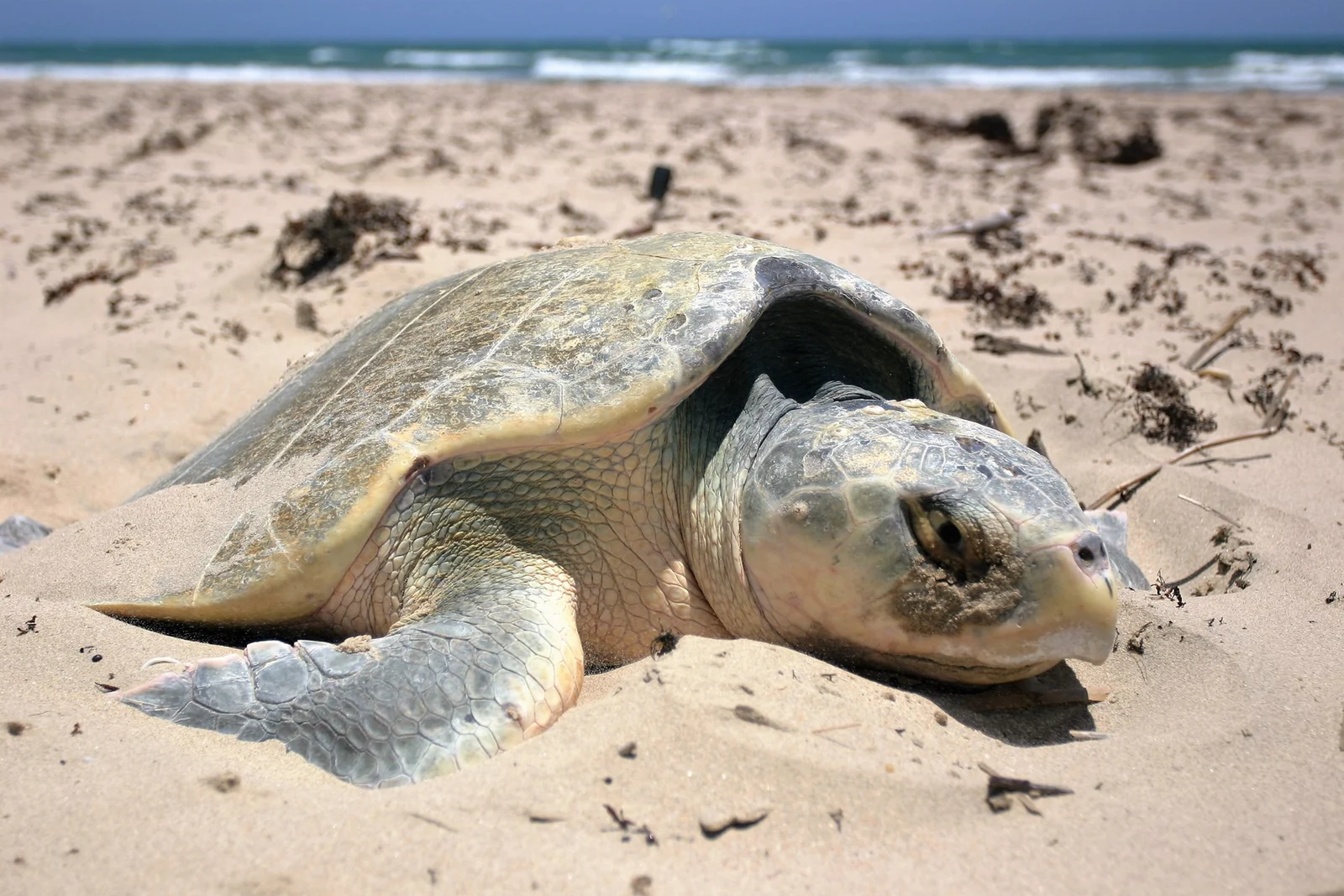
Kemp’s ridley turtles (Lepidochelys kempii) are the smallest living sea turtles. Adults have a broad, nearly circular olive-gray carapace and a pale underside. Their usual shell pattern includes five costal scutes on each side of the central row. These traits can help distinguish the species, but shell pattern should be interpreted as one part of identification rather than as a substitute for context. [1] [2] [3]
A useful evidence-reading exercise is to combine two kinds of information: first, the adult’s nearly circular olive-gray shell and typical scute arrangement; second, the turtle’s age class and location. The shell description pertains to adults, while juveniles can range farther along Atlantic coasts than the main adult breeding and foraging concentration. A turtle encountered far from the principal nesting area therefore does not, by location alone, contradict the species’ restricted breeding range. [2] [1]
Where breeding is concentrated
The great majority of Kemp’s ridley nesting occurs in Tamaulipas, Mexico. Texas is an important secondary nesting area, including Padre Island, where a binational recovery program has worked since the 1970s to establish a secondary nesting colony. These are not equivalent descriptions of the range: Tamaulipas is the main nesting center, while Texas plays an important but secondary role. [2] [1]
That breeding concentration should not be mistaken for the species’ entire occurrence range. Juveniles range farther along Atlantic coasts than the main adult breeding and foraging concentration. Thus, a map of where nesting is concentrated answers a different question from a map of every place a juvenile or wandering animal may occur. Nor does the recovery effort at Padre Island imply that all nesting takes place there, or that every female nests at a secondary site. [2] [1]
What an arribada describes
Adult females may gather offshore and nest synchronously in events called arribadas. Kemp’s ridleys are distinctive among sea turtles for nesting primarily during daylight. The combination of a concentrated group and daytime activity makes the event striking, but it does not mean each female must nest in a large group every time. “Arribada” describes synchronized group nesting; it is not a compulsory pattern for every individual nesting attempt. [2] [1]
The trigger for synchrony remains unresolved. Winds, lunar cycles, and pheromones have been proposed as influences, but none is established as the single cause. A careful account can describe the behavior and distinguish hypotheses from a demonstrated mechanism. The fact that an agency account has an update date also does not date any particular arribada: a page’s publication metadata and the observation date of a specific nesting event are different kinds of evidence. [2]
Feeding grounds and the cost of coastal hazards
Nearshore Gulf habitats with sandy or muddy bottoms provide important adult feeding areas. In Texas, crabs dominate the diet described for Kemp’s ridleys, although fish, sea jellies, and mollusks are also eaten. This is a regional description of feeding, not a claim that every turtle eats the same proportions everywhere. The bottom type and nearshore setting help answer where adults feed, while the diet list identifies the prey reported in that Texas context. [2] [1]
Fishing gear can entangle turtles, causing drowning or injuries. Development and artificial lighting can degrade nesting habitat. These threats affect different parts of the life cycle: gear interacts with turtles in the water, while development and lights alter the beach environment. The distinction is useful when considering why protection cannot be reduced to guarding a nesting beach alone. The evidence here identifies threat types but does not quantify an annual total of deaths or establish the effect of any single local measure. [2]
Counts need the right denominator
Historical annual counts of females or nests should not be read as a current total population estimate. A nest is not necessarily a unique individual: one female can lay more than one nest, so nest totals and numbers of individual turtles have different denominators. Similarly, the species’ main nesting concentration does not mean rare or juvenile records elsewhere represent additional breeding populations. Keeping track of what is counted—nests, females, or sightings—prevents a number from being asked to answer a question it was not designed to answer. [2] [1]
A comparison makes the distinction concrete: a daytime arribada in Tamaulipas describes a nesting event at the core breeding area; a juvenile farther up the Atlantic coast describes occurrence away from that core. Neither observation cancels the other. Together they show why breeding geography, movement, and life stage must remain separate when describing Kemp’s ridley turtles. [2] [1]
Sources & further reading
Have a correction or a source to suggest? Send a note →