
Reading path: The seven sea-turtle species →
A closer look at the evidence
| Question or feature | Explanation | What it does not establish |
|---|---|---|
| Diet across development | Oceanic young eat animal and plant material associated with floating communities; many older juveniles and adults eat algae and seagrass. [1] | Not a universal abrupt switch; regional diets, including eastern Pacific diets, can include animal material. [1] |
| Identification pattern | Usually one prefrontal scale pair and four costal scutes on each side of the vertebral row. [3] | Anomalies and life-stage color differences make a single trait unreliable; costals are not marginal rim scutes. [3] |
| Coastal habitat | Texas bays, Laguna Madre, and adjacent channels serve as juvenile developmental habitat. [2] | Habitat alone does not identify the turtle or prove its diet. [2] [3] |
| Cold-stunning response | Rapid cold can leave turtles unable to swim; trained stranding networks coordinate response. [2] | Do not infer a current stranding or improvise animal handling from this general risk. [2] |
A life stage changes the menu
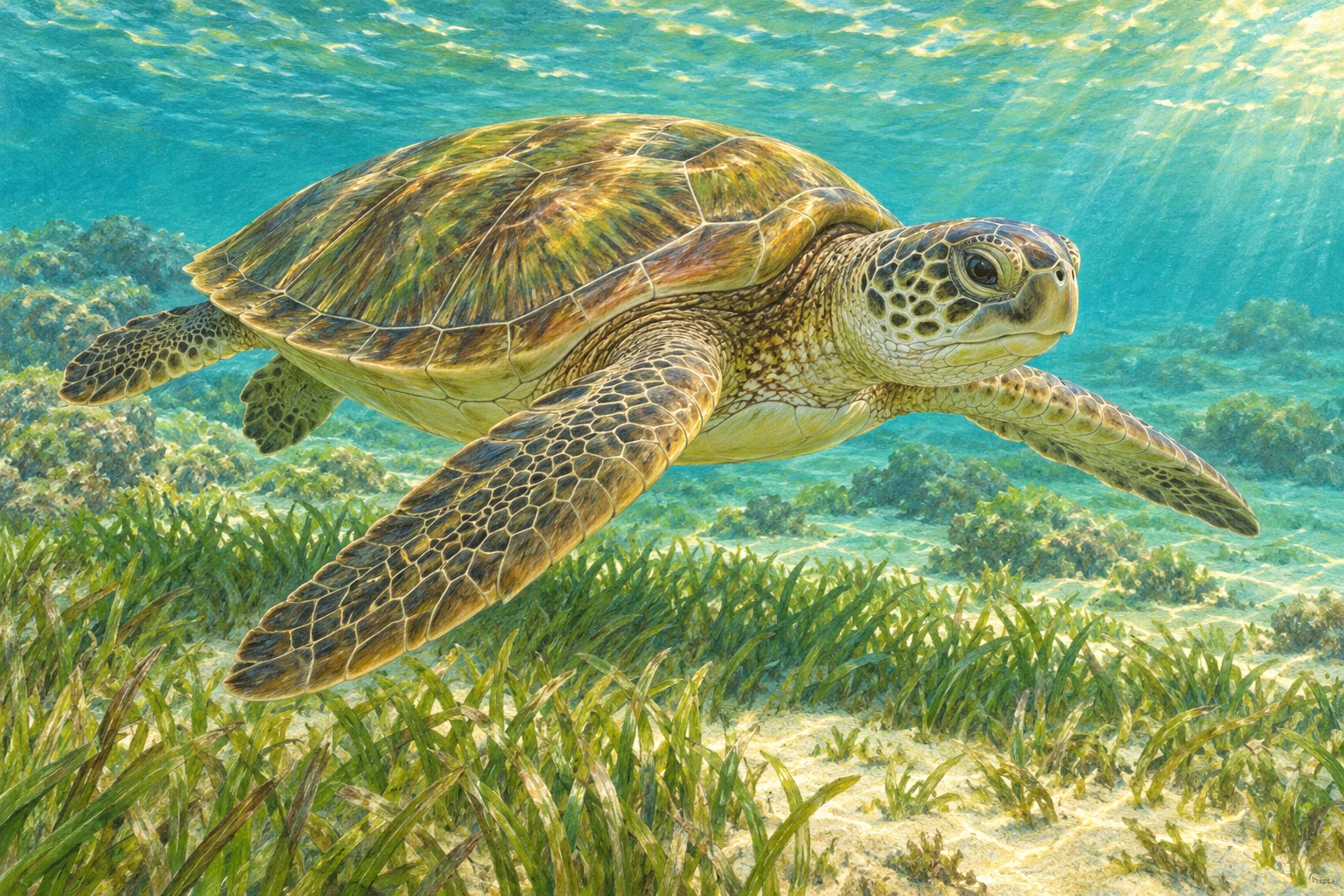
The green sea turtle, Chelonia mydas, is the largest living hard-shelled sea turtle. Its feeding story is not a simple switch from one fixed diet to another on a particular birthday. Developmental stage, region, and available habitat all matter. Young turtles in oceanic settings feed on both animal and plant material associated with floating communities such as Sargassum. Many older juveniles and adults forage on algae and seagrasses in coastal waters. [1]
That change connects the turtle’s life to different places. A young animal among drifting Sargassum may encounter small invertebrates as well as plant material; an older turtle in a coastal bed can crop rooted seagrass. This comparison illustrates a developmental tendency, not a universal schedule or proof that every adult is vegetarian. Some populations, especially in the eastern Pacific, include appreciable animal material in their diets. [1] [2]
For a clearly hypothetical example, imagine two green turtles observed on the same day: one small juvenile feeding among floating Sargassum, and one older turtle cropping a coastal seagrass bed. Those observations fit known life-stage patterns, but they would not establish the exact ages, lifetime diets, or future movements of either animal. The species’ diet cannot be inferred from size alone, and an isolated feeding observation is not a complete menu. [1]
Built to crop, not identified by color alone
Adults have a comparatively small head and a serrated beak suited to cropping vegetation. The common name refers to greenish fat, rather than a requirement that the visible shell appear green. Adult coloration also differs from hatchling and juvenile coloration, so shell color by itself is a weak identification shortcut. [1] [2] [3]
A more useful check combines head scales and shell scutes. Green turtles usually have one pair of prefrontal scales between the eyes and four costal scutes on each side of the central vertebral row. Costal scutes are the larger plates beside that central row; they are not the small marginal scutes around the shell’s edge. [3]
In a clear photograph, locate the central vertebral row and count the larger plates beside it, then check any visible scales between the eyes. Four costals per side and one prefrontal pair support green turtle identification, but anomalies can disrupt the usual pattern. A turtle in seagrass habitat is not automatically a green turtle; use several visible traits and geographic context without approaching or handling the animal. [3] [1]
Seagrass habitat and long-distance links
Coastal feeding habitat can be far from the nesting beach. Green turtles migrate between feeding areas and nesting sites, linking habitats that may be widely separated. A turtle seen grazing in a bay therefore cannot be assumed to nest nearby, and a nesting count records breeding activity rather than every turtle in the population. A regional nesting statistic should not be treated as a worldwide census. [1]
In Texas, bays, Laguna Madre, and adjacent channels provide developmental habitat for juveniles. That regional example shows why “seagrass habitat” is not a single location or a complete description of the species’ range: young turtles also use oceanic habitat, and feeding areas vary across regions and life stages. [2] [1]
Habitat can help explain a likely feeding opportunity, but it cannot independently identify a turtle or establish what it ate. An animal in a coastal grass bed might be a green turtle, yet identification still calls for head and shell traits. Likewise, a grass-grazing observation does not demonstrate that the individual never consumes animal material. [1] [3]
Cold-stunning is a stranding emergency
Rapid cold conditions can leave green turtles cold-stunned and unable to swim. The Padre Island National Seashore account describes trained stranding networks coordinating response; that is the relevant practical point for a member of the public. An incapacitated turtle is not a cue for an untrained person to improvise handling or treatment. Contact the appropriate trained stranding response in the area. [2]
Cool weather alone does not establish that a turtle is cold-stunned. An animal unable to swim needs assessment by the appropriate trained response network, and the reporting route depends on location. This general description does not establish that a stranding is occurring at any particular beach today. [2]
Sources & further reading
Have a correction or a source to suggest? Send a note →