
Reading path: The seven sea-turtle species →
A closer look at the evidence
| Question or feature | Explanation | What it does not establish |
|---|---|---|
| Jaw function | Powerful jaw muscles crush crabs, conches, and other hard-shelled invertebrates. [2] | Loggerheads also eat soft prey, including sea jellies and, in south Texas, sea pens. [2] |
| Usual shell pattern | Typically five costal scutes per side; the first contacts the nuchal scute near the neck. [3] | A usual pattern can vary; confirm with head, other scutes, color, and locality. [3] |
| Life-stage habitat | Young turtles use oceanic habitat before many recruit to coastal feeding areas. [1] | Oceanic duration and routes vary; one transoceanic example is not universal. [1] |
| US conservation classification | Distinct population segments have different threatened or endangered classifications. [1] | Do not apply one population’s classification to all loggerheads. [1] |
A head built for force
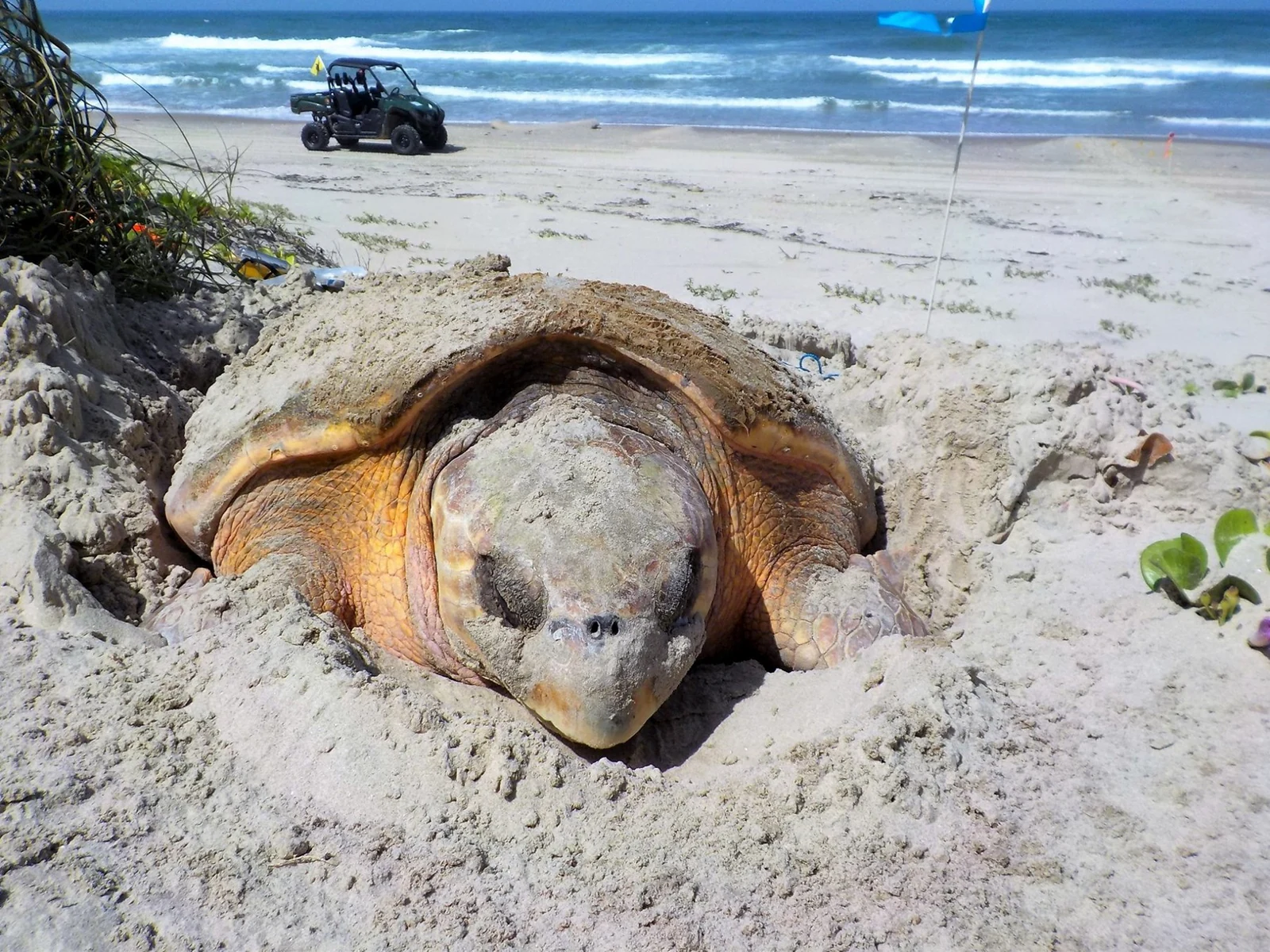
The loggerhead, Caretta caretta, has a notably large, block-like head. Powerful jaw muscles allow it to crush crabs, conches and other hard-shelled invertebrates. That mechanical capability helps explain its access to prey protected by resistant shells, although it also takes softer foods. [1] [2]
Yet jaw strength describes capability, not an exclusive menu. Loggerheads also eat soft prey, including sea jellies, and the Padre Island National Seashore account identifies sea pens as important food in south Texas. A hypothetical comparison makes the distinction clear: one loggerhead crushing a crab demonstrates use of its crushing capacity; another eating a soft sea pen shows that the same general jaw anatomy does not require every meal to be hard-shelled. Local prey availability helps explain observed feeding. [2]
A single jaw photograph cannot establish what the turtle was eating, what it usually eats, or whether it poses a danger to people. Shell-crushing ability is an adaptation for prey, not evidence that the animal is dangerous to humans. [1] [2]
Read the shell pattern in combination
Adults and subadults typically have a reddish-brown, slightly heart-shaped carapace and a pale yellow plastron. Loggerheads usually have five costal scutes on each side of the central row, with the first costal scute contacting the nuchal scute near the neck. These traits offer a practical way to compare shell structure rather than relying on color alone. [1] [3]
In a clear photograph, find the central vertebral row and count the larger costal plates alongside it. If visible, check whether the first costal contacts the nuchal plate near the neck. A large block-like head together with the usual five-costal pattern supports loggerhead identification more strongly than reddish-brown color alone. Use features already visible in the image without disturbing the turtle to obtain another view. [1] [3]
Five costals are a usual pattern, not an infallible rule. Consider the head, other scutes, color, and locality together. Hatchlings are darker than typical adults, and colors alone are less useful than several anatomical features. The scute pattern can also vary, so an atypical count should prompt caution rather than an automatic rejection. [1] [3]
From oceanic young to coastal feeding grounds
Young loggerheads use oceanic habitat before many recruit to coastal feeding areas. That broad life-stage pattern does not specify a fixed duration in the open ocean or a single route. Juvenile oceanic duration and migration routes vary; a transoceanic Pacific example is not the itinerary of every loggerhead. [1]
Adults can migrate between distant feeding grounds and nesting beaches. They must surface to breathe, and adult females come ashore to place eggs in sand. These facts describe different parts of a life cycle, but they do not tell an observer when a particular turtle will surface, where it will nest, or how far it has traveled. [1]
For example, a coastal feeding observation and a later nesting record could involve a migrating adult, but without individual tracking they do not prove the route between those places. A beach’s nesting activity is not a count of every loggerhead using surrounding feeding habitat. [1]
Conservation labels depend on population
US conservation listings recognize distinct population segments with different threatened or endangered classifications. The classification therefore depends on which population segment is being discussed; it should not be flattened into one label applied uniformly to every loggerhead everywhere. [1] [2]
The same care applies to interpreting migration examples and local food reports. A south Texas prey item is evidence about that account’s regional context, not proof of a universal diet. A Pacific route illustrates one possible movement, not a species-wide timetable. These distinctions let anatomy, behavior, and conservation status inform one another without turning a regional observation into a global rule. [2] [1]
Sources & further reading
Have a correction or a source to suggest? Send a note →