
Reading path: The seven sea-turtle species →
A closer look at the evidence
| Question or feature | Explanation | What it does not establish |
|---|---|---|
| Shell construction | Skin and connective tissue cover many small dermal bones; seven ridges run along the upper shell. [1] | Flexible does not mean boneless; the turtle retains a skeleton and shell bones. [1] |
| Cold-water heat conservation | Large body mass, insulation, swimming-generated metabolic heat, and counter-current exchange in flippers reduce heat loss. [2] [3] | This does not establish an unlimited cold-water tolerance. [2] |
| Feeding anatomy | Pointed jaw cusps and backward-directed mouth and throat papillae help retain slippery sea jellies and other soft prey. [1] | The structures are not mammalian-style teeth. [1] |
| Migration context | Some Atlantic leatherbacks link tropical nesting with feeding in Canadian waters. [2] | Routes and seasons differ among populations; this example does not describe every Pacific leatherback. [1] [2] |
A shell built beneath the surface
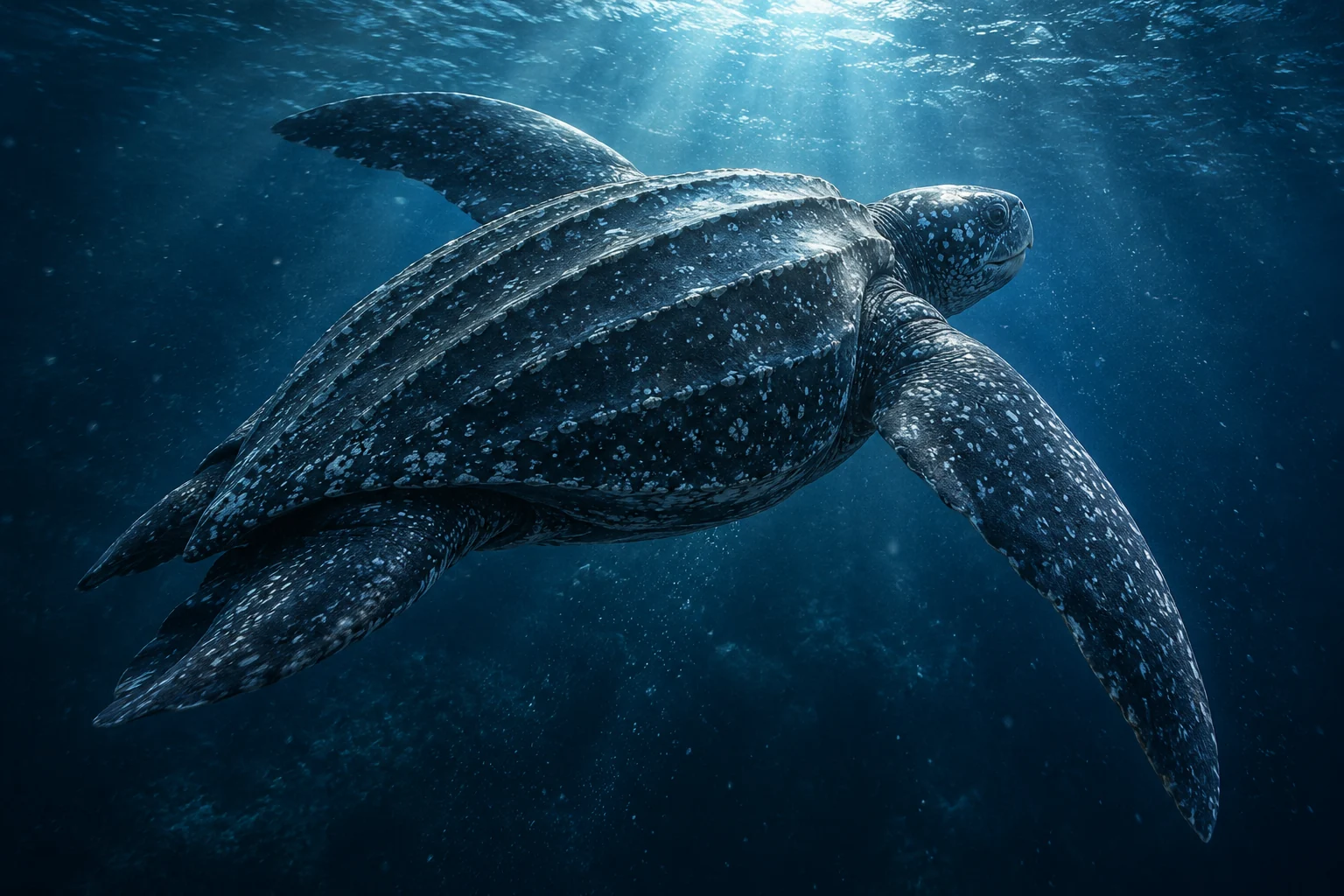
The leatherback turtle (Dermochelys coriacea) is the largest living turtle. Its most recognizable feature is also a source of confusion: the dark, rubbery-looking back is not a bare, boneless covering. Unlike sea turtles with large external hard scutes, a leatherback has many small dermal bones beneath skin and connective tissue. Seven ridges run lengthwise along the upper shell. The result is a shell structure that looks and behaves differently from the conspicuous plate-covered carapace of other sea turtles, but it remains supported by bones. [1]
Calling the shell flexible describes its outer construction; it does not mean the animal lacks a skeleton or has a soft body throughout. The small bones are incorporated beneath the surface rather than displayed as large hard scutes. That distinction matters when identifying the animal: a dark, ridged back is useful, but a description such as “boneless shell” would be inaccurate. The shell’s ridges and skin-covered surface are visible traits, while the underlying small bones explain why “flexible” should not be read literally as an absence of structure. [1]
How a turtle can feed in cold water
Leatherbacks feed heavily on sea jellies and other soft-bodied organisms. Soft prey can be difficult to hold, so the mouth and throat have structures suited to retaining it: pointed jaw cusps and backward-directed papillae help prevent slippery food from escaping. These are not mammalian-style teeth. The arrangement is a mechanical aid to feeding: prey moves inward, while backward-facing structures make it harder for it to slide back out. [1]
Their large body mass slows the rate at which heat is lost, and insulation reduces heat transfer to the water. Swimming also produces metabolic heat. In addition, blood vessels in the flippers can exchange heat between nearby flows: warm blood moving outward transfers some heat to cooler blood returning toward the body. This counter-current arrangement reduces heat loss through the flippers, which are in direct contact with cold water. It conserves heat generated inside the animal; it does not create heat on its own. [2] [3]
Together, these mechanisms help leatherbacks maintain a core temperature above the surrounding cold water. A useful analogy is a heat exchanger that transfers energy from an outgoing warm flow to an incoming cool one. The analogy is limited, though: the turtle is a living animal that generates heat through metabolism, and its physiological capacity does not imply that it can remain indefinitely in water of any temperature. [2] [3]
Flippers, migrations, and a population-specific example
Long front flippers provide propulsion for oceanic swimming and long migrations. Leatherbacks connect feeding areas and nesting areas, and some Atlantic animals visit Canadian waters to feed after nesting in warmer regions. This example shows how a turtle adapted to cold-water feeding can still rely on tropical nesting beaches: the two settings serve different parts of its life cycle. [1] [2]
Imagine a leatherback feeding off Atlantic Canada and later nesting in warmer water. The example illustrates the link between a cold feeding ground and a tropical reproductive site, not a route that every leatherback follows. Migration pathways and feeding seasons differ among populations; Canadian Atlantic patterns cannot be assumed for Pacific leatherbacks. Nor does the example establish an individual turtle’s travel distance, timing, or temperature tolerance. Those details require evidence about a particular animal or population. [2] [1]
Reading the traits without overstating them
The combination of shell, flippers, feeding anatomy, and heat conservation helps explain the leatherback’s oceanic life. The shell’s skin-covered construction distinguishes it from sea turtles with large external scutes; the long flippers are adapted to sustained swimming; and the mouth’s cusps and papillae help retain soft prey. Heat retention, meanwhile, depends on several mechanisms acting together rather than on a single adaptation. [1] [2] [3]
These facts do not supply a universal maximum stay in cold water, a typical migration itinerary, or a precise temperature range. A physiological capability is not an unlimited guarantee. Likewise, a record dive or an age estimate, if encountered elsewhere, should not automatically be treated as typical performance or a known lifespan. For this account, the supported explanation is the set of anatomical and physiological mechanisms and the population-specific link between tropical nesting and high-latitude feeding. [2] [1]
Sources & further reading
Have a correction or a source to suggest? Send a note →