
Reading path: Sea otters and coastal mammals →
A closer look at the evidence
| Question or feature | Explanation | What it does not establish |
|---|---|---|
| Typical dive pattern | Repeated dives commonly around 1,000–2,500 feet for 20–30 minutes. [1] | Typical ranges, not maxima or a description of every dive. |
| Land phases | Adults fast during breeding and return for a molt of hair and outer skin. [1] | Resting or molting ashore alone does not establish distress. |
| Local recovery milestones | Point Reyes records a return in the early 1970s and its first breeding pair in 1981. [2] | These are historical, local observations, not current population totals. |
| Possible distress response | Leave the animal alone and allow trained responders to assess it. [3] | A lone pup is not automatically abandoned; do not handle, feed or push it into the water. |
Two lives, one annual cycle
The northern elephant seal, Mirounga angustirostris, ranges through the eastern and central North Pacific. It spends about nine months of the year at sea, returning to land for breeding and for a molt that sheds hair and outer skin. A beach view therefore captures only part of its routine. [1]
At breeding time, adults fast ashore. That makes inactivity on a beach poor evidence, by itself, that an animal is ill or needs food. The molt is also a substantial land phase: the animal sheds both hair and the outer skin, rather than simply changing its coat as a minor seasonal detail. [1]
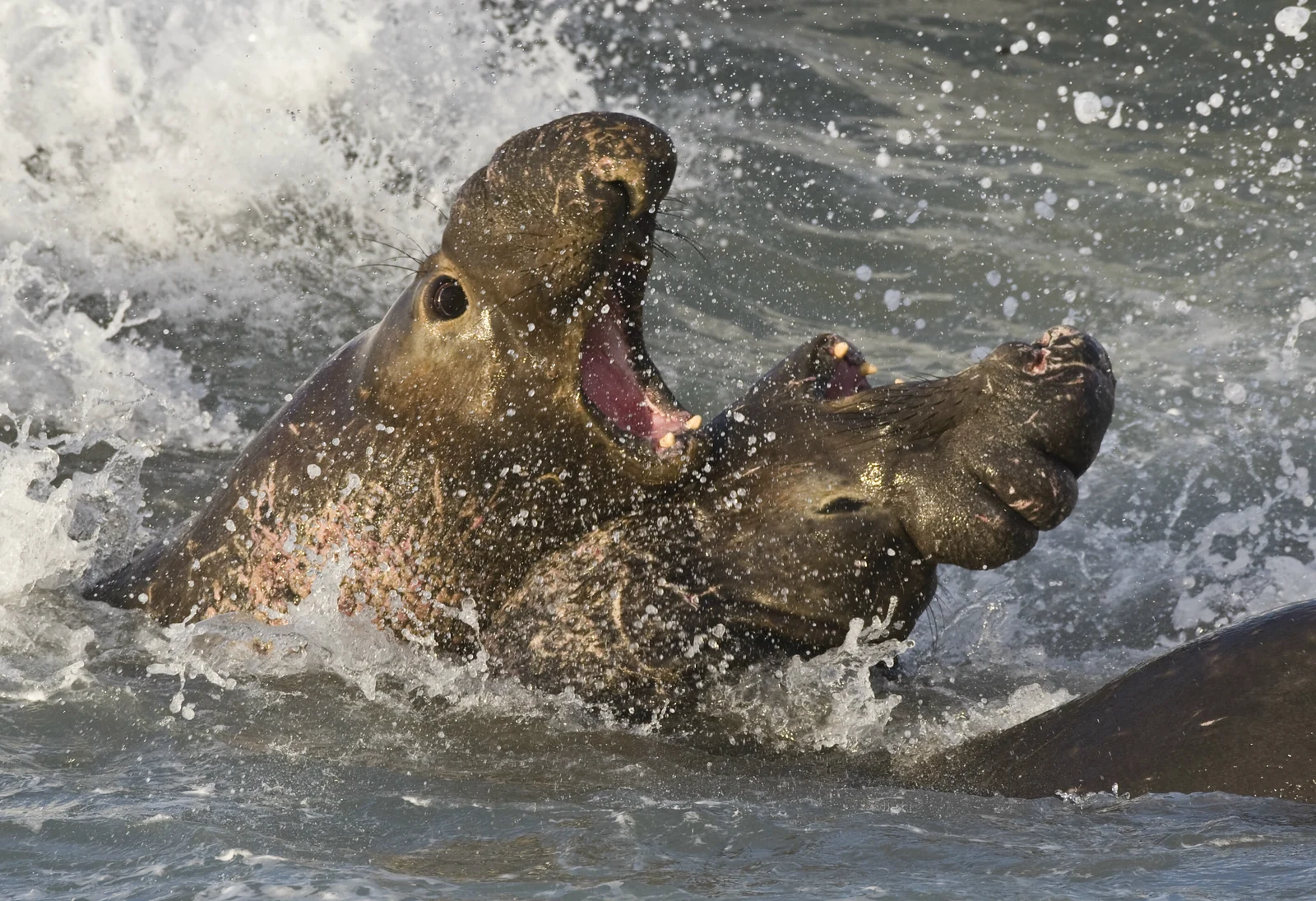
The species has a striking sexual size difference: adult males are substantially larger than adult females. Male size and the inflatable nose also relate to breeding behavior. The nose helps resonate threat calls, an acoustic display used during the breeding season. [1]
A dive is part of a repeated pattern
NOAA describes dives commonly around 1,000–2,500 feet, often lasting 20–30 minutes. These are typical ranges, not a ceiling or a claim that every dive has the same depth and duration. The animal repeats deep dives while at sea, so a single dramatic dive statistic should not stand in for its whole foraging pattern. [1]
The main reported foods are squid and fish, alongside other prey. Taken together, the diet and offshore life help explain why a seal seen fasting ashore should not be assumed to be waiting for human-provided food. Breeding beaches are not where the species spends most of its year. [1]
Consider a hypothetical observation exercise: one visitor counts seals resting at a breeding beach, while a tracking study records repeated offshore dives. The beach count describes animals present at that place and time; it cannot, alone, show how many seals are at sea or characterize their diving. The two methods answer different questions. [1] [2]
Fasting, molt and recovery
Breeding and molting bring elephant seals ashore at different stages of the annual cycle. During these land phases, fasting and a quiet posture can be normal. The timing and duration of an individual visit depend on the animal’s life stage and reproductive schedule, so a beach sighting should be interpreted in its seasonal context. [1]
This distinction matters when reading a beach scene. An animal resting, fasting or undergoing molt may be following its normal cycle. Distress is assessed case by case by trained responders, not inferred simply from stillness or the fact that an animal is alone. [1] [3]
Recovery after near-extinction
Hunting for blubber drove northern elephant seals close to extinction in the nineteenth century. A Mexican hunting ban followed in 1922. At Point Reyes, seals returned in the early 1970s, and the first documented local breeding pair appeared in 1981. These milestones describe recovery at a particular place; they are not a current census of the species. [2]
Older population estimates and growth rates are tied to their dates and methods. They should not be repeated as a 2026 abundance estimate. A local breeding record also cannot be treated as a count of the whole North Pacific population. [2]
Reading a seal on shore
If you encounter a seal that appears to need help, NOAA advises leaving it alone: do not touch, feed or push it into the water. A lone pup is not automatically abandoned. Trained responders assess the animal and its circumstances before deciding whether intervention is needed. [3]
A seal’s seasonal context and behavior matter when interpreting a beach encounter. Breeding, fasting and molting can all involve extended resting on land. If injury or entanglement is suspected, trained responders assess the particular animal; a person on the beach cannot establish sickness simply because it is quiet. [1] [3]
Sources & further reading
Have a correction or a source to suggest? Send a note →