
Reading path: Types of whales →
A closer look at the evidence
| Question or feature | Explanation | What it does not establish |
|---|---|---|
| Northern common minke marking | Usually a conspicuous white band crosses the pectoral flipper. [2] | A submerged flipper or poor light can prevent assessment. [2] |
| Dwarf common form | Has a differently shaped pale flipper-and-shoulder patch. [2] | A brief view may not show enough of the patch to distinguish the form. [2] |
| Antarctic feeding habitat | Antarctic minkes commonly use pack ice and open water between floes; feeding is strongly associated with krill. [3] | This does not describe every common-minke population or its diet. [1] |
| Lunge filtration | Throat grooves expand during engulfment; baleen filters prey from the water. [2] | Prey composition varies with region. [2] |
One common name, two species
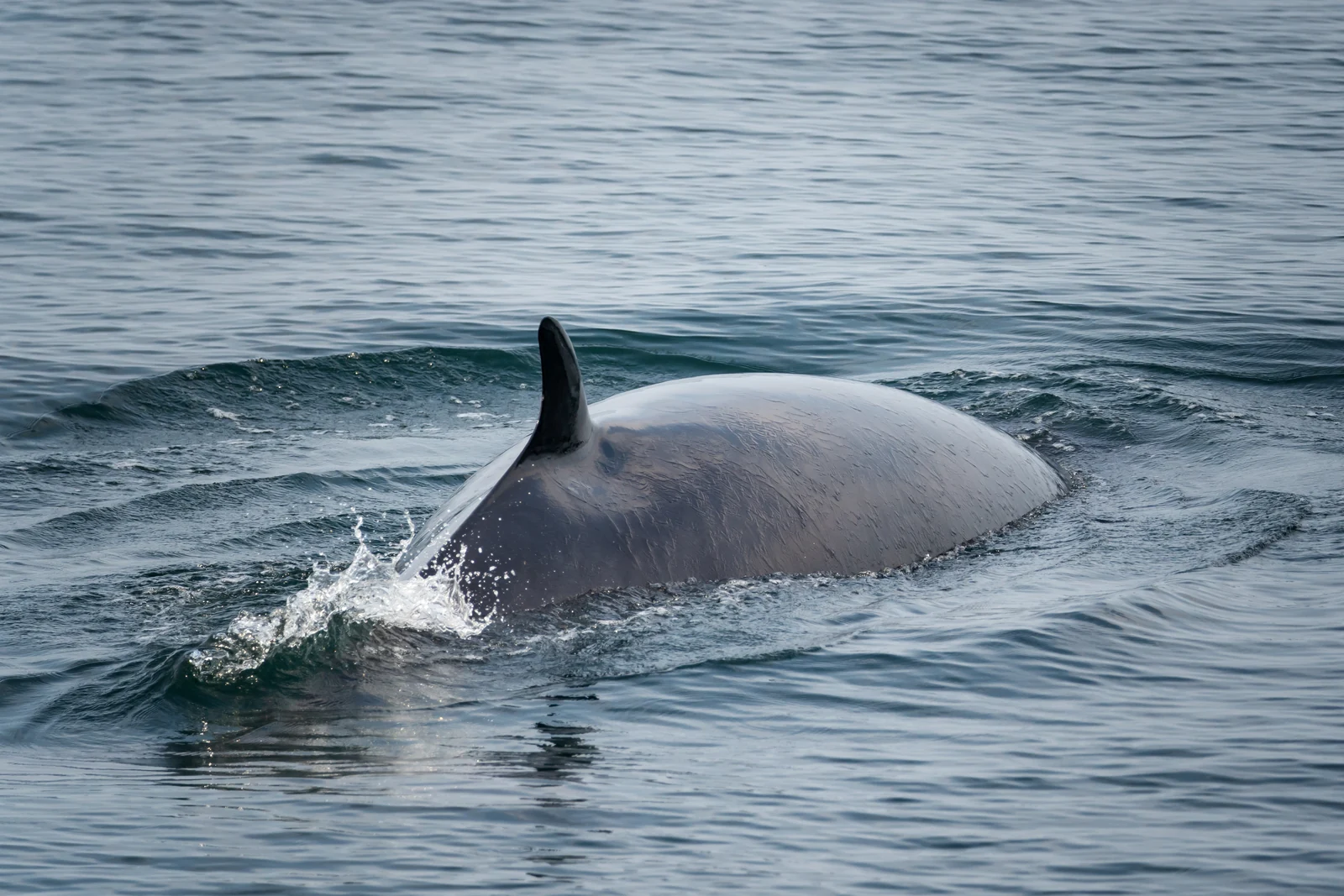
Minke whale refers to two recognized species: the common minke, Balaenoptera acutorostrata, and the Antarctic minke, B. bonaerensis. Both are relatively small rorquals with streamlined bodies, pointed snouts and curved dorsal fins. Because the common name covers distinct species and regional forms, size, range and behavior claims should be attached to the form under discussion rather than generalized to every minke. [1] [2]
The common minke includes a dwarf form with its own flipper-and-shoulder pattern. Geography and markings help narrow an identification, but they do not always resolve it: flippers may be submerged, lighting may be poor, and a brief surface view can omit the most useful patch. [2]
What the flipper can reveal
Northern common minkes usually show a conspicuous white band across the pectoral flipper. The dwarf common-minke form instead has a differently shaped pale patch linking the flipper and shoulder. Antarctic minkes generally lack the distinct mid-flipper band found on the northern common form. These are comparative clues, not a rule that every sighting will display a clear mark. [2] [1]
Consider a hypothetical comparison: a clearly visible white band across the middle of the flipper favors a northern common minke. A broader shoulder-linked pale patch points toward the dwarf common form, while the band is generally absent in Antarctic minkes. If the flipper is underwater, however, “not seen” is not the same as “absent.” Location can inform the interpretation, but the available facts do not make every distant animal identifiable. [2] [1]
Engulfing water, filtering food
Minkes feed by engulfing small prey and water during lunges. Expanding throat grooves accommodate the intake; baleen then filters prey as water leaves the mouth. Their prey varies by region and includes small schooling fishes and crustaceans. Antarctic minke feeding is strongly associated with krill, but that association should not be extended as a uniform diet claim for common minkes in northern oceans. [2] [1] [3]
Engulfment and baleen filtration are shared feeding mechanisms, while prey and habitat differ among forms and regions. Antarctic minkes commonly use pack ice and the open water between floes. That ice association describes an important Antarctic feeding setting; it should not be used as a habitat rule for every common minke elsewhere. [2] [3]
Movement and sound vary by region
Seasonal movement among common minke groups varies with region, age and sex, and some groups show local residency. Therefore, a single annual migration route cannot stand in for all common minkes. Antarctic survey or abundance figures, when encountered elsewhere, likewise cannot be used as estimates for common minkes in the North Atlantic or North Pacific. [2] [1] [3]
Vocalizations also differ regionally. A familiar sound type should not automatically be assigned to every minke population, just as a visible band should be interpreted in light of species and form. A report that records where and how an animal was observed is more useful than one that treats “minke” as a single unvarying category. [2]
A disciplined identification
Start with the pointed snout, streamlined body and curved dorsal fin as general minke features. Then ask whether the flipper marking is clearly visible and what its shape is: mid-flipper band, shoulder-linked patch, or no clear band. Finally, use regional context without allowing it to replace the visual evidence. [2] [1]
This approach keeps uncertainty visible. The northern band is usual, not guaranteed in every view; Antarctic minkes generally lack it; and dwarf common minkes have a different patch. Poor light or a submerged flipper can leave the form unresolved. Those limits are part of sound identification, not a reason to force a conclusion. [2] [1]
Sources & further reading
Have a correction or a source to suggest? Send a note →