
Reading path: Octopuses, jellies and other invertebrates →
A closer look at the evidence
| Question or feature | Explanation | What it does not establish |
|---|---|---|
| Largest species | Tridacna gigas is the largest giant-clam species and has a thick shell with deep radial folds. [1] | The species maximum is not the typical size of every giant clam. [1] |
| Photosymbionts | Symbiodiniaceae live in a branched tubular system in the mantle and provide nutritional support through photosynthesis. [3] | Nutrition share varies with species and body size. [3] |
| Suspension feeding | Water enters the inhalant siphon, crosses filtering gills, and leaves through the excurrent siphon. [3] | This pathway does not establish a fixed proportion of total nutrition. [3] |
| Habitat and harvest | T. gigas occurs in shallow Indo-Pacific reef-associated settings; harvest has reduced it across much of its range. [1] | Historical local rules and a proposed listing do not establish current legal status. [2] [1] |
A large bivalve with a distinctive shell
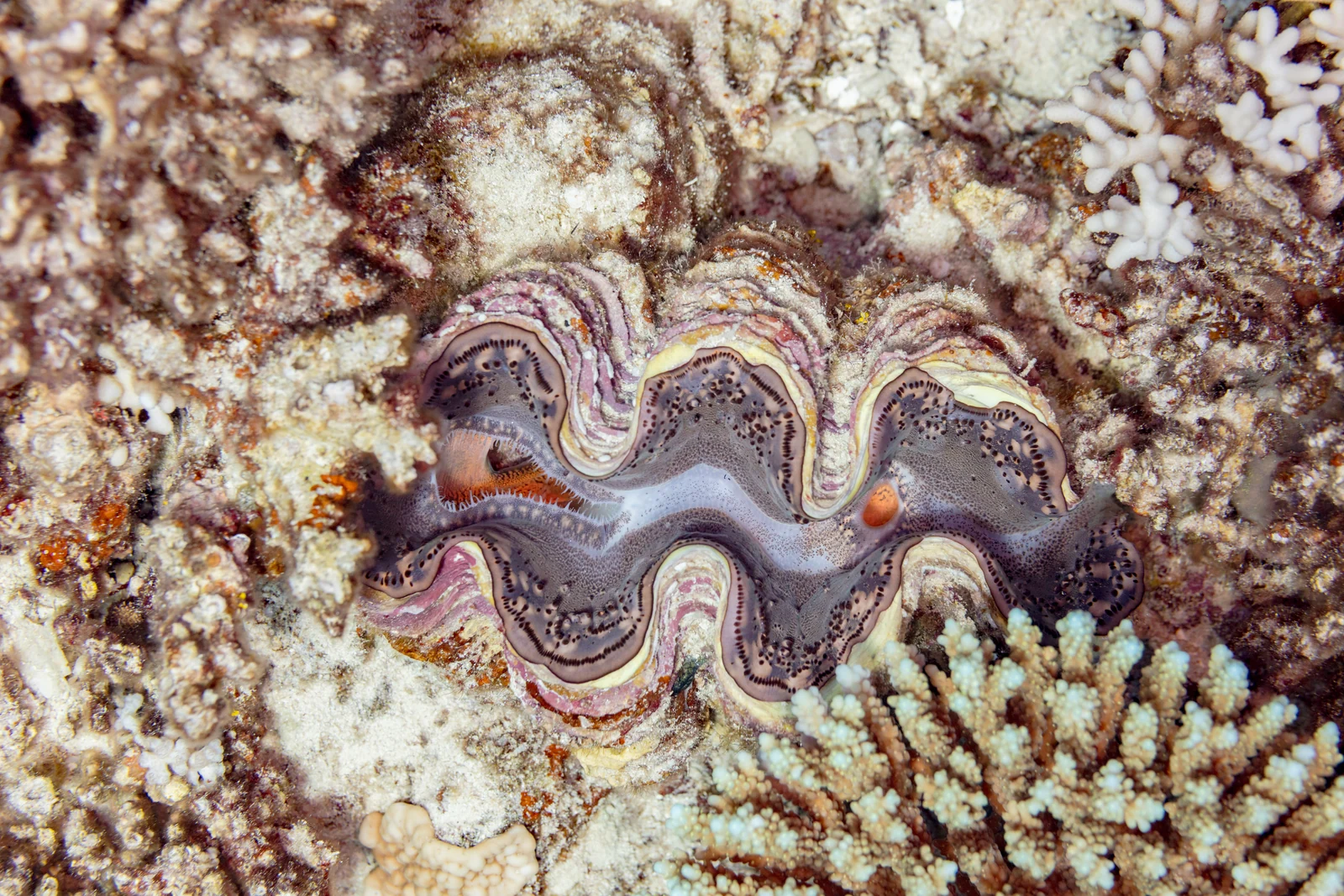
Giant clams are bivalve mollusks. Tridacna gigas is the largest giant-clam species, and its thick, heavy shell has deep radial folds. Those features distinguish the species in broad terms, but they do not make every giant clam a T. gigas or imply that every individual reaches the species’ maximum size. [1]
T. gigas lives in shallow Indo-Pacific reef-associated settings, including lagoons and fringing reefs; bare sand is also included in the species account. These are habitat descriptions for this species, not a rule that every giant clam lives in precisely the same reef setting. [1]
The mantle is exposed to light
When a giant clam opens its shell and spreads its mantle, the exposed tissue receives sunlight. The mantle contains a branched tubular system that houses photosynthetic dinoflagellates in the family Symbiodiniaceae. The clam acquires these symbionts from seawater. [2] [3]
The partnership supplies nutritional support through photosynthesis, but it does not turn the clam into a plant. The photosynthetic organisms occupy the animal’s mantle system, while the clam remains an animal with its own feeding structures and shell. [3]
Water carries food through the clam
Giant clams also suspension feed. Water enters through an inhalant siphon, passes across filtering gills, and exits through an excurrent siphon. The gills capture food particles from the water, giving the animal a feeding route alongside photosynthetic support from its symbionts. [3]
The balance between those routes is not a single fixed percentage. The 2024 NOAA status review says the contribution of photosynthesis versus captured food differs by species and body size. A claim that giant clams eat only sunlight leaves out their active filter-feeding machinery and erases those differences. [3]
A hypothetical comparison of feeding claims
Imagine a clam with its mantle spread in clear, sunlit water. Photosymbionts can use light, while the gills continue filtering waterborne particles. This hypothetical example shows why “sunlight-fed” is incomplete: it describes one nutritional contribution but not the siphons, gills or suspension-feeding route. [3] [2]
A study summarized in NOAA’s 2024 review offers a concrete size comparison for T. gigas. Suspension feeding supplied about 65 percent of the estimated carbon needed for respiration and growth in clams roughly 43 millimeters long, compared with about 34 percent in animals around 167 millimeters long. These are results from particular studied animals and conditions, not a formula for every clam. They demonstrate why a smaller and a larger individual can combine the same two feeding routes in different proportions, and why appearance alone cannot reveal an individual’s nutritional budget. [3]
Size, harvest and the limits of old rules
Harvest for meat and shells has greatly reduced T. gigas in much of its range. The shell and species identity matter when describing the animal, while harvest pressure is a population concern that should not be confused with a size estimate for a particular clam. [1]
A 2011 American Samoa National Park Service article describes regulations from 2009. Those historical rules should not be presented as current local harvesting law. Likewise, NOAA’s 2024 account discusses a proposed U.S. Endangered Species Act listing; that proposal is not proof of a final legal status in 2026. [2] [1]
Sources & further reading
Have a correction or a source to suggest? Send a note →