
Reading path: The seven sea-turtle species →
A closer look at the evidence
| Question or feature | Explanation | What it does not establish |
|---|---|---|
| Shell | Broad, low-domed carapace; upturned margins and non-overlapping scutes, typically olive-gray. [1] | The approximately0.9-metre adult carapace length describes the upper shell, not total head-to-flipper dimensions. [1] |
| Habitat | Shallow continental-shelf and soft-bottom areas; hatchlings enter shallow coastal habitat. [2] [3] | No universal depth or movement distance is given. |
| Diet | Includes sea cucumbers, soft corals, sea pens, and jellies. [1] [2] | No prey proportions or fixed seasonal menu. |
| Breeding range | Known breeding sites are in Australia; feeding grounds also reach Indonesian and Papua New Guinean waters. [1] | Breeding distribution is not the whole occurrence or feeding range. |
A low, broad shell
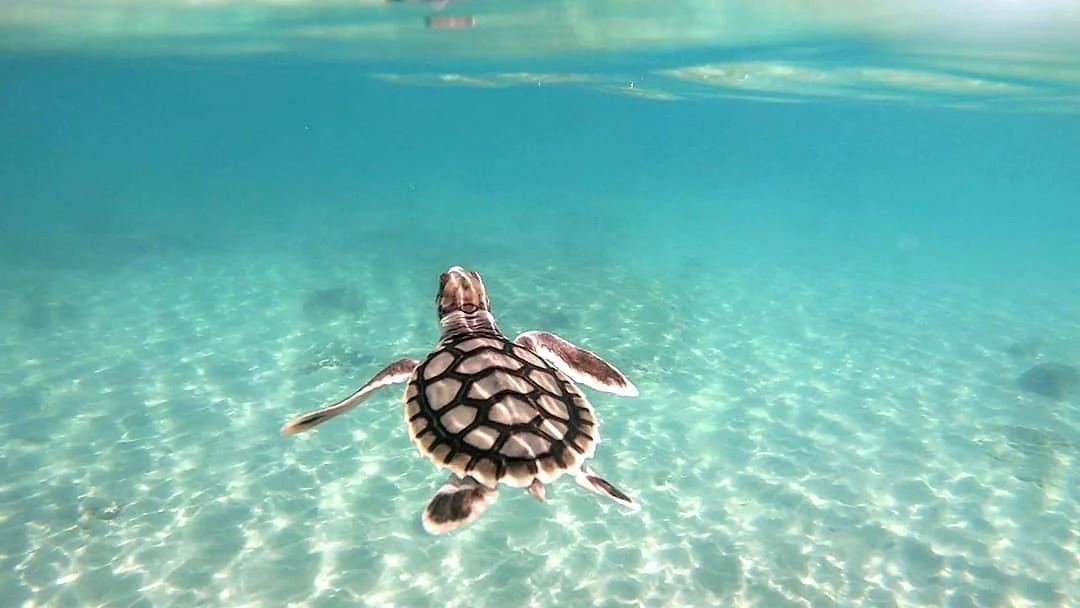
The flatback turtle, Natator depressus, takes its common name from its broad, low-domed carapace. Its shell typically appears olive-gray, with upturned margins and scutes that do not overlap. Those traits help distinguish its outline from the more domed appearance people may expect from a sea turtle, but shell shape alone is not a complete field identification. [1]
The Australian environment department gives an approximate adult carapace length of 0.9 metres. That measures the upper shell rather than the animal’s full reach from head to flippers, and it is an approximate adult description rather than a size for every juvenile or individual. Shape and scale therefore answer different identification questions. [1]
Life over the continental shelf
Flatbacks are associated with the Australian continental shelf, especially shallow subtidal areas with soft bottoms. Their known nesting beaches span mainland and island coasts in northern Australia, including Queensland, the Northern Territory, and Western Australia. These are related but different habitats: sandy beaches serve nesting, while shallow marine bottom habitats support much of feeding and coastal life. [1] [2]
Young flatbacks are thought to remain in continental-shelf or inshore waters rather than following the long oceanic juvenile phase described for several other sea turtles. That is a statement about habitat use; it does not mean juveniles never move or that the species lacks migrations. The sources do not specify a universal movement distance or depth, so neither should be supplied as a species-wide rule. [2]
Soft-bodied prey and coastal feeding
The documented diet includes soft-bodied bottom animals such as sea cucumbers, soft corals, sea pens, and jellies. This menu fits the reported use of shallow shelf and soft-bottom environments: the turtle feeds on available marine animals rather than relying on a hard-shelled prey diet alone. The accounts establish these food groups, but do not give proportions or a fixed menu for every population or season. [1] [2]
A useful map-reading exercise is to compare a breeding map with a feeding map. Every known breeding site is in Australia, yet the feeding range also extends into Indonesian and Papua New Guinean waters. A turtle nesting at an Australian rookery and feeding near Papua New Guinea fits both facts; the breeding distribution does not define the full feeding range. [1]
Nesting varies by region
Nesting does not follow one nationwide calendar. Southern Queensland activity peaks in austral summer, while some northern sites peak in winter or have nesting through the year. Timing must therefore be tied to a specific breeding region rather than generalized to all Australian flatbacks. [1]
At Field Island, also called Gardangal, Kakadu staff and Traditional Owners monitor nesting. Parks Australia describes clutches of around 50 eggs and hatchlings entering shallow coastal habitat. That local account gives a practical glimpse of one monitored place, not a universal clutch count or proof that every colony has the same trend. A stable or monitored local colony cannot establish a range-wide population trajectory. [3]
What the evidence can and cannot identify
For identification, combine the low broad carapace, upturned margins, non-overlapping scutes, and olive-gray coloration rather than treating any single feature as decisive. For habitat, distinguish the beach where eggs are laid from the shallow shelf waters used for feeding. For distribution, keep breeding and feeding ranges separate. Together these distinctions answer the central questions without turning regional observations into universal rules. [1] [2]
Regional context remains essential. A southern Queensland nesting calendar does not predict the timing of a northern colony, and an Australian breeding map does not include every feeding ground in neighbouring countries. Likewise, monitoring at Field Island describes that colony rather than a complete range-wide population trend. [1] [3]
Sources & further reading
Have a correction or a source to suggest? Send a note →