
Reading path: Types of whales →
A closer look at the evidence
| Question or feature | Explanation | What it does not establish |
|---|---|---|
| Jaw asymmetry | Left lower jaw is dark; right is pale, offering a strong visible identification clue. [1] [2] | Glare, distance or a short surfacing can hide the pattern; its precise evolutionary function is not established here. [1] |
| Lunge feeding | Throat pleats unfold as the whale engulfs prey-bearing water; baleen retains prey while water is expelled. [1] | Prey composition varies by location; no single menu applies everywhere. [1] [2] |
| Habitat and movement | Found across major oceans, especially temperate and polar waters, often offshore; movement can be seasonal or comparatively resident. [1] [2] | A universal pole-to-tropics route oversimplifies regional differences. [2] |
A large rorqual with a useful visual clue
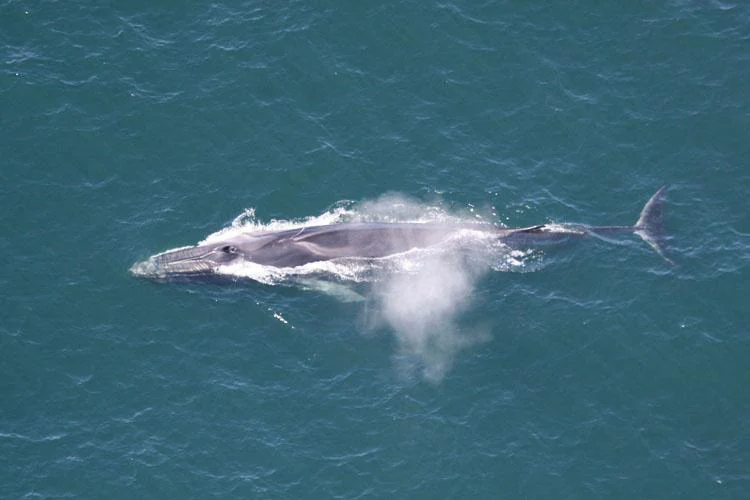
The fin whale, Balaenoptera physalus, is built for speed: its long, streamlined body narrows toward a V-shaped head, and its hooked dorsal fin sits far back along the back. It can occur alone or in small groups, with larger aggregations forming where feeding opportunities bring animals together. These features help establish an identification, but a distant glimpse may not show enough of them at once. [1] [2]
The most distinctive color clue is on the lower jaw. Its left side is dark and its right side pale, a strong asymmetry that can be useful when the animal surfaces broadside. Pale chevrons behind the head and other markings can also help distinguish individuals. The pattern is diagnostic; the available evidence does not establish the exact evolutionary function of the asymmetry. [1] [2]
Reading a brief sighting carefully
Identification depends on what was actually visible. Imagine a hypothetical observer seeing only a fleeting hooked dorsal fin at a distance. That observation fits the fin whale’s profile, but it does not reveal the jaw pattern or pale chevrons, and the sighting alone may not support confident separation from other whales. If a later surfacing exposes the head, a pale right lower jaw alongside a dark left one adds stronger evidence. Even then, glare, angle and distance can conceal the contrast. [1] [2]
A useful evidence note separates observed features from inference: record the body shape, fin position, jaw side and markings only when visible. Do not treat an unobserved pale patch as absent. This matters especially when the animal surfaces briefly, rolls, or is seen against reflected light. A single feature can support recognition without settling every identification question. [1]
How a lunge captures prey
Fin whales eat krill, small schooling fishes and squid, with the mix differing among locations. During a feeding lunge, the whale opens its mouth and takes in a large volume of prey-bearing water. Long throat pleats unfold to accommodate that water and prey. The lunge therefore combines rapid engulfment with a subsequent filtering phase. [1] [2]
After engulfment, water is expelled through baleen, which retains prey. The sequence links anatomy to feeding: expandable throat pleats make room for the water and prey, while baleen acts as a filter as the water leaves. The prey list should not be read as a fixed menu for every fin whale; regional availability shapes what is eaten. [1] [2]
Fin whales are fast swimmers, a trait consistent with their streamlined form, but speed does not mean they feed in the same way everywhere or always travel in groups. They may be solitary or in small groups outside larger feeding aggregations. A sighting of several whales together therefore describes a local observation, not a universal social pattern. [1] [2]
Ocean range and variable movements
The species occupies major oceans, especially temperate and polar waters, and frequently uses deeper offshore habitat. Movement is complex: some populations shift seasonally, while some regional groups are comparatively resident. A simple map showing every fin whale moving between polar feeding grounds and tropical breeding grounds would overstate what is known. Routes and seasonal residence vary by region. [1] [2]
A whale in a particular area cannot be assigned a migration stage solely from a broad seasonal diagram. Site, season and population context matter. Seasonal movements and comparatively resident groups are both documented, so a single location establishes presence without revealing the animal’s complete route. [1] [2]
Risks in a fast, offshore life
Commercial hunting has ended in most places, but fin whales still face vessel strikes, entanglement and underwater noise. These pressures are relevant to animals that use offshore waters and move through regions of human activity. The evidence identifies the threats but does not provide a single current risk level applicable to every ocean area. [1] [2]
For identification, the practical conclusion is modest: combine body form, far-back hooked dorsal fin, jaw asymmetry and chevrons when visible. Treat a brief or glare-obscured view as incomplete evidence, and keep regional movement claims tied to the population and place being discussed. [1] [2]
Sources & further reading
Have a correction or a source to suggest? Send a note →