
Reading path: Sea otters and coastal mammals →
A closer look at the evidence
| Question or feature | Explanation | What it does not establish |
|---|---|---|
| Tail comparison | Dugongs have flukes; manatees have rounded paddle-shaped tails. [2] | A distant or brief sighting may not show the tail clearly. |
| Habitat and food | Dugongs are marine mammals strongly dependent on seagrass meadows. [1] | Dependence does not mean only one plant species or no other food. |
| Breathing | Nostrils near the snout’s top allow the dugong to surface for air. [1] | Surfacing alone does not identify a dugong. |
| Reproduction | Females generally bear one calf every three to seven years; calves may remain close for one to two years. [1] | These are general intervals, not a lifespan or a guaranteed schedule. |
A marine mammal built around seagrass
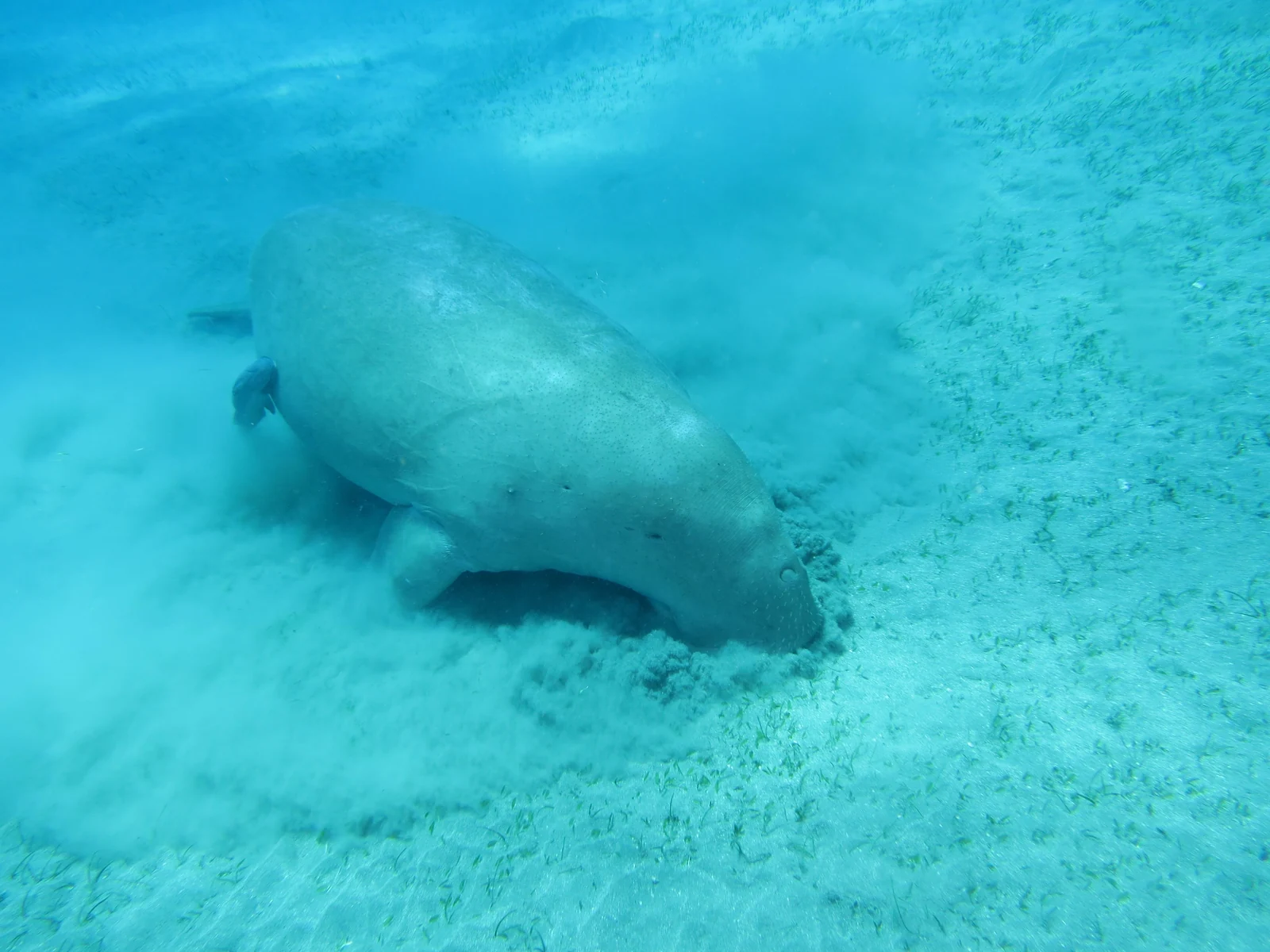
The dugong, Dugong dugon, is a marine mammal in the order Sirenia. It inhabits tropical and subtropical coastal waters and depends heavily on seagrass meadows for food. This strong connection between habitat and feeding helps explain why damage to a meadow can affect animals that use it. [1]
That dependence does not prove an animal eats only one species of seagrass or never takes other material. It identifies a strong ecological connection, not an exclusive menu. Seagrass loss is among the documented threats, alongside fishing-gear entanglement, marine debris and boat strikes. [1]
Tail, flippers and breathing
A dugong swims using two foreflippers and moves its tail up and down. The tail ends in flukes, giving it a different outline from a manatee’s rounded, paddle-shaped tail. These shapes are useful when an animal is seen clearly, though a brief or distant surface glimpse may not reveal the tail well enough to identify it confidently. [1] [2]
Dugongs breathe air. Nostrils near the top of the snout let an animal surface to breathe without lifting its whole head far out of the water. Seeing an animal surface is therefore consistent with normal breathing behavior; it does not by itself identify the species. [1]
Dugong or manatee? Use more than a nickname
Manatees are the dugong’s living sirenian relatives, not another name for the same animal. A practical comparison combines tail shape with habitat: dugongs are marine seagrass specialists, while manatees can use freshwater as well as coastal waters. The evidence supports this broad distinction; it does not mean manatees never enter marine water. [2]
Imagine a hypothetical sighting in which only the back and head briefly break the surface. A label such as “sea cow” does not settle the identification, and an unseen tail cannot be compared. If the tail is visible, flukes favor dugong and a rounded paddle favors manatee; habitat adds context, but a distant indistinct view can remain unresolved. [1] [2]
Slow reproduction and close care
Females generally give birth to one calf at intervals of three to seven years. Calves may nurse and stay near their mothers for one to two years. These figures describe reported reproductive intervals and calf association; they do not specify the lifespan of a dugong or guarantee the exact interval for every female. [1]
An interval of several years between calves makes the loss of breeding females particularly consequential: a replacement calf is not produced immediately after an adult dies. Reproduction is only one part of population change, however. Survival, seagrass condition, entanglement and collisions also matter, so the calf interval alone cannot predict a local population’s future. [1]
Keep geography attached to conservation claims
The Australian government account describes dugongs and their threats in its own jurisdiction. A protection listing or legal status in Australia should not be restated as a rule that applies worldwide. Conservation claims need their geographic scope attached. [1]
Seagrass dependence does not mean every dugong occupies the same meadow or eats the same plant species. An observation can document an animal at one location, while the broader distribution spans tropical and subtropical coastal waters. Repeated local observations are needed to establish which feeding areas particular animals use. [1]
Sources & further reading
Have a correction or a source to suggest? Send a note →