
Reading path: Types of whales →
A closer look at the evidence
| Question or feature | Explanation | What it does not establish |
|---|---|---|
| Head and ice | A very large bow-shaped head and thick skull help bowheads surface through sea ice. [1] | This does not specify a universal route or mean every ice condition is passable. |
| Blubber | Thick blubber insulates the whale and provides an energy reserve. [1] | The species-profile thickness is a descriptive range, not a measurement of the whale in an individual sighting. [1] |
| Lens chemistry | Aspartic acid mirror-image ratios in the lens nucleus are compared with a calibrated reaction rate to estimate age. [2] | The estimate depends on calibration and temperature assumptions; it is not an exact birth date. |
| Baleen isotope cycles | Seasonal patterns can help age young whales and reflect diet history. [2] | Most useful at roughly 20 years or younger; wear removes early records in older animals. |
A whale shaped for an icy seasonal habitat
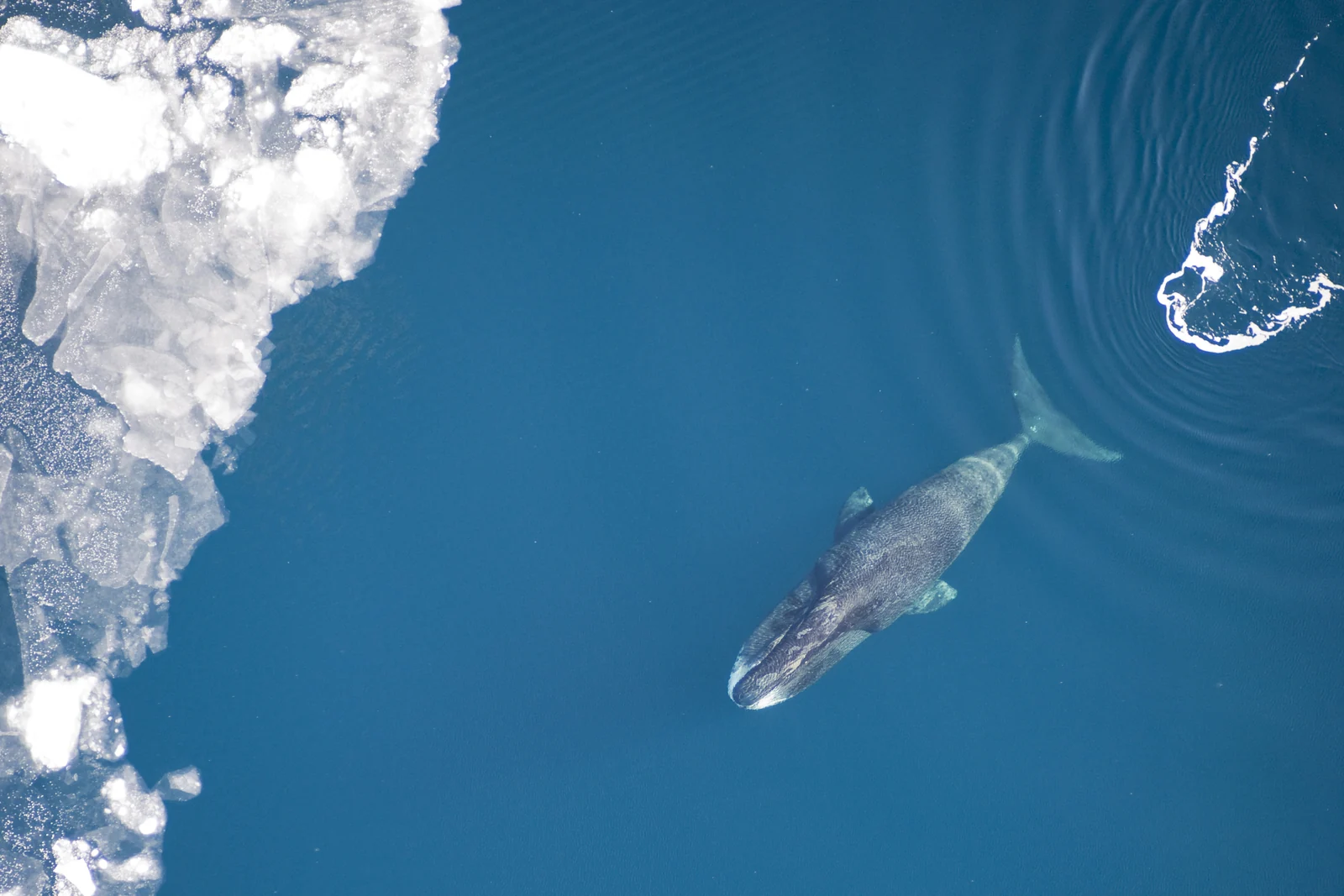
The bowhead whale, Balaena mysticetus, is an Arctic baleen whale with a stocky dark body, pale chin, and no dorsal fin. Its very large, bow-shaped head and thick skull help it surface through sea ice. These traits fit a habitat where access to open water can shift with the seasons, but they do not mean that every whale follows an identical route or that every ice condition is passable. [1]
A thick blubber layer insulates the body in cold water and also provides an energy reserve. NOAA’s profile describes a thickness around 17–19 inches, roughly 43–48 centimetres. The insulation reduces heat loss, while stored energy helps support the animal through seasonal changes in feeding opportunity. [1]
Bowheads feed by filtering small crustaceans, including copepods and krill, through exceptionally long baleen. As with other baleen whales, the plates retain prey as water passes through the mouth. The relevant comparison is between anatomy and diet: the long filtering surface suits small prey suspended in water, while the massive skull is associated with surfacing through ice. Neither feature alone establishes a particular feeding depth. [1]
Seasonal movement follows changing ice
Many bowheads winter near the southern pack-ice boundary and move north as ice retreats. This is a broad seasonal pattern rather than a precise itinerary for every animal. The population found in US waters is the Western Arctic, or Bering–Chukchi–Beaufort, stock; bowheads also occur in several other Arctic regions. [1]
A hypothetical comparison clarifies what the pattern does and does not predict. If a whale is associated with wintering near the pack-ice boundary, the broad account predicts movement north as the ice retreats. It does not let an observer calculate the whale’s exact position on a particular day, infer its age, or identify which population it belongs to. Seasonal habitat descriptions operate at a broader scale than an individual location fix. [1]
Scars can help researchers recognize individuals, but recognition is different from age estimation. A scar may show that a whale has a distinctive mark that can be tracked in later observations; it does not reveal its birth year. Bowhead longevity is established through several lines of evidence rather than an age read directly from body size or appearance. [1] [2]
How researchers estimate an age they cannot observe directly
Historical hunting implements recovered from some whales support survival across very long intervals. Such an object is evidence that an animal lived long enough to carry an implement from an earlier encounter; it is not a birth certificate or an exact age for every large whale. Together with other evidence, these finds support the conclusion that some bowheads may live around or beyond two centuries, while the maximum lifespan remains unknown. [1] [2]
One chemical method examines eye-lens proteins. Aspartic acid occurs in mirror-image forms, and researchers compare their proportions in the lens nucleus against a calibrated reaction rate. The result is an estimated age that depends on calibration and temperature assumptions. It is a biological clock with assumptions, not a direct record of the whale’s birth date. [2]
Baleen can offer a different kind of timeline. Seasonal isotope patterns may preserve cycles that help age young whales, but wear removes the earliest growth record in older animals. Thus baleen cycles are most useful for whales roughly 20 years old or younger; an old whale’s remaining baleen cannot simply be counted backward to recover its whole life. [2]
Several clues answer different questions
Reproductive-tissue evidence applies to mature females. Researchers count ovarian structures left by ovulation, then interpret the counts using estimates of maturity and reproductive timing. Such a record cannot show whether every ovulation led to a successful pregnancy, so it is most useful alongside other age-estimation methods. [2]
Consider a clearly hypothetical evidence-reading exercise. A recovered historic weapon fragment supports the claim that a whale survived an earlier encounter. Lens chemistry can estimate elapsed time, subject to calibration and temperature assumptions. Baleen isotopes can preserve recent seasonal diet history, with the oldest record lost through wear in older animals. These clues complement one another because each measures something different; none should be converted into an exact birthday without accounting for its limits. [2]
The evidence supports exceptional longevity, not a known maximum age for the species or an exact age for any whale merely because it is large. A bowhead’s Arctic adaptations can be described through its skull, blubber, baleen, and seasonal movement with ice. Its age, by contrast, requires specialized evidence and careful interpretation of what each method can—and cannot—measure. [1] [2]
Sources & further reading
Have a correction or a source to suggest? Send a note →