
Reading path: Types of whales →
A closer look at the evidence
| Question or feature | Explanation | What it does not establish |
|---|---|---|
| Color | Calves are gray; skin typically pales toward white as belugas mature. [2] | Color does not give an exact age, and lighting or water conditions affect photographs. [2] |
| Neck and back | Unfused neck vertebrae permit nodding and side-to-side movement; a low ridge replaces a tall dorsal fin. [2] | The low ridge does not prevent ice entrapment. [1] |
| Melon and sound | The flexible melon focuses and shapes outgoing echolocation signals; belugas also use varied calls. [2] | Communication and echolocation are distinct but overlapping tasks; a sound cannot be assigned meaning from type alone. [2] |
| Population status | Alaska has five stocks; Cook Inlet is a separately recognized endangered distinct population segment. [2] | Movement patterns and legal status do not apply uniformly to all belugas. [2] |
Color changes with development
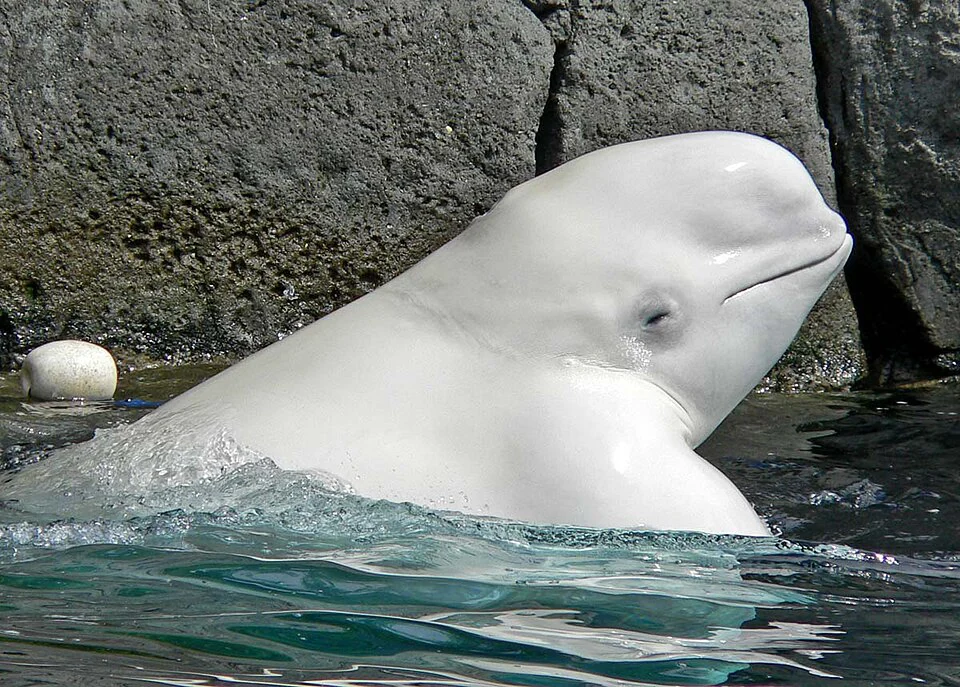
The beluga, Delphinapterus leucas, lives in Arctic and subarctic seas, including coastal waters, continental shelves and estuaries. Calves are gray, and their skin typically becomes paler and white as they mature. Color is therefore a broad developmental clue, not a precise age measurement in years. Light and water conditions can also change how photographs render the animal. [1] [2]
A hypothetical comparison makes the distinction clear: a gray calf beside a white adult illustrates the typical color change, but it does not reveal either animal’s exact age. Both retain the characteristic low dorsal ridge. The ridge is a useful body-form clue, whereas color must be interpreted with developmental stage and viewing conditions in mind. [2]
A neck that can move
Beluga neck vertebrae are not fused, allowing the animal to nod its head and move it from side to side. This flexibility distinguishes its movement from that of cetaceans with more restricted head motion. Along the back, a low ridge replaces the conspicuous upright dorsal fin seen in many dolphins. The ridge should not be confused with a dorsal fin merely because it occupies the same general region. [2]
The back shape is associated with life in ice-covered habitat, but a low ridge does not make belugas immune to ice entrapment. Ice remains a potential hazard. The adaptation and its limit belong together: a different dorsal profile is characteristic, not a guarantee of safe passage through ice. [1]
How belugas use sound
The flexible melon on the forehead focuses and shapes outgoing echolocation signals. Belugas also produce whistles, chirps, squeals and clicks. Communication and echolocation involve different acoustic tasks, although their uses can overlap; not every click should be treated as a message, nor every vocalization as sonar. [2]
Sound is especially relevant in habitats where visibility may be limited, such as turbid estuarine water. In those conditions, acoustic signals provide information through a different channel from sight. The evidence here describes the melon’s role and broad call types, but does not assign a single meaning to each sound or provide a universal interpretation for a recording. [2]
Food and seasonal behavior
Belugas eat fish including salmon, cod and eulachon, as well as squid, octopus, crustaceans and other invertebrates. The available evidence does not support a single diet or feeding depth for every population. Some populations gather in shallow waters to molt, rubbing against gravel or the bottom to shed old skin. This behavior is population-specific enough that it should not be presented as an annual event for every beluga group. [1] [2]
Belugas can also move between social groups, so a group seen together is not necessarily a permanent, closed family. This social flexibility matters when interpreting photographs or counts: membership at one moment does not establish an enduring family boundary. [1]
Population context matters
Movement and habitat use differ among populations. Alaska’s five recognized stocks have differing movement patterns and habitats; some belugas remain localized while others travel farther. A single migration route or feeding depth therefore cannot describe the whole species. Local context is necessary to interpret where an animal is likely to move and what habitat it uses. [2] [1]
Conservation status also must be stated at the right scale. Cook Inlet has its own endangered distinct population segment; that status is not identical to the legal or population status of every beluga. A statement about that population cannot be generalized to all Arctic and subarctic belugas. [2]
Taken together, the most useful identification cues are the pale adult coloration, low dorsal ridge and flexible head movement, interpreted with the animal’s life stage and viewing conditions. None alone resolves age, population, or movement history. [2] [1]
Sources & further reading
Have a correction or a source to suggest? Send a note →