
Reading path: Marine organisms and body plans →
A name with a place in the animal tree
The accepted name Halocynthia aurantium (Pallas, 1787) belongs to the ascidians, within the tunicates and the phylum Chordata; its family is Pyuridae. “Sea peach” is a common name, not a clue that the organism is botanical. Its soft, often rounded outline may evoke a fruit, but its classification is based on biological relationships and diagnostic features. [1]
The chordate connection can seem surprising in an adult that resembles a stationary sac. Many tunicates have a swimming larva with a tail and notochord, structures associated with chordates. In ascidians, the adult form is adapted to a different way of life after settlement. The life cycle helps explain why the animal’s adult appearance alone does not advertise its evolutionary placement. [2]
Two siphons and a protective covering
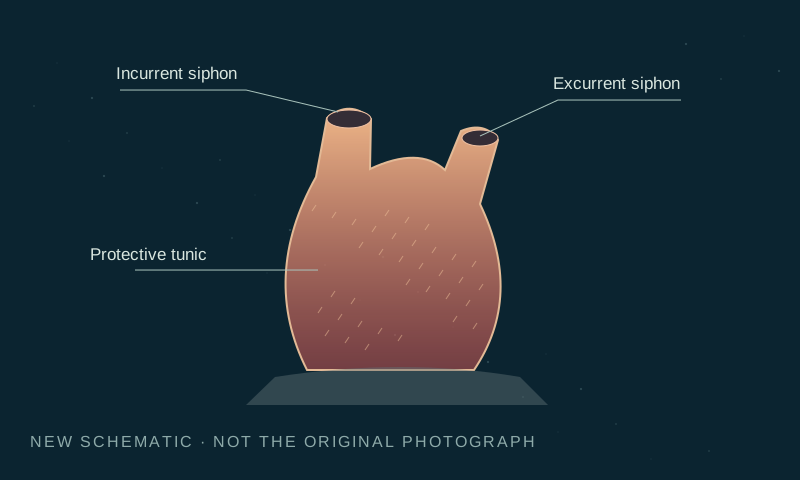
An attached ascidian draws water in through one siphon and releases it through another. As water passes through the body, suspended food particles can be captured, and the current supports other exchanges with the environment. The tunic forms a protective outer covering around the animal. It is tissue associated with the ascidian body, not a plant stem or a coral skeleton. [2]
Imagine a hypothetical field observation of a rounded, orange-toned animal fixed to a rock. If two openings are visible, a notebook might record their positions, approximate dimensions, attachment surface, color, and whether water appears to move through them. These observations support the interpretation that the animal is an ascidian, but color and outline alone do not demonstrate that the individual is Halocynthia aurantium.
A specimen notebook as evidence
A careful entry separates what an observer saw from what they concluded: “two siphon openings visible” is an observation; “therefore this is H. aurantium” is an identification inference. The inference may be reasonable, but it needs comparison with diagnostic characters, reliable location data, and, when available, examination of the specimen or well-documented images. A filename containing a species name is a label someone supplied, not independent proof. [1]
A practical hypothetical notebook entry might read: “Attached to shaded rock; rounded body; two siphon openings; surface orange; image scale included; identification tentative.” Later, a taxonomic check could confirm, revise, or leave the name unresolved. Keeping the first description intact makes that later correction possible and prevents an early guess from being mistaken for a direct field observation.
Why the distinction matters
Calling a sea peach a plant hides the mechanisms that make it an animal: it filters particles from water, exchanges materials across body surfaces, and belongs to a lineage whose larvae share chordate features. Calling it a sponge or coral because it stays in one place similarly substitutes a visual shortcut for anatomy and development. Movement is not a requirement for animal life; an attached adult can still feed and respond through its own tissues. [2]
A taxonomic record supports the accepted name and its placement, but it does not establish the identity of every orange, attached specimen encountered in the field. The strongest account keeps two levels visible: the record tells us what H. aurantium is classified as, while the notebook tells us what a particular observer actually documented. Linking those levels carefully is the heart of reliable natural history. [1]
Sources & further reading
Have a correction or a source to suggest? Send a note →