
Reading path: Marine organisms and body plans →
A new science guide at a historical Coldwater address. About the earlier site →
What to look for
| Feature | Observation | Comparison or limit |
|---|---|---|
| Movement | Eight rows of comb plates carry beating cilia. | A pulsing bell points to a different body plan. |
| Color | Comb rows scatter external illumination into rainbow colors. | A rainbow band alone is not evidence of bioluminescence. |
| Feeding | Many forms have sticky tentacles; Beroe lacks them. | Do not use tentacles as a universal ctenophore trait. |
Eight rows that move an animal
A comb jelly’s signature feature is eight rows of comb plates running along its body. Each plate is made of fused cilia, tiny hairlike structures that beat together. Their coordinated strokes push water and propel the animal, much as repeated oar strokes move a small boat. Ctenophores are the largest known animals to swim using cilia. [1] [2]
This is a different kind of propulsion from a jellyfish’s pulsing bell. A ctenophore may instead appear to glide as successive comb plates beat along its length. That motion is useful to notice in a clear video, but the visible pattern alone does not reveal the animal’s speed, direction, or how much its movement is affected by surrounding currents.
Rainbow shimmer and living light
Under illumination, moving comb rows can scatter light into rainbow colors. The color shifts as the cilia move and the viewing angle changes; it is an optical effect, not light produced by the animal. A bright streak along a comb row in a photograph can therefore show reflected or scattered light without showing bioluminescence. [2]
Bioluminescence is a separate phenomenon: a chemical process in the animal produces light. Some comb jellies can show bioluminescent displays, including when disturbed, but the trait should not be assumed for every species. A still image may capture a colored row without showing whether light was generated by the animal or scattered from an external source. [1]
Different outlines, different feeding tools
The group includes rounded and lobed forms, as well as animals shaped more like belts. Tentacles are common in some forms, where sticky cells help capture small prey, but they are not universal. Beroe, for example, lacks tentacles and feeds through a large mouth; some lobate comb jellies have flattened lobes extending below the body. [2]
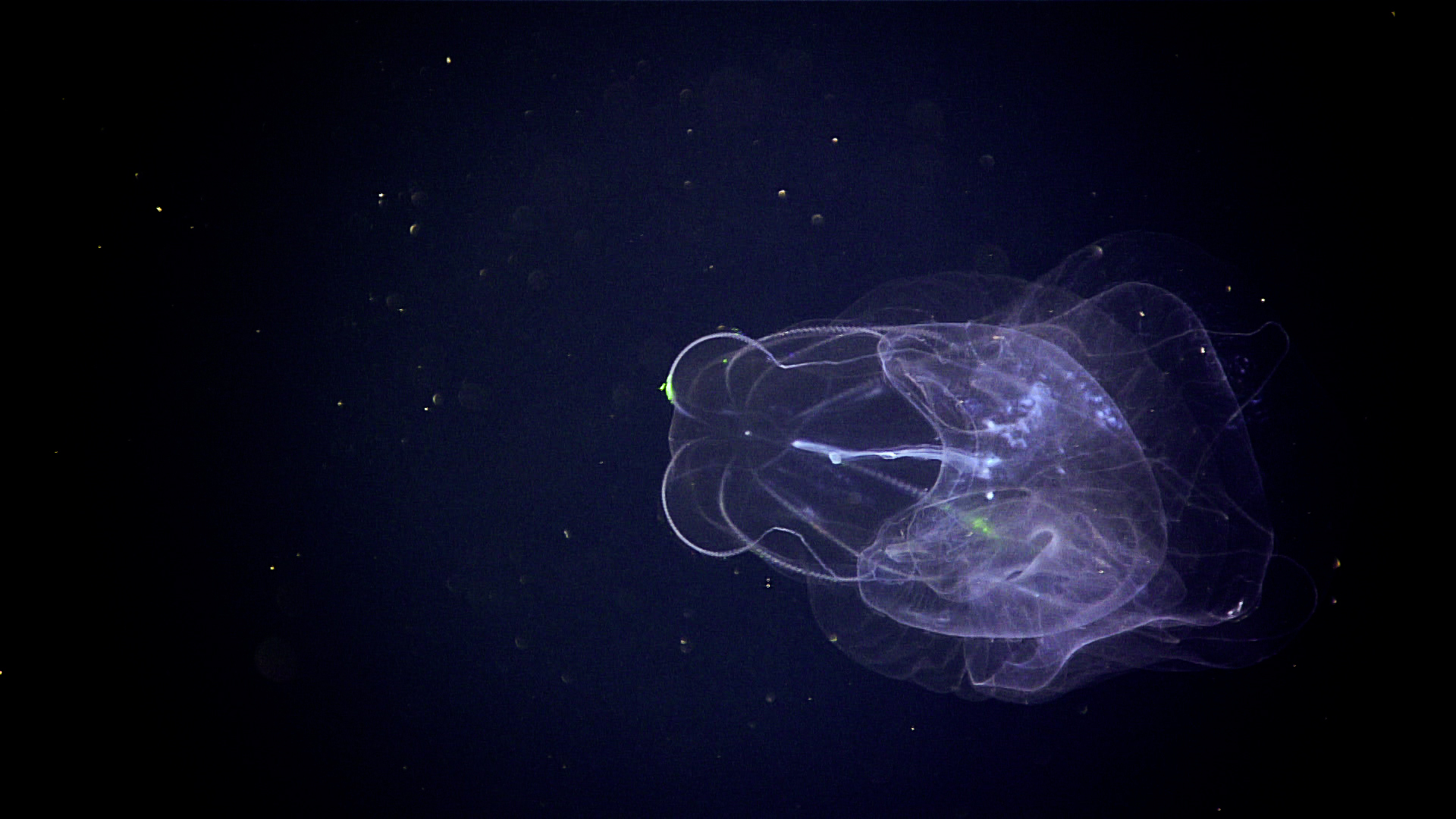
In a hypothetical close-up, a viewer might see two broad lobes and infer that the animal belongs to a lobate form. That outline is a useful clue, not a complete identification: a single image may hide the mouth, comb rows, or features needed to distinguish a species. Fragile open-ocean forms can be especially difficult to identify from photographs alone. [1]
Not a jellyfish with a different look
Comb jellies belong to phylum Ctenophora; jellyfish belong to Cnidaria. Their gelatinous appearance can invite comparison, but the groups differ in key structures. Comb-jelly tentacles, when present, use sticky cells called colloblasts. Cnidarian stinging cells, or nematocysts, are a different capture mechanism. [2]
The distinction helps interpret what a photograph can and cannot establish. Eight apparent rows of shimmering combs may support a broad ctenophore identification if the image is clear. Color alone is weaker evidence: it may come from scattered light, bioluminescence, or illumination conditions. Additional views, movement, and anatomical detail make a stronger basis for identifying the animal.
Sources & further reading
Have a correction or a source to suggest? Send a note →