
Reading path: Marine organisms and body plans →
A new science guide at a historical Coldwater address. About the earlier site →
What to look for
| Feature | Observation | Comparison or limit |
|---|---|---|
| Movement | The medusa contracts its bell to move water. | Comb jellies use comb rows rather than a jellyfish bell. |
| Development | Many species pass from polyp through ephyra to medusa. | This is not a universal lifecycle for every gelatinous animal. |
| Aggregation | Record counts, area, time and sampling effort. | A bloom does not identify its environmental cause. |
A bell that swims by pulsing
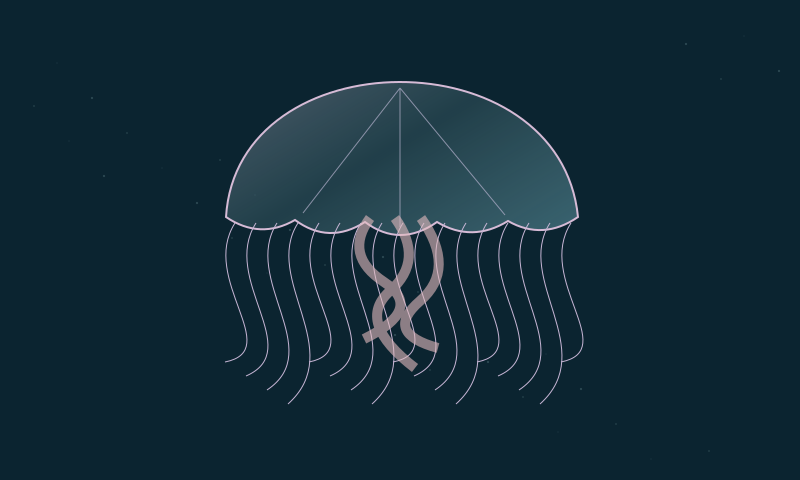
A scyphozoan medusa moves by rhythmically contracting its bell. Each contraction pushes water backward; the returning shape draws water into the space beneath the bell, producing a sequence of short swimming strokes. The animal’s nerve net coordinates these movements without a centralized brain. The bell is therefore both a body wall and a simple propulsion system, while the trailing tentacles extend the animal’s reach into surrounding water. [1]
A hypothetical observation makes the mechanics easier to picture: imagine watching a medusa cross a calm tank. It advances in pulses, then drifts between them. The pauses do not mean it has stopped interacting with its surroundings; prey and water currents can still pass its tentacles. Jellyfish capture prey with stinging cells, while a comb jelly’s sticky tentacles use a different mechanism. Similar silhouettes can conceal distinct biology. [1]
From polyp to ephyra
Many scyphozoans alternate between a swimming medusa and a small polyp attached to a firm surface. After sexual reproduction, a fertilized egg develops into a ciliated planula larva. A planula may settle and become a polyp, which can feed and reproduce asexually. In the characteristic scyphozoan process called strobilation, the polyp divides into a stack of disc-like sections. Each section can detach as an ephyra, a juvenile medusa that grows into the familiar bell-shaped adult. [1]
This is a common pattern, not a rule for every gelatinous animal. Hydrozoans can produce medusae by budding from polyps, and some hydrozoan polyps transform into medusae. Some jellyfish lineages have other life-history arrangements. Ctenophores are a separate animal phylum, not scyphozoan jellyfish: their comb rows, made of beating cilia, propel them through water. Life stages and anatomy together help distinguish groups that a casual glance might lump together. [1]
Feeding and the limits of resemblance
Tentacles are not merely streamers. In scyphozoans they carry cnidocytes, cells containing nematocysts that discharge when triggered by contact or chemical cues. Captured plankton or other small prey can then be moved toward the mouth beneath the bell. Food is digested in a simple internal cavity rather than in a complex stomach and intestine. The arrangement suits an animal that encounters prey while moving through the water column. [1]
A comb jelly may also have tentacles, but its colloblasts catch prey by adhesion rather than by firing venomous structures. Its colored comb-row shimmer is light refracted by moving cilia, not evidence that it is a scyphozoan or that the animal is glowing. In a hypothetical field note, recording both body shape and the visible means of movement would be more informative than writing only “transparent jelly.” [1]
Reading a bloom in context
A large aggregation is an observation about where many animals are found at a particular time. It does not, by itself, identify why they gathered or establish a long-term population trend. Potential influences include food availability, currents, predators, fishing pressure, coastal structures, and nutrient inputs; temperature may matter for some populations, but a bloom is not proof that warming caused it. [1]
To interpret a reported bloom, compare counts made at the same place and season across years, and record water conditions, sampling method, and life stage where possible. Light also changes with depth: the upper ocean is generally the bright, photosynthetic zone, while sunlight dwindles sharply below it. That context can affect where observers and prey encounter medusae, but it is not a direct explanation for any single aggregation. Separating what was seen from the cause inferred is essential. [2]
Sources & further reading
Have a correction or a source to suggest? Send a note →