
Reading path: Marine organisms and body plans →
A new science guide at a historical Coldwater address. About the earlier site →
What to look for
| Feature | Observation | Comparison or limit |
|---|---|---|
| Body plan | Segmentation and paired appendages are common. | The traditional polychaete grouping contains varied forms. |
| Bristles | Many forms have conspicuous chaetae. | Tomopteris lacks the usual bristly appearance. |
| Habitat | Record whether the animal is benthic or pelagic. | Do not infer a seafloor lifestyle from the word worm. |
A useful body plan, not a single look
Polychaetes are marine annelids whose name refers to the many bristles, or chaetae, found on many members of the group. Their bodies are divided into segments, and many segments bear paired side appendages called parapodia. Chaetae and parapodia can help with crawling, anchoring, defense, or movement through water. The group includes thousands of described species and occupies habitats from tide pools to the deep sea. [1]
The name can suggest a uniformly hairy animal, but that would be misleading. Some polychaetes have conspicuous bristles, while the gossamer worm Tomopteris lacks the bristly chaetae often associated with the group. “Polychaete” is a useful traditional name for this diversity; it should not be treated as proof that every lineage placed under it forms one settled evolutionary branch. [2]
Following the seafloor
Many familiar polychaete lifestyles are tied to the bottom. A burrowing worm can use its segments and bristles to brace against sediment as it advances, while a tube-dweller can remain partly sheltered and extend feeding structures into passing water. These are different solutions to the same physical problem: staying in place or moving through a dense, shifting substrate while obtaining food and avoiding predators. [1]
As a hypothetical observation, imagine examining a patch of sediment and finding a short trail beside a small opening. The trail alone would not identify its maker, but its position near a burrow could prompt a question about how an animal anchors itself or moves sediment. Body form, behavior, and habitat together provide stronger clues than the word “bristle” does by itself.
A worm in the water column
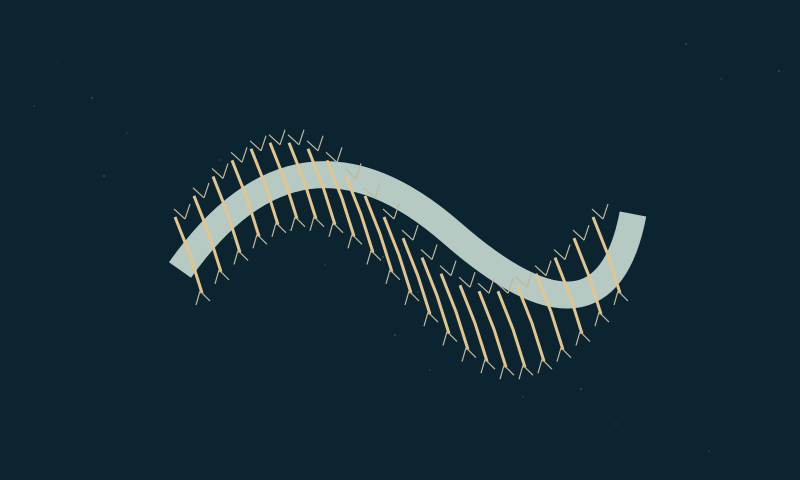
Tomopteris illustrates a different setting. It lives in open water rather than routinely resting on the seafloor, and its large parapodia act as swimming appendages. Researchers’ high-speed observations describe two motions working together: a flexible body wave travels forward toward the head, while parapodia paddle in a coordinated sequence. The legs provide much of the thrust; the body wave can extend them farther into water that has not already been disturbed by the animal. [2]
The parapodial paddles can also change shape. Their divided ends spread during the power stroke and narrow or angle during recovery, producing more resistance in one direction than the other. This is a mechanical explanation for how repeated strokes can move the worm forward despite the return motion of each leg. It is a measured account of Tomopteris swimming, not a template for every polychaete. [2]
Comparing movement carefully
A bottom-dwelling worm and a midwater swimmer face different surroundings. Sediment offers friction and places to brace; open water offers little support, so a swimmer must generate thrust continuously. Comparing a parapodium used to grip or crawl with one used as a paddle shows how related body parts can serve different jobs. It also explains why observing posture and movement matters as much as noting anatomy. [1]
In a hypothetical video, a worm that remains beside a tube while its appendages sweep through the current would suggest a stationary feeding strategy; a transparent animal repeatedly changing direction in the water column would suggest active swimming. Those observations would support different functional interpretations, but not establish a species identity. Polychaete diversity is best understood through such contrasts: shared segmentation, varied appendages, and lifestyles shaped by distinct habitats. [2]
Sources & further reading
Have a correction or a source to suggest? Send a note →