
Reading path: Types of sharks →
A closer look at the evidence
| Question or feature | Explanation | What it does not establish |
|---|---|---|
| Defining tail | The elongated upper tail lobe distinguishes thresher sharks; common threshers are described using it to strike and stun prey. [1] | The upper tail contributes roughly half of total length in pelagic threshers; distinguish total from precaudal length. [2] |
| Recorded hunting sequence | In pelagic threshers, observations were grouped into preparation, strike, recovery and prey collection; pectoral-fin movement altered pitch before an overhead strike. [2] | The study analyzed 25 hunts at one Philippine site; unsuccessful attempts were recorded too. [2] |
| Common-thresher diet and movement | Prey includes anchovies, sardines, hake, mackerel and squid; seasonal movement through the eastern North Pacific includes prey-rich coastal waters. [1] | These diet and movement details are for the common thresher, not automatically every thresher species. [1] |
| Reproduction | NOAA describes common threshers bearing two to four live pups. [1] | This litter description concerns common threshers and should not be applied automatically to the other thresher species. [1] |
A tail built to stand out
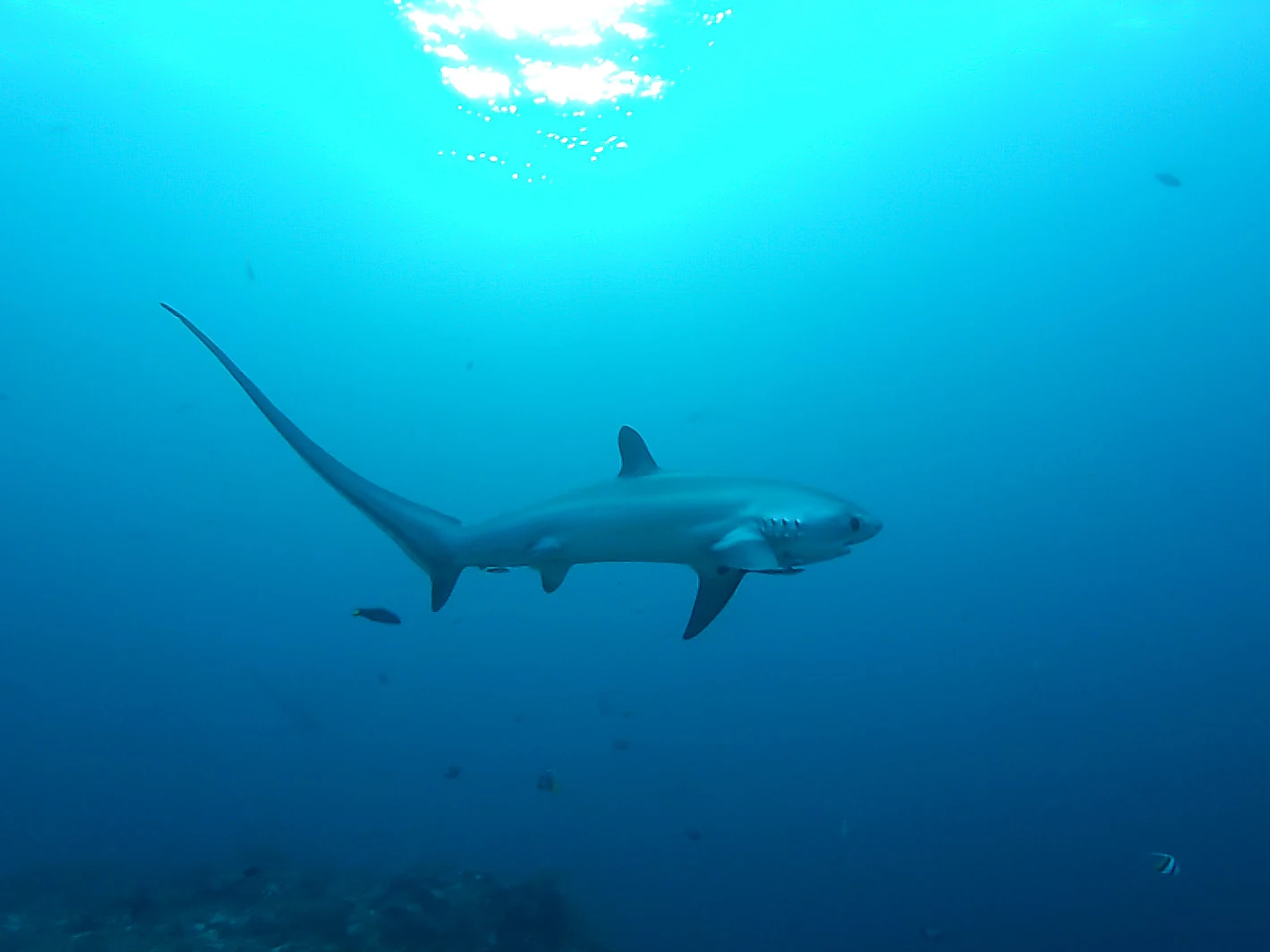
The defining feature of a thresher shark is its elongated upper tail lobe, which can be a conspicuous part of the animal’s outline. The name covers several species, including the common thresher (*Alopias vulpinus*) and the pelagic thresher (*A. pelagicus*). They should not be treated as interchangeable when describing a particular behavior or measurement: the detailed tail-slap study focused on pelagic threshers, while NOAA’s diet and migration account here concerns common threshers. [1] [2]
That distinction helps answer what the tail does. NOAA describes common threshers using the long tail to strike and stun prey. A video study provides a closer account of how pelagic threshers performed hunting strikes at Pescador Island in the Philippines. It offers evidence of a hunting method in a particular species and setting, not proof that every thresher uses the tail in exactly the same way. [1] [2]
From preparation to collection
Researchers recorded 61 observations of pelagic threshers from June through October 2010 and analyzed 25 hunting events. They divided the observed hunts into preparation, strike, recovery and prey collection. That sequence is more informative than a single dramatic tail movement: it connects posture and motion with what happened before and after the strike. [2]
As an overhead strike began, the shark drew its pectoral fins inward, changing its body pitch and lifting its rear body. The long tail then swept overhead. After recovering from the movement, the shark turned to collect fish. Some successful events left several sardines available after one strike, so the sequence could yield multiple prey before collection with the jaws. [2]
A useful evidence-reading exercise is to separate observed actions from explanations. The researchers recorded bubbles near some tail strikes, but a proposed gas-release explanation does not establish that the shark generated an explosive shock wave. Nor does a successful clip show that all attempts work: the study also recorded unsuccessful attempts. A tail movement on its own is not enough to identify a hunt without the surrounding behavior. [2]
What common threshers eat and where they travel
Common threshers eat small pelagic fishes, including anchovies, sardines, hake and mackerel, as well as squid. They migrate seasonally through the eastern North Pacific and often use coastal waters rich in prey. These facts fit the picture of a shark that encounters schools of fish, but the diet list does not mean every individual eats every listed prey in every place or season. [1]
The pelagic-thresher observations offer a concrete comparison within that broader picture. In the filmed events, one overhead strike could leave several sardines to collect, rather than requiring a separate jaw capture for each one. This is a description of observed events at one Philippine site, not a count of the usual number of prey per strike across the species. [2]
The exceptionally long tail also matters when measuring a thresher. In pelagic threshers, the elongated upper tail makes up roughly half the total length. A total-length measurement therefore includes a very different proportion of tail than it does in many other sharks. The hunting study distinguished total length from precaudal length, the measurement ending at the tail base. [2]
Interpreting the hunting tool carefully
The recorded hunts show that a long tail functions as more than a swimming structure: a change in pitch, a rapid overhead strike and recovery are followed by collection of dead or stunned fish when the attempt succeeds. Bubbles near some strikes prompted hypotheses about pressure and dissolved gas, but those proposals should remain distinct from the directly observed hunting sequence. [2]
Common, bigeye and pelagic threshers are separate species. NOAA’s common-thresher account describes prey and seasonal movement in the eastern North Pacific, while the 2013 study documents pelagic-thresher hunts at Pescador Island. Reproduction also needs a species label: NOAA describes common threshers bearing two to four live pups, a small litter that helps explain concern about replacing fishing losses. [1] [2]
Sources & further reading
Have a correction or a source to suggest? Send a note →