
Reading path: Types of sharks →
A closer look at the evidence
| Question or feature | Explanation | What it does not establish |
|---|---|---|
| Salinity range | Bull sharks use coastal marine waters and estuaries and can enter fresh water far upriver. [1] | Freshwater tolerance does not mean every river has bull sharks or identify a river shark as this species. [1] |
| Freshwater blood value | In one study, freshwater juveniles maintained about 595 milliosmoles per kilogram in blood versus about 3 in surrounding water. [2] | A controlled juvenile result, not a universal value across ages, sites or seasons. [2] |
| Seawater adjustment | After seawater acclimation, blood reached about 940 milliosmoles per kilogram; urea and trimethylamine oxide increased substantially. [2] | The reported value belongs to the study conditions and is slightly below its experimental seawater. [2] |
| Organ response | Rectal-gland salt-transport enzyme activity rose in seawater, while kidney activity was higher in freshwater animals. [2] | Predator avoidance and food supply were proposed explanations for upper-river habitat choice, not tested conclusions. [2] |
Recognizing the bull shark
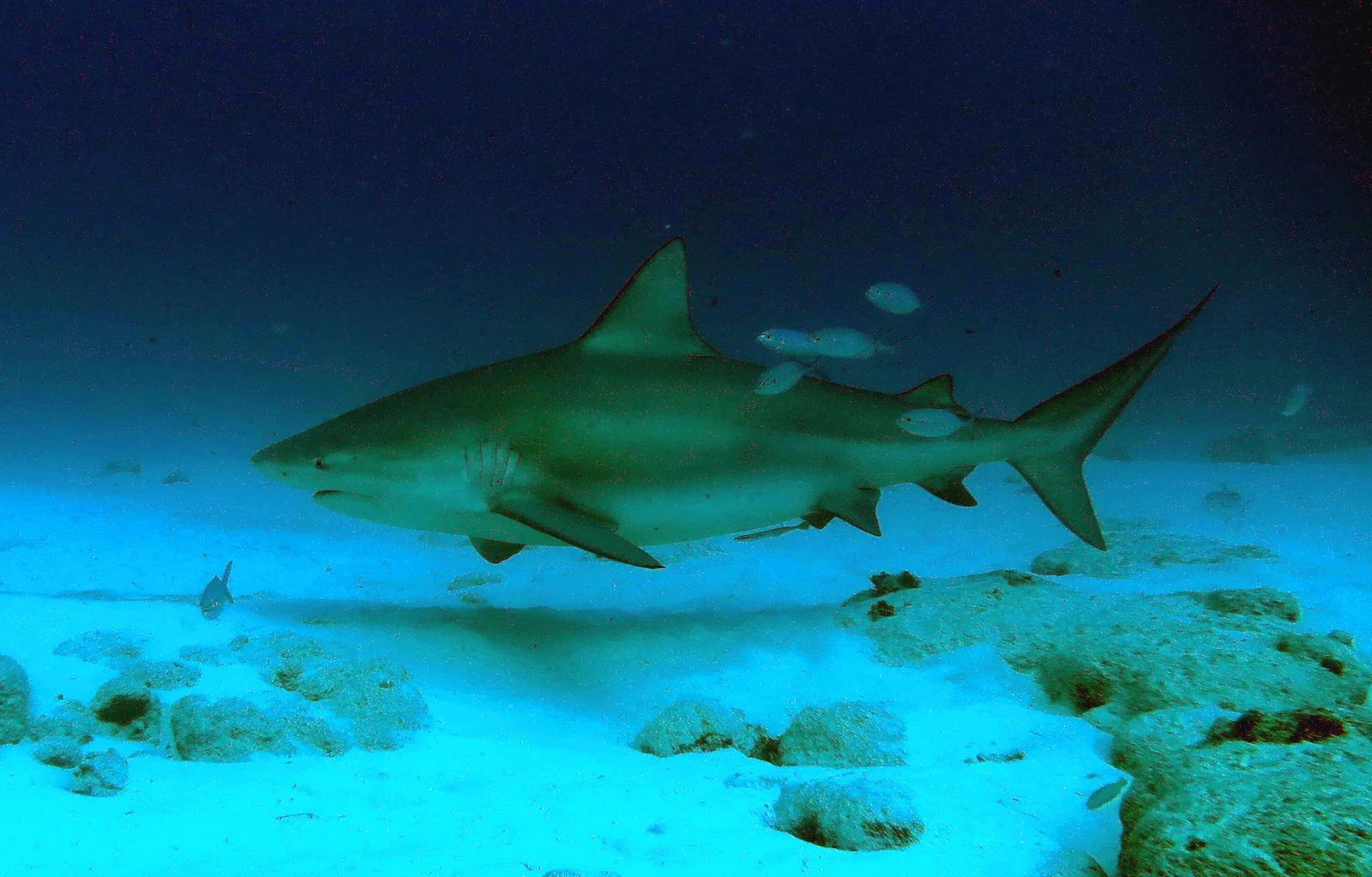
The bull shark, Carcharhinus leucas, has a stout body, broad rounded snout, small eyes, grey back and pale belly. It inhabits coastal marine water and estuaries, and can travel far upriver into fresh water. This combination of body form and habitat distinguishes the basic profile, but a river location alone cannot identify a shark. [1]
Freshwater tolerance is not unique proof of species identity. The genus Glyphis includes river sharks, so an animal reported from a river should not automatically be called a bull shark. In particular, the common name “Ganges shark” has been used for bull sharks but also refers to the distinct species Glyphis gangeticus. Scientific names prevent that ambiguity. [1]
The internal problem created by changing salinity
Water outside a shark’s body changes greatly between fresh water and seawater. In a controlled study, freshwater-caught juvenile bull sharks maintained blood at about 595 milliosmoles per kilogram while surrounding water measured about 3. The blood therefore remained far more concentrated than the very dilute freshwater. [2]
After acclimation to seawater, juveniles’ blood concentration rose to about 940 milliosmoles per kilogram, slightly below the experimental seawater. Urea and trimethylamine oxide showed especially large increases. Rather than passively matching the surrounding water, the sharks changed the concentration of dissolved substances in their blood. [2]
A numerical comparison makes the direction clear: in the freshwater condition, the measured blood value was about 595 versus about 3 outside; in the seawater-acclimated condition, blood was about 940 and slightly below seawater. These are values from one controlled juvenile study, not fixed targets for all ages, rivers or seasons. [2]
Organs adjust with the environment
The study also measured salt-transport enzyme activity in several organs. Activity rose in the rectal gland after seawater acclimation, while kidney activity was higher in freshwater-acclimated animals. These different responses show that salinity adjustment involves coordinated changes across organs, rather than one simple switch. [2]
The researchers acclimated freshwater-caught juveniles to seawater over 16 days. The resulting changes in blood solutes and organ activity demonstrate osmoregulatory plasticity: the same species can adjust its internal regulation across contrasting salinities. The experiment establishes physiological capacity under its conditions; it does not measure how quickly every wild shark can adjust during every movement. [2]
What river use may offer—and what remains a proposal
The bull shark’s broad habitat range includes sea, estuary and fresh water, and its documented food includes fishes, other sharks and several vertebrate groups. That opportunistic diet is consistent with access to varied aquatic habitats, but the evidence does not show that every river offers the same prey or that diet alone explains a shark’s location. [1]
The study proposed predator avoidance or food supply as possible explanations for bull sharks occupying upper rivers. Those were hypotheses about habitat choice, not results directly proven by the acclimation experiment. Its design showed that juveniles could enter seawater after freshwater capture; it did not test why individual sharks chose one reach over another. [2]
How to interpret a freshwater report
For a hypothetical report of a shark far upriver, separate three questions. First, is the animal actually identified as Carcharhinus leucas? A freshwater setting is compatible with bull sharks but is not enough to establish identity. Second, is the claim about capability or about a particular observation? The experiment supports juvenile physiological capacity, not a dated sighting. Third, what mechanism is relevant? The measured blood and organ adjustments explain how salinity transitions are possible, while leaving the animal’s reason for entering that reach open. [1] [2]
The figures should remain tied to the experimental conditions: juvenile animals, a controlled acclimation, and a 16-day transition. They are not measurements from every wild population, nor do they establish that bull sharks occur in every river. This evidence explains a physiological adaptation and its limits without turning habitat capability into a claim about any particular location. [2]
Sources & further reading
Have a correction or a source to suggest? Send a note →