
Reading path: Types of sharks →
A closer look at the evidence
| Question or feature | Explanation | What it does not establish |
|---|---|---|
| Identification | Conical snout, sharp dark-to-white boundary and broad triangular serrated teeth support white-shark identification. [1] | A dorsal-fin glimpse or size estimate alone is weak; makos and salmon sharks can be confused with white sharks. [1] |
| Senses | Lateral-line water-motion detection complements vision, smell and electric-field detection through ampullae of Lorenzini. [2] | These sensory capabilities do not identify a photographed shark or establish a detection distance. [2] |
| Newborn size | CDFW describes newborns as roughly 4–5 feet long. [1] | This is newborn length, not a typical adult measurement. [1] |
| Juvenile range | A study documented increased juvenile occurrence in Monterey Bay during and after the 2014–2016 heatwave. [3] | It focused largely on sharks under 2.5 metres and does not establish total population size or the cause of every movement. [3] |
Reading the body and its size
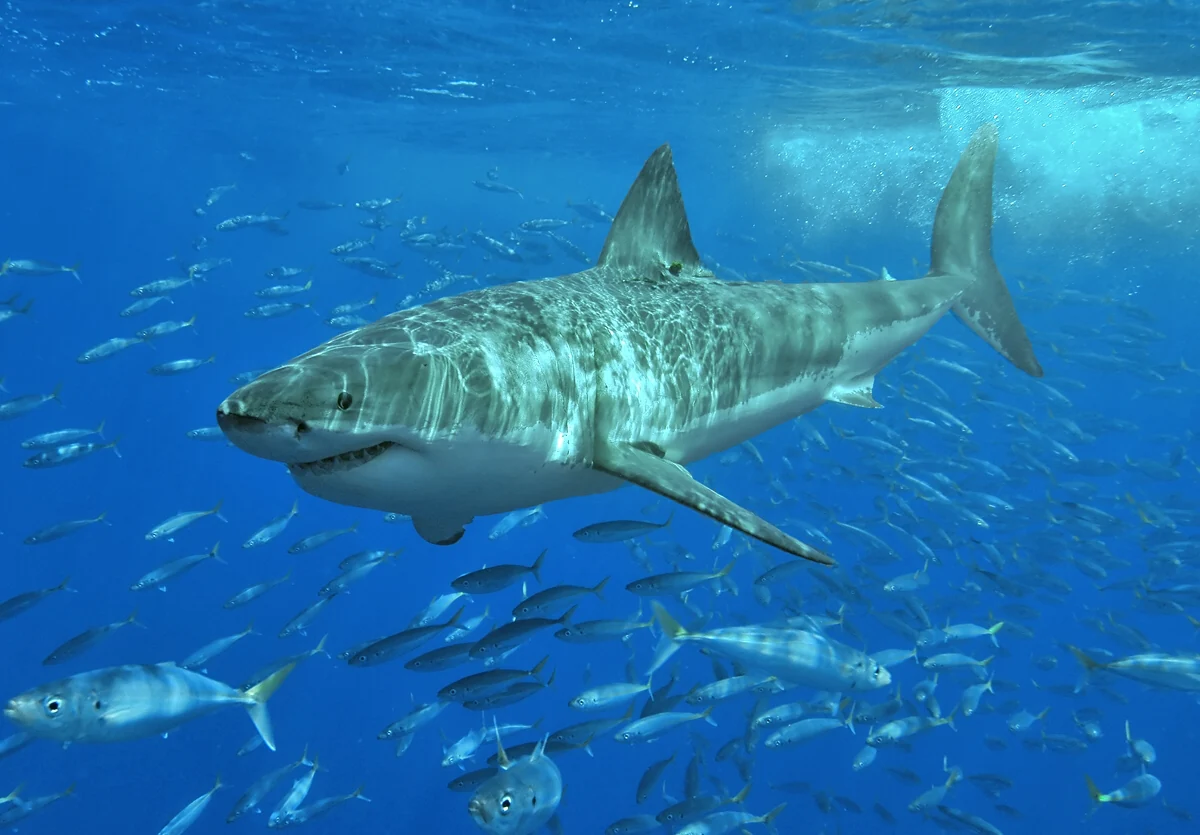
The white shark, Carcharodon carcharias, has a robust, streamlined body, a conical snout and a narrow tail stalk edged by lateral keels. A dark upper surface meets a white underside along a sharp boundary. These features together are more useful for identification than a glimpse of one fin. [1]
The teeth add a stronger clue when visible: white sharks have broad, triangular, serrated teeth. A mako’s teeth are narrower and smooth-edged, so tooth shape can separate the species more reliably than a rough size estimate. Makos and salmon sharks can otherwise be mistaken for white sharks. [1]
CDFW describes newborn white sharks as roughly 4–5 feet long. Even at birth they are substantial predatory fish. This figure describes a newborn, and should not be confused with an adult measurement or used to assign an exact age to a larger shark. [1]
How a shark detects what a picture cannot show
White sharks combine several senses to find and assess prey. Vision and smell work alongside the lateral line, which detects disturbances in the surrounding water. Near the snout, pores connect to ampullae of Lorenzini that detect weak electric fields associated with living prey. Each system provides a different kind of signal; electroreception does not mean the shark can identify prey species from an image or detect every animal at any distance. [2]
Consider a hypothetical identification exercise: a photograph shows a dark-backed shark, but its teeth are not visible. The color boundary and conical snout may support a white-shark identification, yet the image alone may not settle it. A broad, serrated triangular tooth would add useful support; a narrow, smooth-edged tooth would point toward a mako. Sensory abilities explain how an animal experiences its surroundings, but they cannot substitute for visible diagnostic anatomy in a photograph. [1] [2]
Diet changes as the shark grows
Juveniles typically eat fishes, rays and smaller sharks. Adults have a broader recorded diet that includes marine mammals and scavenged whale tissue. This life-stage pattern matters: describing the species with one short prey list can hide how its feeding changes as it grows. [1]
The diet evidence also does not mean every adult eats marine mammals, or that every juvenile eats each listed prey. It describes documented patterns, not a prediction for an individual shark. Likewise, scavenging whale tissue is part of the recorded adult diet, not evidence that all feeding involves active pursuit. [1]
Juvenile habitat and a regional range shift
Shallow Southern California waters are important juvenile habitat. Warmer conditions and accessible small prey, including stingrays, help explain why these coastal waters can serve young sharks. Habitat is not a permanent boundary, however: conditions and where juveniles occur can change. [1]
A 2021 study combined sightings, photographs, electronic tracking and modeled thermal habitat to investigate juvenile range change. It documented increased juvenile occurrence in Monterey Bay during and after the 2014–2016 marine heatwave, north of the previously usual juvenile range. The study focused on young sharks, largely under 2.5 metres; it was not a census of all white sharks in the northeastern Pacific. [3]
That result supports a regional change in juvenile occurrence, not a current population total. Nor does it prove that warming caused every individual movement. The study joined several kinds of evidence to examine a population-level pattern, while the precise cause of a particular shark’s presence remains unknown. [3]
What the evidence can and cannot settle
An observation of a shark, its estimated size and the study’s regional pattern answer different questions. A sighting can document presence; tracking can record movements of tagged individuals; modeled thermal habitat estimates suitable conditions. None alone is a complete count of animals. Read the juvenile range result as evidence about distribution and changing habitat use, rather than a claim about all ages or a new estimate of abundance. [3]
Scientists study white sharks through complementary methods. Photo-identification can recognize animals by scars, fin shapes and other markings, while electronic tags reveal the movements of tagged individuals. Those observations help describe habitat use, but a location record does not by itself establish age, maturity or the number of sharks occupying an entire ocean region. [1] [3]
Sources & further reading
Have a correction or a source to suggest? Send a note →