
Reading path: Types of sharks →
A closer look at the evidence
| Question or feature | Explanation | What it does not establish |
|---|---|---|
| Food and filtering | Plankton, fish eggs, small crustaceans and small schooling fishes are filtered from water moved through the mouth. [1] | The tiny teeth are not the principal food-catching apparatus or the filtering mesh. [1] |
| Water intake | Forward swimming and active suction can both move food-bearing water across filtering structures. [1] | These are two documented feeding modes; one mode should not be assumed to describe every feeding event. [1] |
| Individual recognition | Spot patterns were used to recognize sharks in the Ningaloo study. [2] | Recognition identifies an individual; it is not itself a length measurement. |
| Growth estimates | Models estimated different growth patterns and plateaus by sex. [2] | These estimates draw on a studied sample and aquarium data, not every adult worldwide. |
A shark built around a broad intake
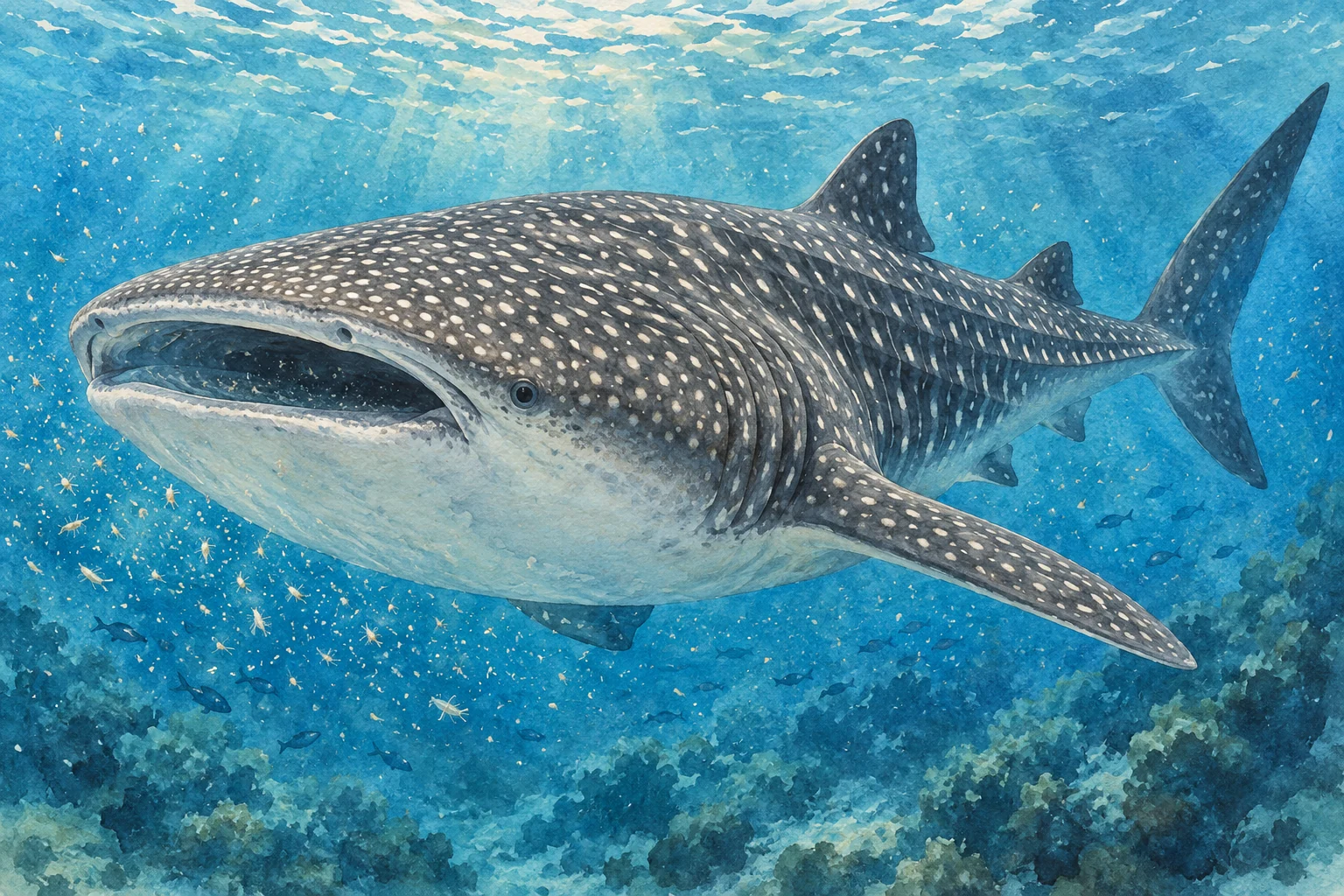
The whale shark (Rhincodon typus) is the largest living fish. Its name can obscure a basic distinction: it is a shark with gills, not a whale that must breathe air. Its broad, flattened head and mouth near the front create a different outline from that of many familiar predatory sharks. Pale spots and bars break up its dark back, and three prominent ridges extend along each side of its body. [1]
Those markings have a practical scientific use. Researchers can recognize individual sharks from their spot patterns, much as a distinctive pattern can distinguish one animal from another in repeated images. Spots help establish identity; they do not themselves provide a length measurement. [1] [2]
Moving prey-bearing water through the mouth
Whale sharks eat plankton, fish eggs, small crustaceans and small schooling fishes. The feeding process begins with water carrying potential food. A shark can swim forward to bring water through its mouth, and it can also use active suction to draw water in. Food is separated from water at filtering structures; the numerous tiny teeth are not the main apparatus for catching and processing these small food items. [1]
A whale shark’s broad mouth takes in water containing many small food items. Its filtering structures retain food while water leaves through the gill region. Forward swimming and active suction provide different ways to supply that flow; the tiny teeth are not the filtering mesh and do not perform the main food-catching role. [1]
How researchers distinguish size from identity
Size estimates become more informative when researchers know which animal they measured. A 2009–2019 Ningaloo study followed 54 sharks over 11 field seasons and used their spot patterns to recognize individuals. Researchers collected more than 1,000 stereo-video measurements and used them in growth models that differed between sexes. [2]
The method comparison is straightforward: paired, calibrated cameras provide measurements of a swimming shark, while its spots help researchers determine whether measurements from different years belong to the same shark. One method addresses size; the other addresses identity. A length measurement without reliable identity may be difficult to place in an individual growth history. [2]
For a hypothetical example, suppose paired images measure one identified shark in two field seasons. The lengths can be compared as observations of that individual, subject to measurement uncertainty. If the spot pattern instead belongs to a different shark, treating the two lengths as one animal’s growth would combine measurements from separate individuals. Reliable identification therefore matters as much as a good length measurement. [2]
Sex-specific growth models, not a universal ruler
The AIMS analysis modeled faster early growth and a plateau around 8–9 metres for males, and slower growth toward a larger plateau near 14 metres for females. These are model estimates based on the studied animals and additional aquarium data. They are not direct measurements of every adult whale shark or a global average for the species. [2]
The distinction matters when interpreting a large reported length. The release discusses record lengths separately from lengths directly measured in its 54-shark field sample. A reported maximum should not be silently treated as a confirmed field measurement from that sample, or as a typical adult size. The modeled plateaus likewise describe estimated growth patterns, not guaranteed endpoints for every individual. [2]
Reading a whale shark account carefully
When comparing claims about whale sharks, first ask what was measured, how the animal was identified, and whether a figure is a direct observation or model output. Then check whether the comparison separates males and females. A collection of lengths, an individual growth record and a modeled plateau answer different questions. [2]
Feeding anatomy and growth models answer different questions about this giant fish. The mouth and filtering structures explain how food is collected; repeated measurements help estimate how size changes through time. Neither a large mouth nor a single impressive length reveals an individual’s whole growth history, and the Ningaloo measurements are not a worldwide count of whale sharks. [1] [2]
Sources & further reading
Have a correction or a source to suggest? Send a note →