
Reading path: Rays and reef fish →
A closer look at the evidence
| Question or feature | Explanation | What it does not establish |
|---|---|---|
| Breathing at rest | Spiracles behind the eyes admit water to the gills while the ray rests on the bottom. [1] | This describes the southern stingray evidence; it does not establish identical details for all ray groups. |
| Prey detection and access | Snout electroreceptors help locate prey; the nose and flexible fins move sediment to uncover it. [1] | Sediment movement alone does not prove that prey was detected or captured. |
| Diet | Reported foods include shellfish, lobsters, crabs, and fish. [1] | Prey availability and individual feeding observations matter; this is not a fixed menu for every ray. |
| Tail spine | A venomous barb near the tail base serves defense. [2] | A calm appearance does not establish that handling is safe. |
A body built close to the bottom
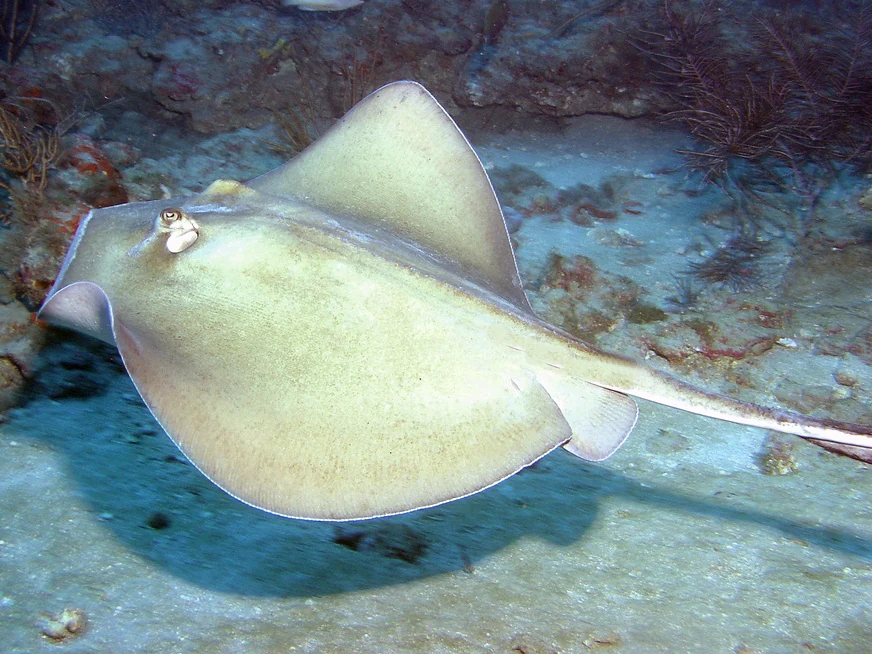
The southern stingray, *Hypanus americanus*, is a useful example of a bottom-associated ray. Its body forms a broad, flattened disc with an angular outline, an arrangement that keeps it close to the seafloor while it searches or rests. The shape is distinctive, but it does not by itself identify every ray: different groups have different feeding structures and defenses. [1] [2]
Southern stingrays occur in tropical and subtropical waters of the western Atlantic, including the Caribbean and Gulf. Those broad regional labels describe a range, not a precise location for an individual animal or a claim that it occupies every habitat within those waters. [1]
Breathing while partly buried
A stingray resting under sediment still needs water to pass over its gills. Spiracles behind the eyes admit water for breathing while the animal lies on the bottom. Their position and function help explain how a ray can rest buried without relying on water entering through its mouth at the sediment surface. [1]
In a hypothetical observation, suppose only the eyes and openings just behind them are visible above a shallow layer of sand. That pattern is consistent with a resting, partly buried ray, but the view alone cannot establish its activity or intent. A photograph records a moment; it does not prove that the ray is feeding, asleep, or safe to approach. [1]
Finding food under sand and mud
The snout has electroreceptors that help locate prey. Once prey is detected, the nose and flexible fins can shift sand or mud to expose it. These are complementary steps: sensing helps locate a target hidden from view, while movement of sediment makes it accessible. [1]
Southern stingrays eat shellfish, lobsters, crabs and fish. These prey categories fit the combination of sensory searching and sediment movement described above: hidden animals must first be located and then made accessible. The exact prey captured during a particular encounter still requires observation; a ray beside a crab has not necessarily eaten it. [1]
A practical evidence check is to distinguish movement from a confirmed meal. If a ray sweeps sediment, the behavior may be feeding; visible prey exposure or capture is stronger evidence. Record what can be seen, such as sediment displacement or prey capture, instead of assigning a motive from a single image. [1]
A defensive tail, not a feeding tool
A venomous barb near the tail base is a defense. The ray's calm appearance does not make the spine harmless, and the tail should not be described as the structure that finds or uncovers prey. The feeding evidence instead points to electroreceptors on the snout and flexible parts of the body that move sediment. [2] [1]
A ray can look calm while retaining an effective defense. FWC describes southern stingrays as normally unaggressive, but that description does not remove the injury risk from a defensive spine. Observing the animal’s disc, spiracles and feeding movements requires no contact with the body or tail. [2]
Reading a sighting carefully
To describe a southern stingray observation, note the angular disc, whether the animal is buried, and whether sediment is actively being moved. If the spiracles are visible, their position behind the eyes helps distinguish them from the eyes themselves. Then describe any visible prey exposure or capture separately from the inference that the animal is feeding. [1]
For example, a hypothetical field note might read: “Angular disc partly covered in sand; openings behind eyes visible; one fin moved sediment; no prey seen.” That wording preserves what was observed without claiming a meal or inferring the ray's intent. It also avoids treating a species example as a description of every stingray. [1] [2]
Sources & further reading
Have a correction or a source to suggest? Send a note →