
Reading path: Rays and reef fish →
A closer look at the evidence
| Question or feature | Explanation | What it does not establish |
|---|---|---|
| Filter feeding | Cephalic fins channel water and prey toward the mouth; gill structures retain prey. [1] | Diet commonly includes planktonic animals, with some small-fish feeding also observed. |
| Ventral spot pattern | A clear underside pattern can support matching an individual to photo-ID records. [1] | Poor image quality or missing records can prevent a reliable match. |
| Deep dives | Tagging has documented dives deeper than 1,000 metres. [1] | A recorded deep dive is not a typical feeding depth. |
| Atlantic species records | Mobula yarae was recognized as a third manta species in 2025. [3] [2] | Some older Atlantic labels may need reassessment; do not assume every record’s identity. |
How the manta feeds
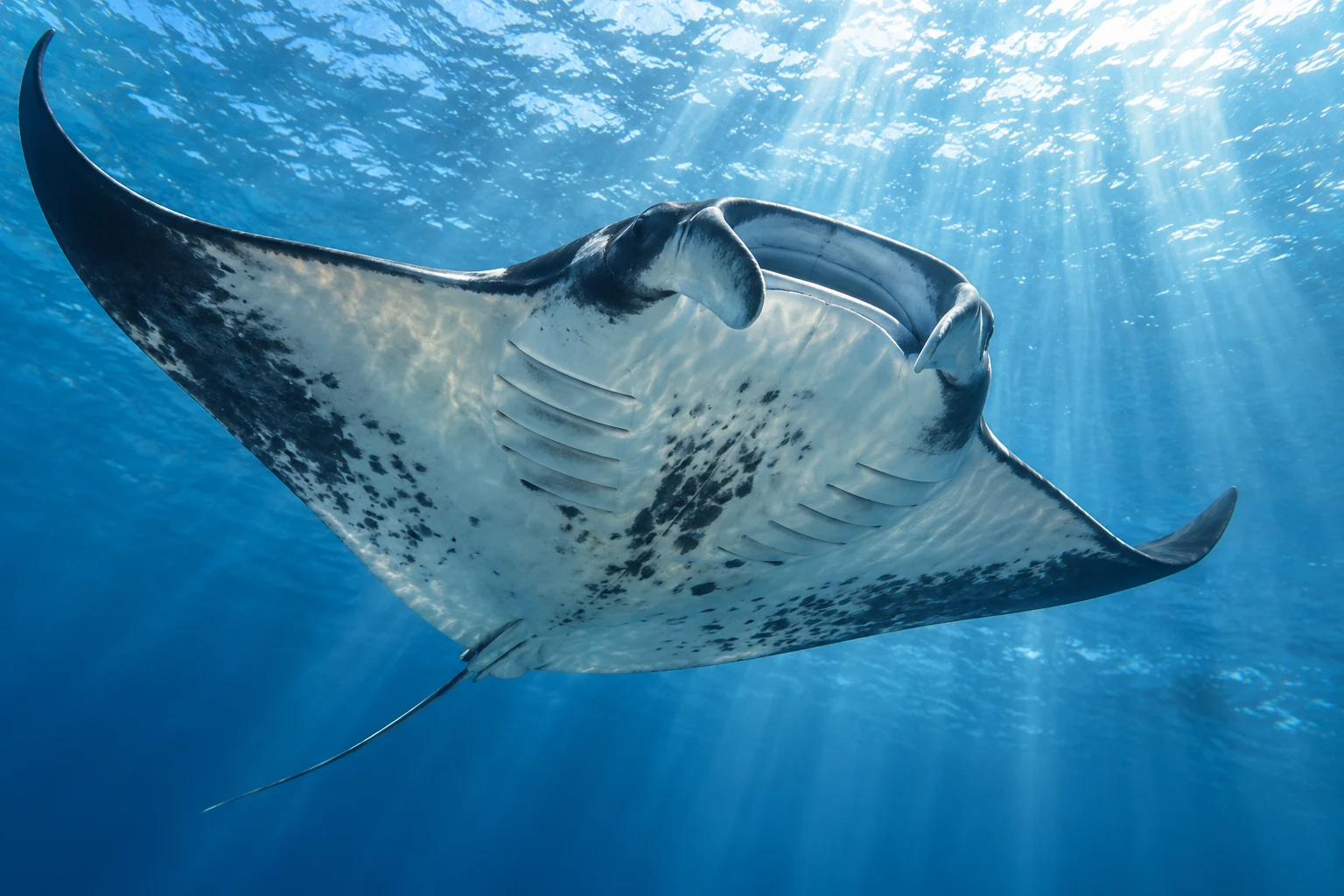
The oceanic or giant manta ray is Mobula birostris. Broad pectoral fins give it a wing-like outline, and paired cephalic fins beside the mouth help direct water and prey inward. Gill filtering structures retain prey as water passes through. [1]
Common prey include copepods, euphausiids and other planktonic animals. Some feeding observations also include small fish, so “filter feeder” does not mean the documented diet consists exclusively of microscopic organisms. The method depends on both water flow and prey moving through the mouth and filtering apparatus. [1]
Feeding behavior can include barrel rolls and coordinated feeding chains. These are observed strategies, not a complete list of every way a manta feeds. The account describes varied feeding and diving behavior, so a single maneuver should not be treated as universal. [1]
Read markings at the right level
Distinct spots on the underside can support photo identification of individual manta rays. The useful comparison is between a clear belly image and an individual record: the spot arrangement can function as a visual pattern for matching. Image quality and a supporting record matter; an indistinct photograph may not support a reliable match. [1]
Individual identification is not the same as species identification. A hypothetical researcher could match a clear underside pattern to a known individual while still needing morphology and geographic context to assess which species it belongs to. Size alone is not a species diagnosis. [1] [2]
Movement across depths
Tagging has documented substantial variation in diving, including dives deeper than 1,000 metres. That figure demonstrates the capacity recorded in tagged animals; it does not establish a typical feeding depth, and it is not a reason to approach or follow a manta. Other observations include varied strategies, rather than a fixed depth routine. [1]
A useful evidence-reading exercise is to separate the claim “tagged animals have dived beyond 1,000 metres” from the different claim “giant mantas usually feed at that depth.” The first is supported; the second is not established by a maximum or notable tagged record. [1]
A changed Atlantic species picture
The older NOAA overview still describes two manta species, but a third species, Mobula yarae, was formally recognized in 2025. That update changes how some Atlantic records should be interpreted. Older photographs labeled M. birostris may need reassessment, especially where the original identification did not account for the new species. [3] [2]
The Atlantic manta species account describes a diagnosis using morphology and genetics and notes limits in older Atlantic records. A historic Florida image carrying the older name cannot simply be treated as confirmed M. birostris after the split. The new recognition is not proof that every old record belongs to M. yarae; reassessment requires evidence. [2]
Feeding risks and observation limits
Bycatch is a documented threat to giant manta rays: fishing operations can capture animals that were not the intended target. The consequences depend on the fishery and encounter, so a sighting of a healthy ray does not establish how often animals in that region interact with fishing gear. Threat assessment requires information beyond the appearance of one animal. [1]
When interpreting a sighting, keep three questions separate: whether the underside pattern matches an individual record, whether morphology and location support a species identification, and what a tag or feeding observation says about behavior. A single image or depth record may answer one question well and leave the others open. [1] [2]
Sources & further reading
Have a correction or a source to suggest? Send a note →