
Reading path: Rays and reef fish →
A closer look at the evidence
| Question or feature | Explanation | What it does not establish |
|---|---|---|
| Atlantic species | The invasion involves Pterois volitans and P. miles; both are Indo-Pacific natives, and P. miles is also associated with the Red Sea. [1] | Individual sightings still require identification; the invasion involves two closely related species. |
| Diet and impact | Lionfish consume small fish and crustaceans, including juvenile reef fishes. [2] | A local count or feeding observation cannot establish the impact across the entire Atlantic. |
| Venomous spines | Spines can injure people and potential predators. [1] | This does not establish food safety or give medical treatment guidance. |
| Targeted removals | Repeated removals can reduce impacts at local sites. [1] | They are not expected to eradicate the established western Atlantic population. [2] |
Two species, one expanding range
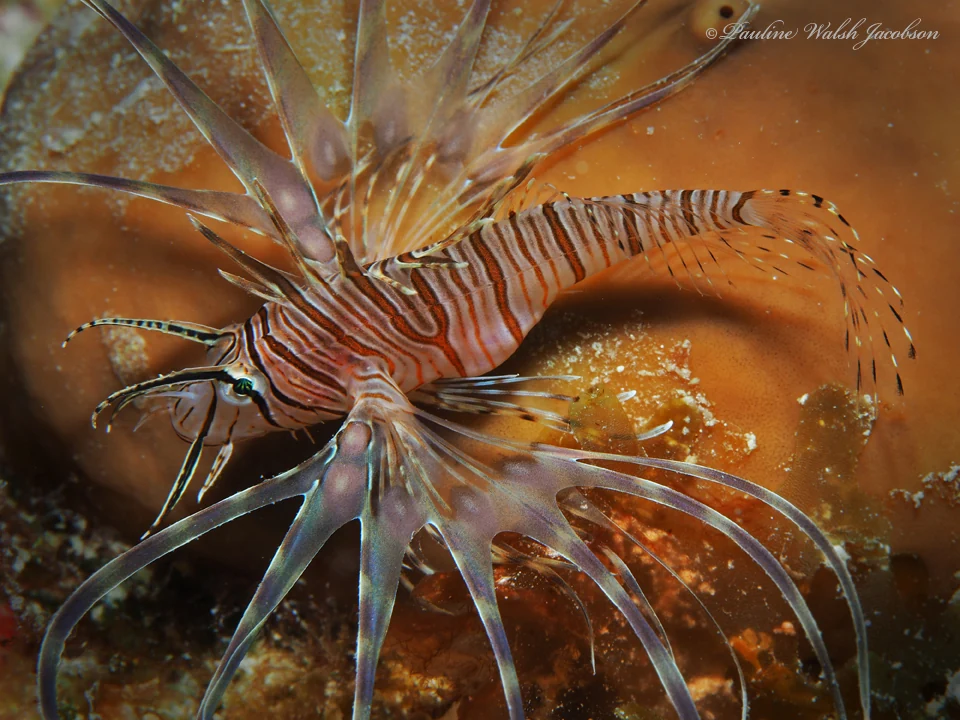
The Atlantic invasion involves two related lionfishes, <i>Pterois volitans</i> and <i>Pterois miles</i>. Both are native to the Indo-Pacific; <i>P. miles</i> is also associated with the Red Sea. In the western Atlantic they are established along the southeastern United States, through the Caribbean and in the Gulf. This is a broad regional distribution, not evidence that every reef or coastline has the same density. [1] [2]
A western Atlantic specimen was recorded near Dania, Florida, in 1985. That record marks an early documented occurrence; it does not pinpoint the release that began the invasion or prove that the fish was the first one present. The precise introduction pathway remains unresolved. Aquarium releases are considered likely, but the evidence does not support assigning the whole invasion to one escape or storm. [1] [2]
That distinction matters when reading an invasion timeline. A first recorded specimen is a dated observation, while an origin story explains how animals arrived. The first can be reported with a place and year; the second remains uncertain here. The species’ native range and current establishment describe different geographic facts and should not be collapsed into a claim that the lionfish naturally migrated into the Atlantic. [1] [2]
How a reef predator affects its prey
Lionfish eat small fish and crustaceans, including juvenile reef fishes. Consuming young fish can affect the reef community and the supply of animals that survive to larger sizes. A local impact assessment must account for lionfish abundance, prey availability and the site being surveyed; the appearance of one lionfish cannot reveal that effect. [2]
Consider a hypothetical reef survey that finds fewer lionfish after repeated targeted removals. That result supports local control at the surveyed site. It does not establish that the wider Atlantic invasion has ended: other connected habitats may remain occupied and can supply fish back to the area. A useful report records the site, survey date, number seen and number removed, because a count without location or method is difficult to compare. [1] [2]
This also separates ecological effect from eradication. Local removals can reduce impacts where they are repeated, yet conventional methods are not expected to eliminate the established western Atlantic population. The scale of the goal should match the scale of the evidence: a reef-level count can describe that reef, not the entire basin. [1] [2]
Spines and venom: what the warning means
Lionfish have venomous spines that can injure people and potential predators. Contact with a spine can deliver venom, making capture and handling hazardous. Recognizing the fish is useful for observation and reporting, but it is not a reason to touch it or attempt an improvised removal. [1]
Venom delivered by a spine is distinct from food-borne toxins. The fact that a fish has venomous spines does not, by itself, prove that its flesh is unsafe to eat, nor does it guarantee that any particular preparation is safe. Those are separate questions requiring food-safety evidence. Likewise, a predator’s exposure to a spine is not the same as eating the fish. [2]
For practical observation, keep distance and use a qualified local response program for any removal. Rules differ by jurisdiction; collection in Flower Garden Banks National Marine Sanctuary may require permits and specialist handling. A general account of lionfish control cannot establish what a visitor may legally collect at a particular site. [1]
From first records to targeted control
The first recorded lionfish sighting in Flower Garden Banks National Marine Sanctuary was at Stetson Bank in July 2011. This is a sanctuary-specific observation, not the date the species first entered the western Atlantic. It also should not be presented as a live report of current abundance: the cited fact is a historical first observation. [1]
Targeted removals can reduce lionfish impacts at local sites, which makes them a management tool rather than a promise of basin-wide eradication. In an evidence-reading exercise, compare two claims: “repeated removals lowered the count on this reef” and “the Atlantic population has been eliminated.” The first can follow from a suitably documented local survey; the second does not follow from it. Surveys need comparable effort and clear site boundaries to support even the local comparison. [1] [2]
The strongest account keeps four details separate: which lionfish species are involved, where they are native and established, what a dated record actually documents, and what a removal effort can achieve at its own site. The route of introduction remains uncertain, local control is possible, and conventional eradication is not expected. These statements can all be true at once. [1] [2]
Sources & further reading
Have a correction or a source to suggest? Send a note →