
Reading path: Rays and reef fish →
A closer look at the evidence
| Question or feature | Explanation | What it does not establish |
|---|---|---|
| Swimming | Dorsal and pectoral fins support swimming and maneuvering. [3] | The sources describe weak swimming, not an inability to swim. [2] |
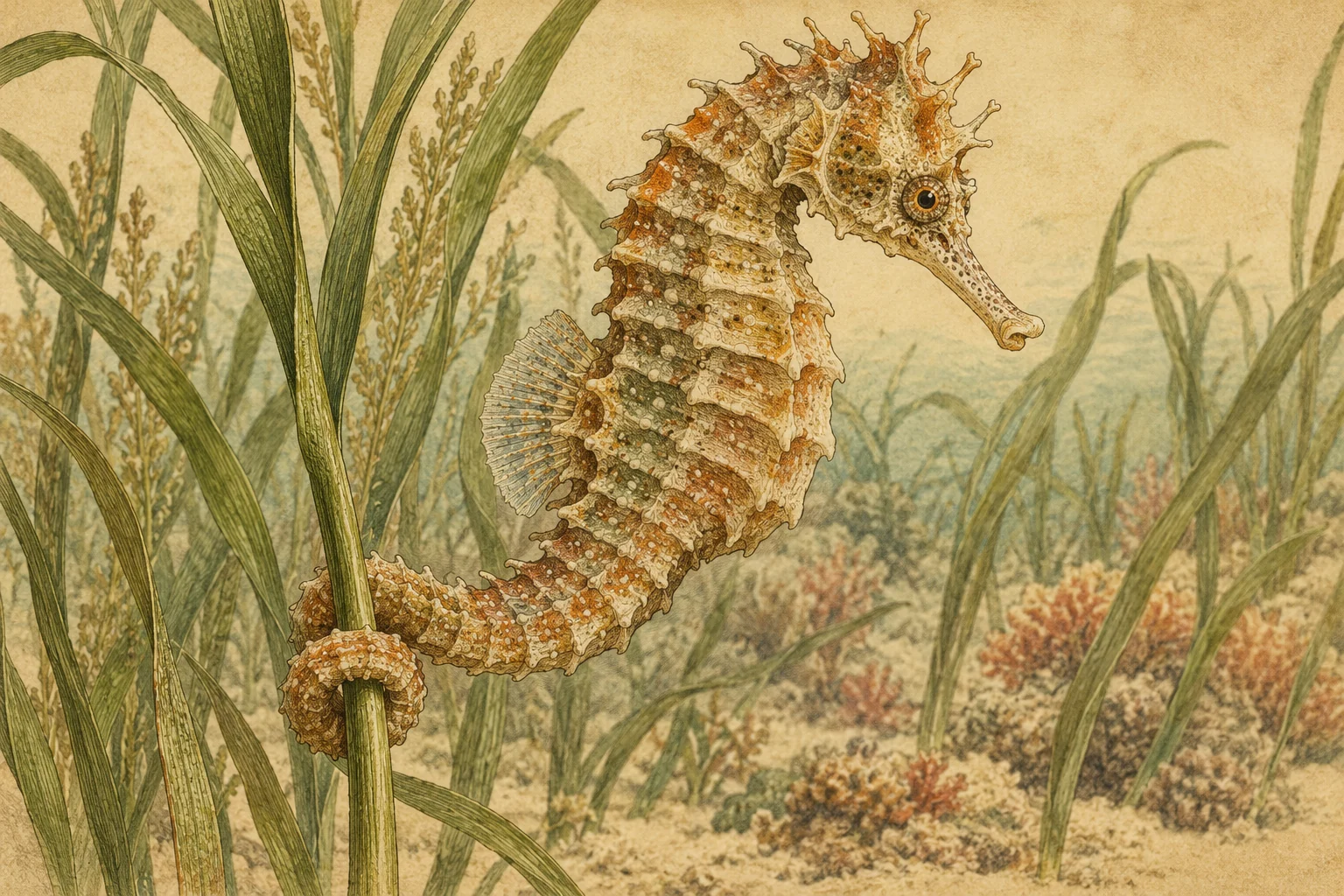
| Tail grip | A muscular prehensile tail coils around anchors such as seagrass, coral, and sponges. [2] | A grip is temporary; seahorses can release it and move. |
| Male pregnancy | The female transfers mature eggs into the male's brood pouch; the male carries developing young and gives birth by muscular contractions. [1] | Gestation and brood size vary among species and conditions. |
| Camouflage | Skin chromatophores contribute to color changes and camouflage. [1] | A photograph alone cannot show the speed, trigger, or effectiveness of a color change. |
Fish with a different swimming plan
Seahorses are fishes in the same family as pipefishes. Their bodies are relatively stiff because of bony armor, and they lack the usual tail fin found at the end of many fish bodies. They can swim, but their swimming is weak compared with sustained, powerful swimmers. [1] [2]
A dorsal fin and pectoral fins provide swimming and maneuvering. The muscular tail has a different job: it can curl around a suitable anchor such as seagrass, coral, or a sponge. The tail grip lets the animal hold position rather than relying on strong swimming to resist moving water. [3] [2]
Holding position while feeding
The contrast between fin movement and tail grip is easiest to see as two tasks. Small fins help a seahorse move and maneuver; a coiled tail helps it remain in place. A strong grip can be useful while feeding in current because the animal is less likely to be displaced from its chosen position. [2]
In a clearly hypothetical example, imagine a seahorse gripping a seagrass stem as water moves past. The fins still allow limited movement, but the tail supplies the anchor. This does not mean the animal is permanently attached: it can release its grip and swim elsewhere. [2] [3]
A tail wrapped around a stem demonstrates a grip at that moment. It does not mean the fish is permanently attached. The same muscular tail can release one anchor and coil around another, while the fins supply movement between positions. Anchoring and swimming are complementary parts of the seahorse’s behavior. [2] [3]
Male pregnancy, step by step
In seahorses, the female transfers mature eggs into the male's brood pouch. Fertilization and development take place in connection with that pouch, and the male carries the developing offspring before giving birth through muscular contractions. The sequence identifies the male as the carrier and birthing parent, while the female supplies the eggs. [1]
After release, the young must feed and survive independently. The pouch therefore provides a stage of parental carrying, but the evidence does not imply that the male continues to care for the young after birth. Brood size and gestation differ among species and conditions, so a general account should not turn one species' figures into a rule for all seahorses. [1]
Male pregnancy also occurs in related pipefishes and sea dragons. A controlled breeding study in Gulf pipefish, Syngnathus scovelli, documents another member of the family in which males carry developing broods. This broader comparison explains why pregnancy is not exclusive to seahorses, while leaving room for differences in reproductive anatomy among species. [4]
Color change and camouflage
Skin chromatophores contribute to changes in color and camouflage. A color match can make a seahorse harder to distinguish from nearby vegetation or other cover. The match is an observation about that animal and background, however; it does not mean the fish becomes invisible or can match every surrounding surface equally well. [1]
A hypothetical evidence-reading exercise: a photograph shows a seahorse whose color resembles a nearby plant. The image supports the observation that the colors are similar at that moment. It cannot, by itself, establish how quickly the fish changed color, whether it changed specifically in response to that plant, or how effective the match is against predators. [1]
Read the limits of a behavior claim
A seahorse gripping a stem is using its tail as an anchor; a seahorse swimming is using its fins to maneuver. These behaviors fit an animal with weak swimming, not an animal incapable of movement. Likewise, a male carrying developing young is evidence of brood-pouch pregnancy, while the released juveniles' independent survival is a separate life stage. [2] [3] [1]
Gestation and brood size vary among seahorse species and with conditions. A description of one brood should identify its species and distinguish egg transfer, development in the pouch and the release of young. These are successive stages: the female supplies the eggs, while the male carries developing offspring and gives birth. [1]
Sources & further reading
Have a correction or a source to suggest? Send a note →