
Reading path: Types of sharks →
A closer look at the evidence
| Question or feature | Explanation | What it does not establish |
|---|---|---|
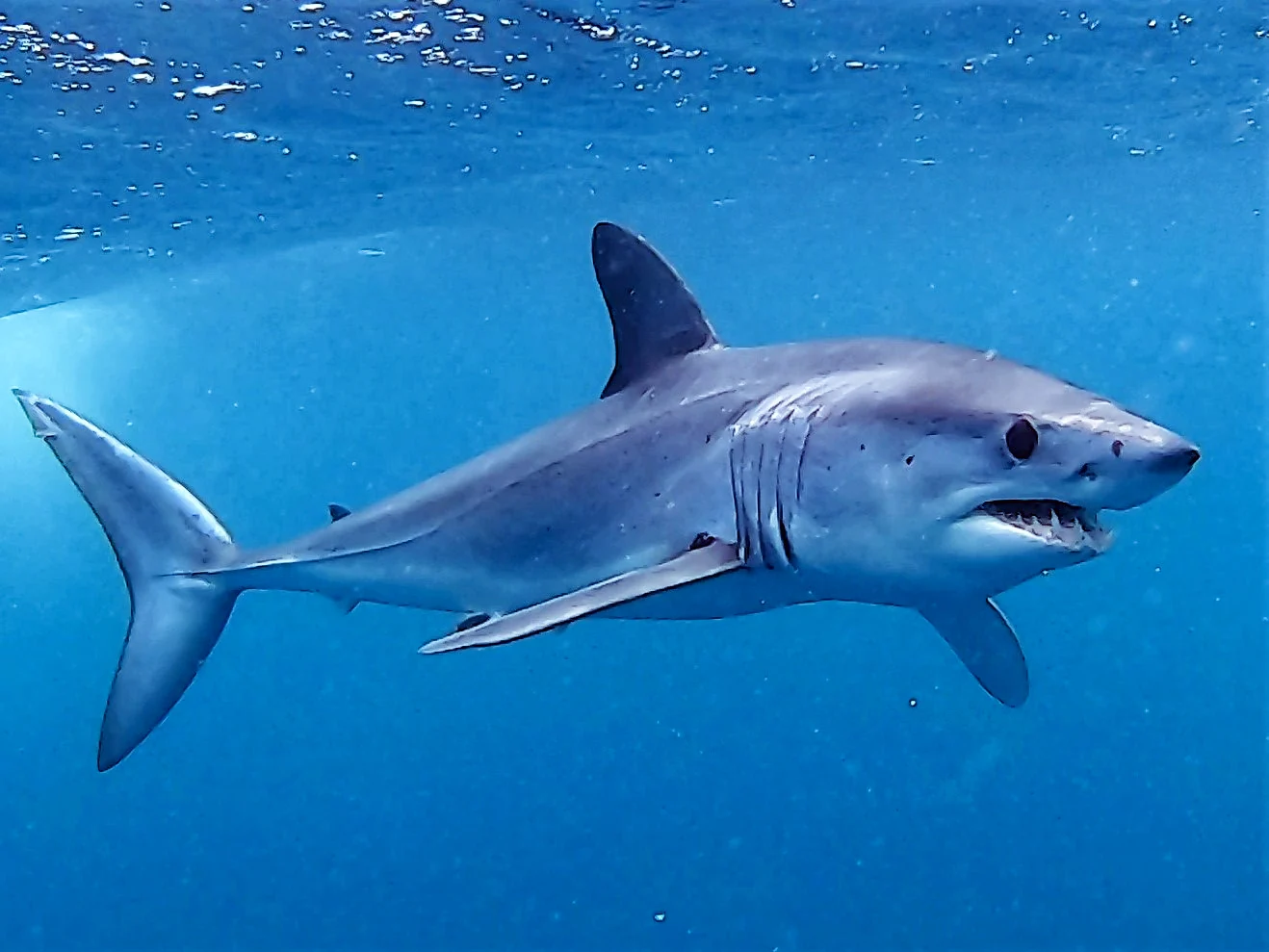
| Identification | Pointed snout, metallic blue back, pale underside, crescent tail and strong tail-base keel; long narrow smooth-edged teeth. [1] | A partial or unclear view may hide distinguishing features; longfin makos differ in snout underside color and pectoral-fin length. [1] |
| Regional endothermy | Deep red swimming muscles and countercurrent vessels retain heat in selected body regions. [2] | Does not mean all tissues are equally warm. [2] |
| Swimming evidence | Accelerometers and animal-borne instruments measure activity in free-ranging sharks. [2] | Avoid a universal speed maximum; methods, burst duration and behavior matter. [2] |
| Fishing pressure | Targeted and incidental pelagic-fishery catches concern a species with a slow reproductive schedule. [3] | Assessments differ among ocean regions; a 2022 US ESA decision is not a global population verdict. [3] |
Recognize the shortfin mako
The shortfin mako (Isurus oxyrinchus) lives in tropical and temperate oceans and travels through both coastal and offshore waters. Its streamlined shape includes a pointed snout, metallic blue back and white underside. The crescent-shaped tail and strong lateral keel at its base are additional parts of the profile. [1]
Teeth offer a more detailed comparison with another large shark. Shortfin makos have long, narrow, recurved teeth with smooth edges; white sharks have broad triangular teeth with serrated edges. The underside of the mako’s snout is pale. Longfin makos tend to have darker coloration there and longer pectoral fins. These features work together more reliably than a general impression of a fast, blue shark. [1]
For a hypothetical identification exercise, suppose a clear image shows a pointed snout, pale underside, crescent tail and narrow smooth-edged teeth. Those details support shortfin mako identification. If the pectoral fins are conspicuously longer and the snout underside darker, the comparison with a longfin mako deserves attention. A single blurred view may not show enough to decide. [1]
How heat stays in working muscles
Shortfin makos have deep red swimming muscles and countercurrent blood-vessel networks that retain metabolic heat in selected regions. In a countercurrent arrangement, blood vessels carrying heat in opposite directions exchange energy, reducing how quickly warmth is lost to surrounding seawater. The result is regional endothermy: muscles and other tissues can remain warmer than ambient water. [2]
That does not mean every part of the shark is equally warm. The evidence describes selected body regions, so “warm-bodied” should not be taken to mean uniform internal temperature. This physiological system helps explain why a mako can sustain active swimming in ocean water, but it does not establish one universal top speed. [2]
Speed claims depend on how swimming is measured, how long a burst lasts and what an individual is doing. Accelerometers and other animal-borne instruments can measure activity in free-ranging sharks, improving on speed figures based only on anecdotes. Yet instrumented activity is still bounded by the individuals, conditions and behaviors actually recorded. [2]
Pelagic prey and a slow replacement rate
Shortfin makos eat active pelagic prey, including fishes and squid. The status review describes slow reproductive schedules that limit how quickly the species can replace losses from fishing. That combination—mobile prey and limited replacement—helps explain why fishing pressure is a conservation concern even when individual sharks range widely. [3]
Targeted catches and incidental capture in pelagic fisheries are both identified as major concerns. Incidental capture matters because a shark can be caught in a fishery aimed at other species. These pressures should be discussed alongside reproduction and prey, rather than treating speed or wide-ranging movement as protection from fishing losses. [3]
A key caveat is geographic scale. Assessments differ among ocean regions, and fishing measures should retain their basin and date labels. A result for one region cannot automatically describe every population worldwide. Similarly, a 2022 US decision not to list the species under the Endangered Species Act was a particular legal finding; it does not establish that every regional population is healthy. [3]
Keep performance, identification and status distinct
The evidence answers three different questions. Body shape and teeth help identify a shortfin mako; countercurrent vessels and red muscle explain regional heat retention; fishery assessments describe conservation concerns. None substitutes for the others. For example, the smooth-edged teeth distinguish the mako from a white shark, while the documented heat-retention anatomy explains physiology rather than species identity. [1] [2]
A careful account of swimming should state what was measured and avoid attaching a universal maximum to the species. A careful account of fisheries should name the ocean region and assessment period, rather than implying conditions are unchanged worldwide. And a legal decision in the United States should remain within that jurisdiction and decision context. [2] [3]
Together, the documented traits describe a shark built for active life in open-water systems, but they do not justify turning an anecdotal burst into a species record or one regional assessment into a global verdict. Keep the anatomical clues, the measured behavior and the fishery evidence in their proper frames. [1] [2] [3]
Sources & further reading
Have a correction or a source to suggest? Send a note →