
Reading path: Rays and reef fish →
A closer look at the evidence
| Question or feature | Explanation | What it does not establish |
|---|---|---|
| Inflation | Tetraodontidae puffers inflate by swallowing water. [1] | Shared inflation behavior does not make puffers and porcupinefishes the same family. |
| Beak and fins | Four fused dental units form the beak; dorsal and anal fins are rearward, and pelvic fins are absent. [1] | These features do not constitute a complete species key. |
| Surface spines | Many puffers have small spinules; large prominent spines characterize a different family, porcupinefishes. [1] | The museum’s surface-air warning concerns porcupinefishes specifically. [2] |
| Toxin variation | TTX and saxitoxin risks vary by species, tissue and region; Indian River Lagoon southern puffers are a documented saxitoxin example. [3] [4] | No general preparation method or universal toxin status is established. |
Inflation and the body plan
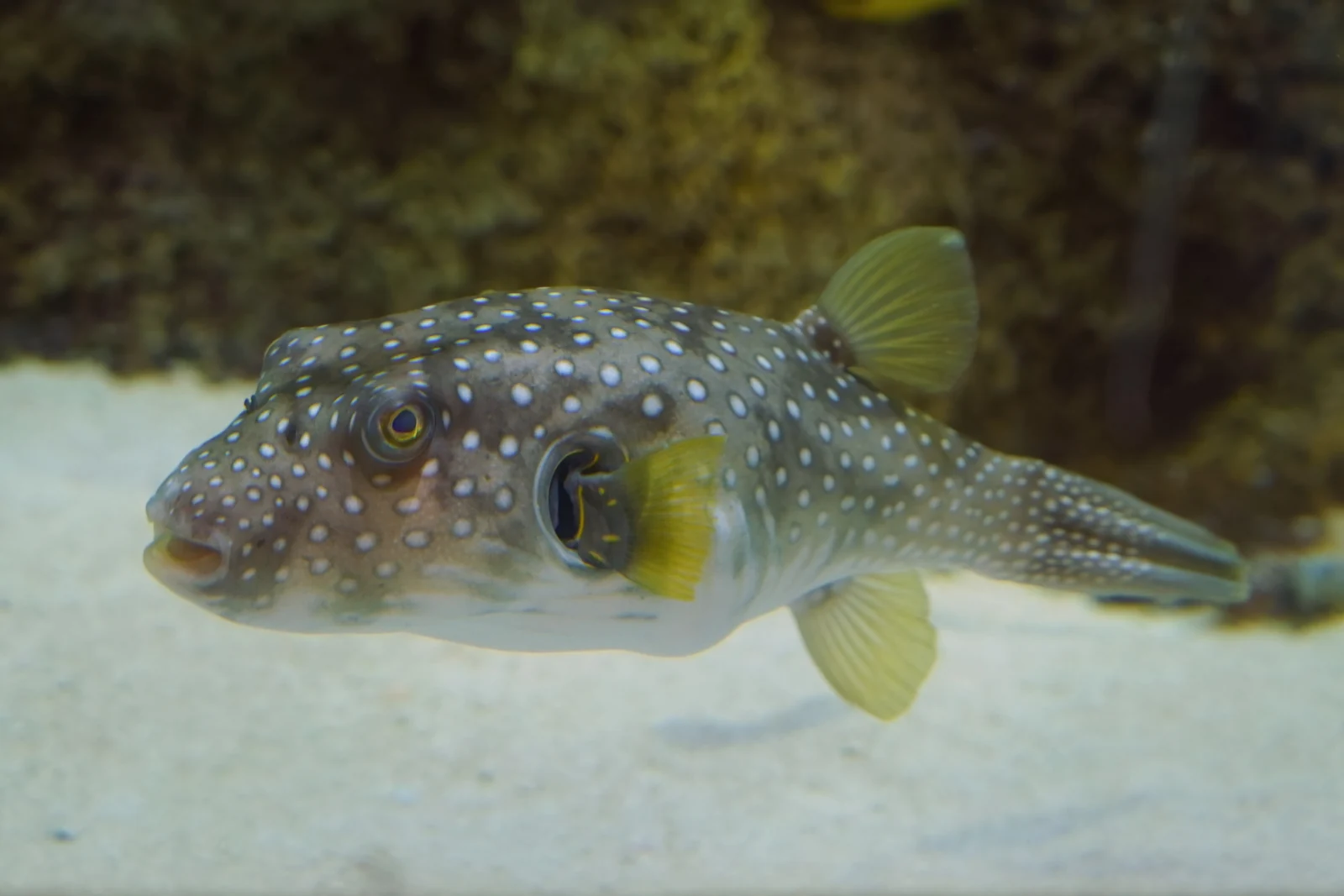
Pufferfishes in the family Tetraodontidae can inflate by swallowing water. The resulting change in shape is a defensive response. Inflation is a behavior of the animal, while its beak, fin placement and skin structures provide additional anatomical clues to its identity. A rounded outline alone is not a complete species identification. [1]
Their beak is made of four fused dental units, with a central division in each jaw. The dorsal and anal fins sit toward the rear of the body, and pufferfishes lack pelvic fins. Together these features give a practical anatomy-based description: look for the fused beak and rear-positioned fins rather than assuming that a rounded body alone identifies a puffer. [1]
Many puffers have small skin spinules. Porcupinefishes, in a different family, have the large prominent spines that are often confused with them. This distinction matters in both identification and advice: evidence specifically about porcupinefish should not be presented as if it were a direct experiment on all Tetraodontidae. [1] [2]
A comparison that prevents a family mix-up
A simple evidence-reading exercise is to compare the described surface structures. Small spinules on many puffers fit Tetraodontidae; large conspicuous spines point to the separate porcupinefish family. The shared capacity to inflate does not erase the taxonomic difference. The Australian Museum’s account of water underwater and air at the surface addresses porcupinefish inflation, so it cannot establish a universal pufferfish handling rule. [1] [2]
That museum account warns that air ingestion at the surface can cause buoyancy problems in porcupinefishes and says there is no fixed lifetime number of inflations. It is not a reason to provoke a fish for a photograph or to handle one to test its response. Nor does “no fixed number” mean repeated inflation is harmless under every circumstance; the source’s example and limits are specific to porcupinefishes. [2]
For a field description, note the visible body outline, skin texture and fin placement without inducing inflation or handling the fish. A beak can help distinguish this feeding anatomy from ordinary separate teeth. Those features are useful together, while identifying a particular species still requires its diagnostic markings and structures. [1]
Toxins differ by species, tissue and place
Some pufferfish contain tetrodotoxin (TTX), a neurotoxin. It may occur in internal organs and skin, and in some species it can also be present in flesh. Ordinary cooking, freezing and drying do not destroy TTX. Processing can also contaminate flesh, so removing a particular organ does not establish that the remaining meat is safe. [3]
Pufferfish poisoning can also involve saxitoxins acquired through the food chain. The FDA identifies southern puffers from Florida’s Indian River Lagoon as an example in which saxitoxins can occur in the meat. This is a regional and species-specific example, not proof that every puffer has saxitoxin or that all fish from other places have the same toxin distribution. [4]
A hypothetical comparison shows why “I removed the organs” is not a reliable safety conclusion. In one case, TTX in organs could contaminate flesh during processing, while some species may have TTX in flesh already. In another, an Indian River Lagoon southern puffer may contain saxitoxin in the meat. The species, location and toxin differ; none of these facts supports home preparation. [3] [4]
What a toxin fact can—and cannot—establish
Toxin presence differs among species, tissues and locations. “Pufferfish” names a group rather than one uniform food-safety category. The Indian River Lagoon example also shows why capture locality matters: a regional food chain can expose fish to saxitoxins, creating a hazard that cannot be assessed from the outward appearance of the fish. [4] [3]
FDA links 28 cases during 2002–2004 to southern puffers from Florida’s Indian River Lagoon system. The important biological lesson is the location of the toxin: in these fish, saxitoxins can occur in the meat itself. An assumption that only internal organs are hazardous would therefore miss the documented exposure route. [4]
Anatomy can help explain what a puffer is; it cannot certify an individual fish as safe to eat. Toxin presence, processing contamination, and regional differences make food safety a separate question from appearance. Likewise, the porcupinefish warning about surface air should remain attached to that family and source rather than converted into a pufferfish experiment. [1] [2] [3]
Sources & further reading
Have a correction or a source to suggest? Send a note →