
Reading path: Types of sharks →
A closer look at the evidence
| Question or feature | Explanation | What it does not establish |
|---|---|---|
| Head and fins | Nasal barbels sit near the blunt, small mouth; both dorsal fins are rounded, with the first positioned far back near the pelvic fins. [1] | Color varies: adults range tan to dark brown, and small juveniles can have darker spots. [1] [2] |
| Suction feeding | A large pharynx behind the small mouth supports suction; teeth help hold or extract prey, including conchs. [2] | The conch example combines suction and teeth; it does not mean every prey type is captured through the same sequence. [2] |
| Habitat and activity | This Atlantic species is a tropical and subtropical coastal bottom-dweller; daytime refuges include sand, caves and crevices, with frequent nighttime bottom activity. [1] [2] | These are common patterns, not a schedule that predicts an individual shark’s behavior. [2] |
| Reproduction and safety | Young develop inside the mother without placental nourishment; a resting shark can still deliver a serious bite. [2] | A resting animal can still inflict a serious bite; observe without touching, restraining or feeding it. [2] |
Recognizing an Atlantic nurse shark
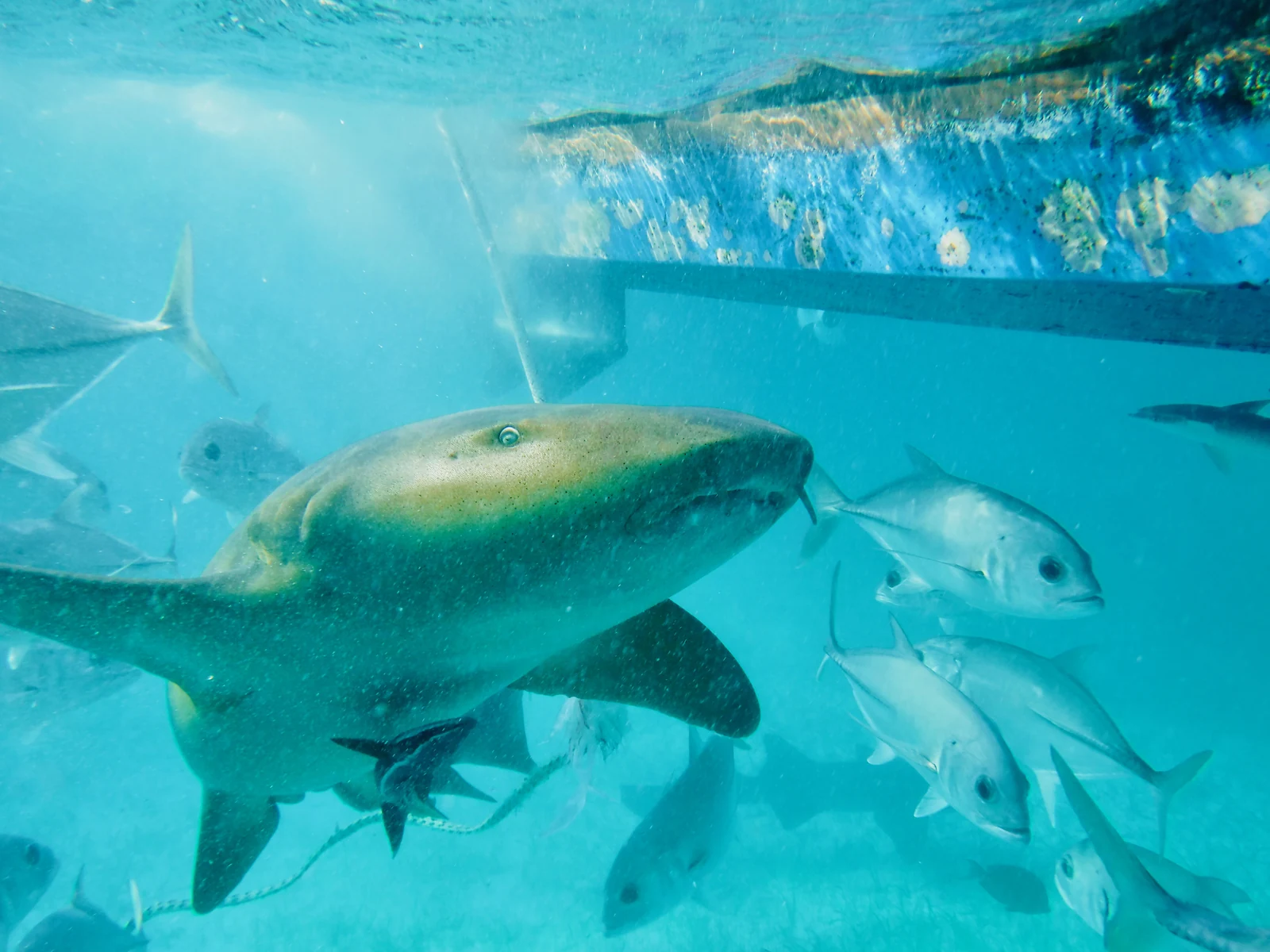
The Atlantic nurse shark (*Ginglymostoma cirratum*) lives in tropical and subtropical coastal waters and spends much of its time near the bottom. Its blunt head, small mouth and pair of nasal barbels create a recognizable profile. The barbels hang near the mouth and help distinguish the head; they do not make the shark harmless or suitable to approach. [1]
Adults range from tan to dark brown, while small juveniles can show darker spots. Both dorsal fins are rounded, and the first sits well back, near the pelvic fins. The upper tail lobe is long and the lower lobe very small. That tail differs from the nearly symmetric tail of a fast-swimming mako, a useful contrast when the whole animal is visible. [1]
These features should be considered together. Color varies with age, and a single silhouette may hide the dorsal-fin placement or tail proportions. The nasal barbels, rounded fins and long upper tail lobe provide several anatomical checks when a full view is available. A resting posture alone offers much weaker evidence of identity than that combination. [1]
How suction works with a small mouth
A nurse shark’s small mouth might suggest a narrow diet, but the mouth is backed by a large pharynx. That chamber supports suction feeding: the shark draws water and prey inward, then its teeth help hold or extract food. The feeding mechanism therefore depends on more than mouth width alone. [2]
Its food includes fishes, rays, crustaceans and mollusks. Conchs provide a concrete example of the mechanics: suction works together with the teeth as the shark turns and extracts the animal. A small opening can thus be part of a feeding system that handles varied prey, rather than evidence that the shark can eat only tiny or soft items. [2]
The evidence supports the roles of suction and teeth, but not a detailed measurement of suction force or a complete account of how every prey type is captured. It would be a mistake to extend the conch example into a claim that all food is extracted in the same way. [2]
Resting sites and daily pattern
Nurse sharks rest on sand or in caves and crevices during the day and are often active near the bottom at night. Individuals may gather at resting sites and repeatedly return to preferred refuges. These habits help explain why a shark can be encountered resting in a sheltered place while still being a predator that feeds and moves at other times. [2]
Consider a hypothetical observation: a nurse shark lies still on sand at midday, then is absent from that spot during a nighttime survey. The first observation is consistent with a common daytime-resting pattern; the second does not prove the shark left the area, because the sources describe preferred refuges and common nighttime activity, not a guaranteed schedule for a particular individual. [2]
Time of day is a pattern, not a reliable prediction of what any one shark is doing. Nor does a resting posture make contact safe. The museum account cautions that a resting nurse shark can inflict a serious bite; the appropriate interpretation is to observe without touching, restraining or feeding it. [2]
Young and species boundaries
Young nurse sharks are born alive after developing inside the mother without placental nourishment. The embryos use their own yolk supply during development. Live birth therefore describes how the young emerge, while the absence of a placenta describes how they are nourished before birth; those are separate features of reproduction. [2]
The scientific name keeps this account focused on the Atlantic nurse shark, Ginglymostoma cirratum. Its coastal habitat includes settings used differently by age and time of day: juveniles occur in shallow reefs, grass flats and mangrove areas, while larger animals often rest around reefs and rocky shelter before moving into shallower feeding water after dark. [1] [2]
Sources & further reading
Have a correction or a source to suggest? Send a note →