
Reading path: Rays and reef fish →
A closer look at the evidence
| Question or feature | Explanation | What it does not establish |
|---|---|---|
| Two jaw sets | Oral jaws capture prey; mobile pharyngeal jaws can advance, grip and retract prey toward the esophagus. [1] | The filmed experiment studied Muraena retifera; other bony fishes also have pharyngeal jaws. [1] |
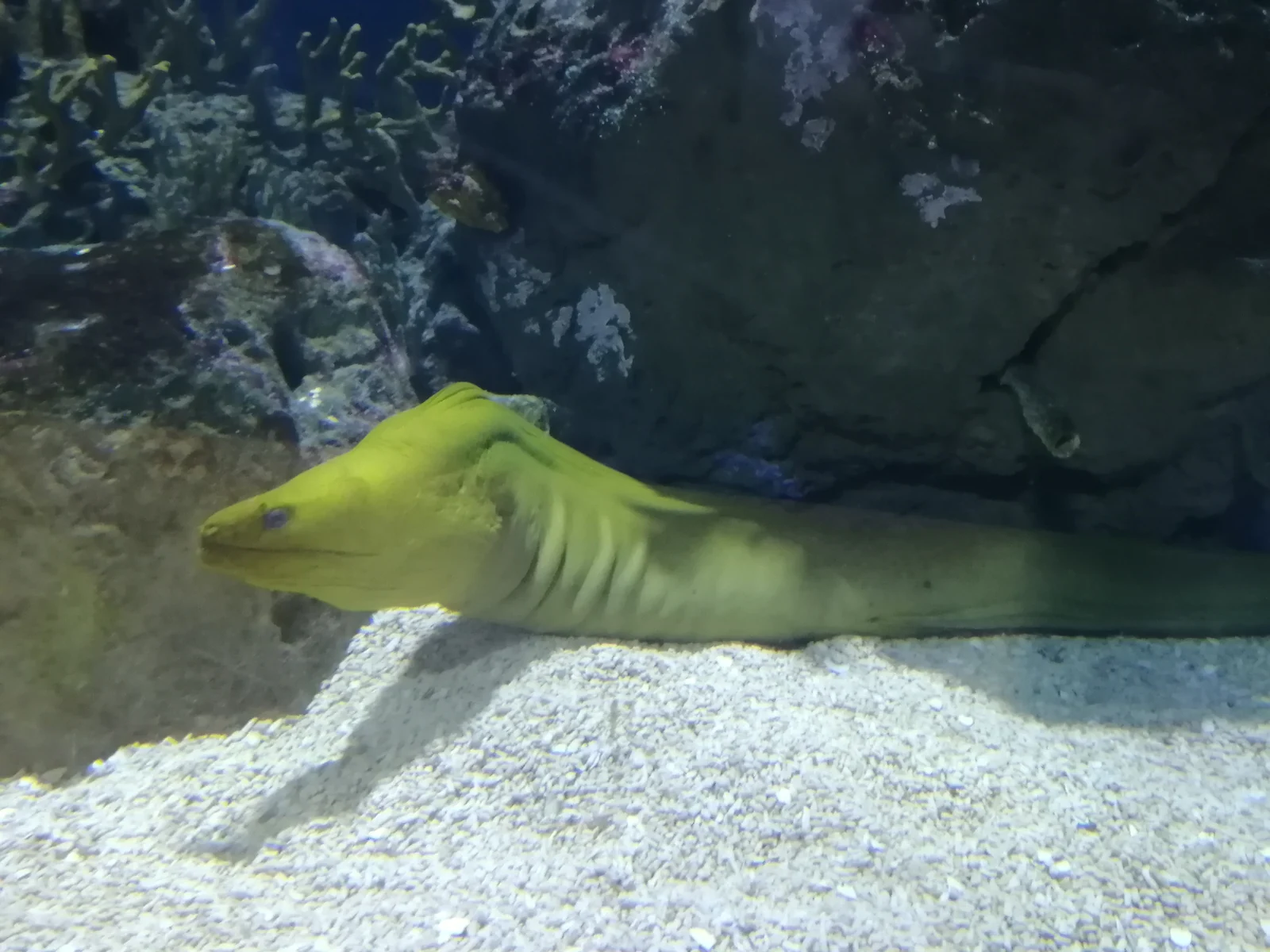
| Green moray color | Yellowish mucus over underlying skin contributes to the green appearance of Gymnothorax funebris. [2] | The green moray’s mucus-influenced color is one feature; color alone is not a complete identification test. [2] |
| Mouth movement | Opening and closing the mouth pumps water over the gills. [2] | An open mouth by itself does not demonstrate aggression or feeding. [2] |
| Green moray diet and habitat | This Atlantic species hunts from reef crevices and eats fish, crustaceans and cephalopods. [2] | The source does not establish the same prey or habitat details for every moray species. [2] |
A capture followed by a second grip
Morays are elongated fishes in the family Muraenidae. A study of reticulated morays examined how they transport prey despite reduced suction capacity. The oral jaws first capture food at the front of the head; mobile pharyngeal jaws farther back in the throat then provide another grip to move it inward. [1]
High-speed video of the reticulated moray, Muraena retifera, showed the throat jaws moving forward into the mouth after oral capture. They gripped the prey, then retracted and carried it toward the esophagus. The action is a transfer: hold at the mouth, advance the throat jaws, take a second grip, and pull inward. [1]
A useful comparison is a handoff between two grips rather than a single bite that somehow drags food down the throat. In a hypothetical filmed sequence, a fish held at the mouth would first indicate oral capture; a forward-moving throat grip followed by inward movement would indicate transport. Mere repeated mouth opening, with no prey or transfer, would not show this feeding mechanism. [1]
What is unusual about the throat jaws
Pharyngeal jaws are not exclusive to morays: other bony fishes have them too. The standout feature in the study is their extreme forward movement and role in transporting prey, rather than the simple presence of a second jaw set. [1]
The experiment filmed Muraena retifera, so its observed motion should not be presented as a direct measurement of every moray species. It offers a well-documented explanation for moray feeding, but species-specific details may vary. Nor does the evidence establish how often every species uses the mechanism or how much force it produces. [1]
This distinction matters when interpreting a dramatic-looking feeding clip. If the image shows prey being drawn in, the two-jaw sequence is a possible explanation supported by the reticulated moray study. If the clip shows only an open mouth, it does not establish a strike, threat or even a feeding event.
Green morays: crevices, prey and color
The Atlantic green moray, Gymnothorax funebris, uses reef crevices while hunting. Its recorded prey includes fish, crustaceans and cephalopods, a broader menu than a shorthand label such as “fish eater” suggests. These facts describe the green moray specifically; they should not be transferred automatically to every animal identified as a moray. [2]
Yellowish mucus over the underlying skin contributes to the green moray’s appearance. This is a particular explanation for Gymnothorax funebris, not a statement that all morays share the same color. Lighting, viewing angle and the visibility of other anatomical features still matter when identifying a photographed eel. [2]
The green moray has no pectoral or pelvic fins, and its long dorsal and anal fins continue around the tail. Its elongate body suits movement through reef crevices. The museum account describes a mainly nocturnal hunter that relies strongly on smell to find fishes, crabs, cephalopods and shrimp. [2]
Reading an open mouth carefully
Green morays open and close the mouth to pump water over their gills. An animal repeatedly gaping while positioned in a crevice may therefore be ventilating, not signaling aggression. A still photograph of an open mouth cannot distinguish ordinary ventilation from a feeding or defensive moment without other context. [2]
For a simple evidence-reading exercise, compare two hypothetical observations. In the first, a moray remains in a crevice and opens and closes its mouth without prey movement; gill ventilation is consistent with the known mechanism. In the second, prey is captured at the mouth and a second set of jaws visibly advances and retracts; that sequence matches the feeding behavior documented in reticulated morays. The observations support different explanations because they include different evidence. [1] [2]
Fin absence is not a unique test for a green moray: the museum notes that morays generally lack pectoral fins and true eels lack pelvic fins. A long body, crevice habitat or open mouth alone therefore cannot distinguish Gymnothorax funebris from every related eel. Keep the species identification separate from the behavior being observed. [2]
Sources & further reading
Have a correction or a source to suggest? Send a note →