
Reading path: Types of sharks →
A closer look at the evidence
| Question or feature | Explanation | What it does not establish |
|---|---|---|
| Adult head margin | Nearly straight leading edge with a shallow central notch; contrast with the arched, multiply notched scalloped hammerhead. [1] | Juvenile great hammerheads have more curved margins. [1] |
| Fin combination | Tall, curved first dorsal fin plus pelvic fins with inward-curving rear edges; no ridge between dorsal fins. [1] [2] | A tall dorsal fin alone does not confirm identity. [2] |
| Prey and teeth | Triangular serrated teeth; diet includes rays, bony fishes, other sharks, crabs and squid. [1] | Prey importance varies with local availability; no single prey defines every site. [1] |
| Habitat and young | Uses shallow tropical coasts and offshore waters; shallow bays and coastal waters serve as juvenile nursery habitat. [2] | This does not establish a universal depth, season or nursery map. [2] |
Read the head, then check the fins
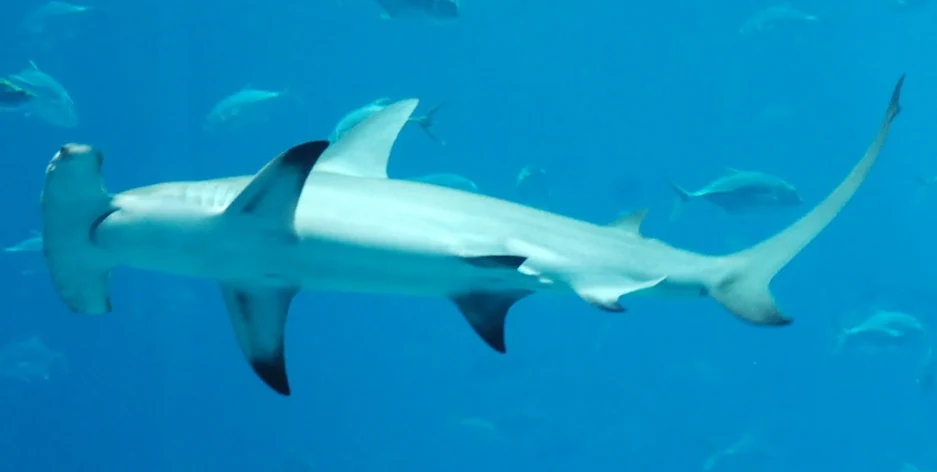
The great hammerhead (Sphyrna mokarran) is the largest living hammerhead species. That distinction does not make every especially large hammerhead a great hammerhead: reliable identification comes from several visible features considered together. In mature animals, the head’s leading edge is nearly straight, with a shallow notch at the center. The outline is a useful first clue because other hammerheads have different patterns of curvature and notching. [1]
Next, inspect the first dorsal fin. It is notably tall, pointed and strongly curved. The rear margins of the pelvic fins are also curved inward, a feature that helps distinguish the species when the fins can be seen. The back between the dorsal fins lacks a ridge. Color can support the identification: the upper body is darker olive, brown or grey, and the underside is pale; adults lack striking fin-tip patterns. [1] [2]
A practical checklist is to confirm a mostly straight adult head margin with one central notch, then look for the tall curved first dorsal and concave rear edges of the pelvic fins. No single item is conclusive. A tall dorsal fin without a clear view of the head and pelvic fins is not enough to settle the identification. [1] [2]
Separate similar hammerheads carefully
Head geometry helps distinguish the great hammerhead from two similar species. Scalloped hammerheads have an arched leading margin with multiple notches; smooth hammerheads lack the central notch described for the great hammerhead. Those differences are most useful when the head is visible clearly enough to trace its outline. [1] [2]
Age changes the appearance. Juvenile great hammerheads have more curved head margins than adults, so the nearly straight outline is a stronger clue for mature animals than for young ones. A photograph of a juvenile that appears more rounded should therefore not be rejected as a great hammerhead on that feature alone. Check the other anatomy and treat an uncertain view as unresolved. [1]
For example, imagine a distant image showing a very tall first dorsal fin but an indistinct head and hidden pelvic fins. The fin profile is consistent with a great hammerhead, but the evidence is incomplete. If a second view shows a shallow central notch and inward-curving pelvic-fin edges, the combined evidence becomes stronger. This is a hypothetical identification exercise, not a claim about a particular sighting. [1] [2]
What the hammerhead eats
Great hammerheads have triangular, serrated teeth suited to taking fishes, other sharks and invertebrates. Stingrays are particularly important prey where available; bony fishes, crabs and squid also feature in the reported diet. The species’ diet is therefore broader than rays alone, and the local availability of prey matters when describing what it eats. [1] [2]
The teeth help explain how the animal can take prey with different body forms, but tooth shape by itself does not reveal what an individual shark last ate or what prey dominates at a particular site. A ray-focused account may fit an area where rays are available, while the source evidence also documents other prey categories. Keep the distinction between a known diet range and a site-specific menu. [1]
A comparison with head shape is useful: teeth are evidence about feeding equipment, while the head margin and fins are the more direct identification checklist. Mixing those kinds of evidence can lead to overconfidence. A serrated tooth pattern is consistent with the documented feeding anatomy, but it does not identify a shark as a great hammerhead on its own. [1]
Coast, offshore water and young sharks
The species uses both shallow tropical coastal waters and offshore habitat. Coastal settings include reefs, inlets and bay mouths. Its habitat use therefore extends beyond one reef setting, and a shark’s coastal location should be considered alongside the anatomical features used to identify it. [2]
Females give birth to live young, and shallow bays and coastal waters serve as nursery habitat for juveniles. This connects the use of coastal water to an important life stage, but it does not mean every bay is a nursery or that juveniles occupy every coastal site. The source evidence supports the general nursery role, not a precise map or season for all populations. [2]
Habitat can help frame an identification, but location alone cannot confirm a species. A shark seen near an inlet still needs the anatomical checks above, and a young animal’s more curved head margin can complicate comparisons with adults. A clear view of several features provides stronger support than either an impressive size estimate or a habitat label. [1] [2]
Sources & further reading
Have a correction or a source to suggest? Send a note →