
Reading path: Rays and reef fish →
A closer look at the evidence
| Question or feature | Explanation | What it does not establish |
|---|---|---|
| Appearance | Typical Amphiprion ocellaris are orange with three pale bands; background coloration varies. [1] | The pattern is not a complete species-identification test. |
| Anemone association | Protective mucus and acclimation help the fish live among tentacles of compatible host anemones. [1] | It does not confer immunity to every stinging animal. |
| Breeding hierarchy | Groups have a size-based hierarchy with a dominant breeding female and a breeding male below her. [2] | Social rank and reproductive role are related; a size measurement alone does not establish every individual’s developmental state. |
| Sex change and study scope | The breeding male can change to female after the female is lost; the cited role study concerns A. percula. [1] [2] | A. percula findings should not be presented as direct A. ocellaris measurements. |
Identify the fish before explaining it
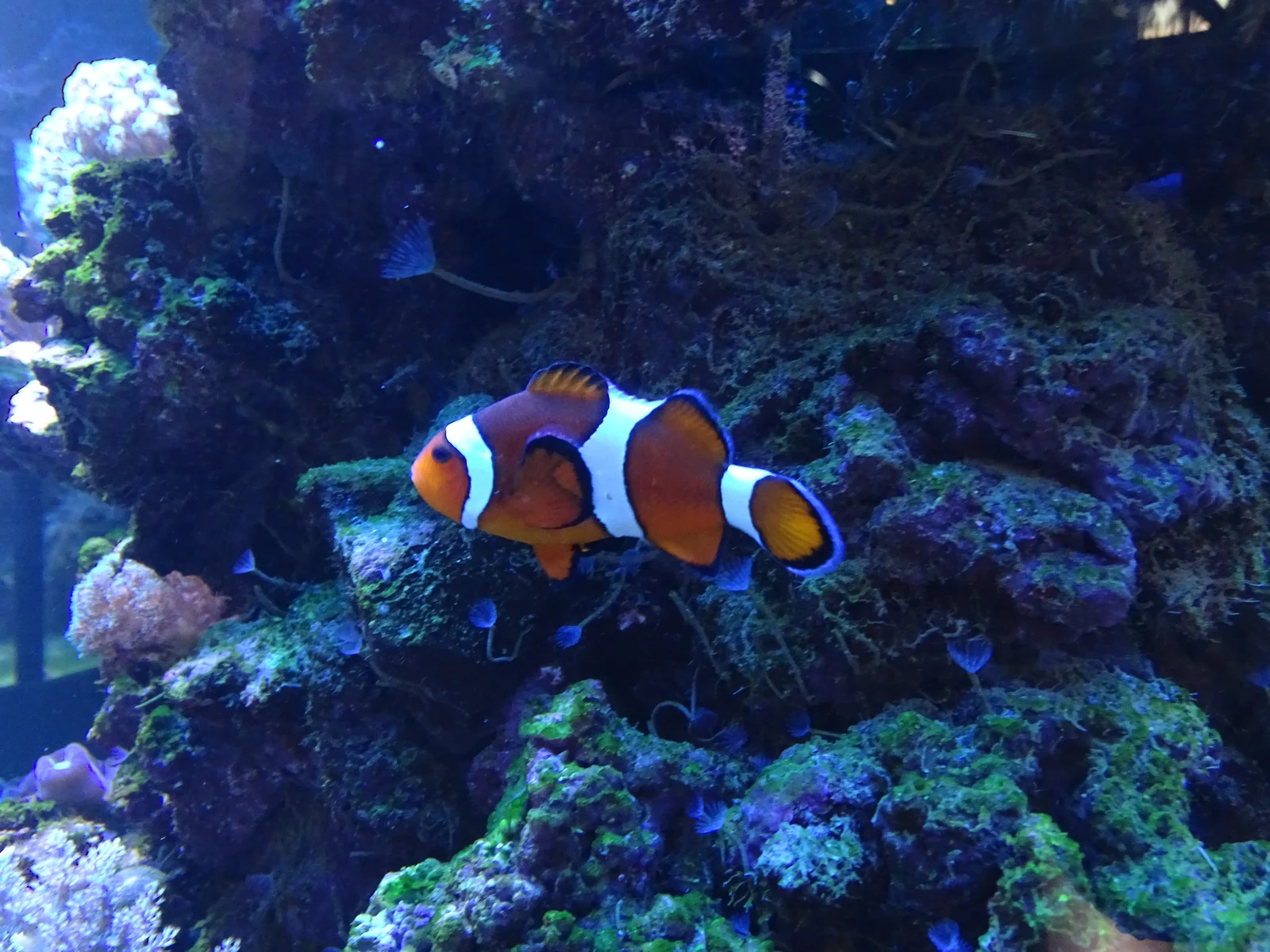
The clown anemonefish <i>Amphiprion ocellaris</i> is one named species in the damselfish family. Typical individuals are orange with three pale bands, though background coloration varies. The three-band pattern is a useful description, not a guarantee that every fish has identical coloration or that appearance alone resolves every species identification. [1]
Amphiprion percula is distinct from A. ocellaris. An original A. percula study examined social dominance and subordinate roles, connecting adoption of those roles with changes in growth, behavior and gene expression. Those results describe the species and experimental setting studied, even when related clownfish share a similar social hierarchy. [2] [1]
This species distinction is useful whenever a general-sounding claim appears. A finding about one named species may help formulate questions about another, but it is not automatically evidence that the second species behaves identically. The available account supports the characteristic bands and anemone association for <i>A. ocellaris</i>, and the cited social-role study for <i>A. percula</i>. [1] [2]
A partnership built around a stinging host
Clown anemonefish live among the stinging tentacles of compatible host anemones. Their association involves protective mucus and acclimation: the fish establishes a relationship with a suitable host rather than being broadly immune to stings. This is a specific adaptation linked to a compatible anemone, not protection against every stinging animal or every contact. [1]
For A. ocellaris, the museum profile names host anemones including Heteractis magnifica, Stichodactyla gigantea and S. mertensii. Such associations are specific biological relationships. Seeing a clownfish among one host’s tentacles does not establish that it can safely enter any anemone or tolerate every type of stinging contact. [1]
A hypothetical comparison helps keep the mechanism precise. If one fish is described as sheltered among a compatible host’s tentacles and another as protected from all stings, only the first claim matches the evidence. The mucus and acclimation explain a particular partnership; they do not establish universal immunity. [1]
Size order shapes the breeding group
Clownfish groups have a size-based breeding hierarchy. The dominant breeding individual is female, with the breeding male below her and smaller nonbreeding individuals lower in the group. Position in that hierarchy affects which fish reproduce and which can advance when a breeding position becomes vacant. [2] [1]
If the breeding female is lost, the breeding male can change sex and take the female role; a subordinate can then move upward in the hierarchy. The male-to-female transition is called protandry. It is a change within an established social group, not evidence that two randomly chosen fish will immediately become a breeding pair. [1] [2]
This is a useful worked scenario, provided it is understood as an illustration of the described hierarchy: a breeding female disappears, the breeding male assumes the female role, and a subordinate advances. The sequence explains how vacancies can be filled within the group. It does not mean all fish change sex on the same schedule, or that an isolated hatchling should be labeled a functioning male. [2] [1]
Eggs, care and what the studies can show
The female lays adhesive eggs on a surface close to the host anemone, and the male fertilizes and tends them. He fans the eggs with his fins and removes damaged or infertile eggs. After hatching, the young enter a planktonic stage, so care of the attached egg mass differs from the independent life of the larvae. [1]
The <i>A. percula</i> study adds a broader point about social roles: adopting dominant or subordinate positions is associated with changes in growth, behavior and gene expression. The result supports a view of social position as biologically consequential. It does not establish that each measured response is identical in <i>A. ocellaris</i>, or that a role alone predicts an individual’s entire development. [2]
Read claims at the right level: species, life stage, social position and observation type. The species profile describes <i>A. ocellaris</i> appearance, host association, sex change and egg tending. The original study investigates role-related plasticity in <i>A. percula</i>. Taken together they explain why “clownfish” is a convenient common name but an imprecise substitute for the species named in a particular piece of evidence. [1] [2]
Sources & further reading
Have a correction or a source to suggest? Send a note →