
Reading path: Types of sharks →
A closer look at the evidence
| Question or feature | Explanation | What it does not establish |
|---|---|---|
| Fin-marking pattern | Look for the dark first dorsal tip, sometimes edged by a pale band, a black lower tail lobe and smaller dark tips on other fins. [1] | Turbidity, angle and underwater color shifts can obscure markings. [1] |
| Body and habitat | Yellow-brown to grey above, white below; shallow tropical Indo-Pacific settings include reefs, sandy shallows, reef edges and tidal mangrove access. [1] [2] | Habitat alone cannot confirm the species; the common name does not include every shark with dark fin tips. [1] [2] |
| Additional identification features | The blacktip reef shark has a short rounded snout and lacks an interdorsal ridge. [2] | A distant fin-only view does not reveal enough characters for a confident identification. [2] |
| Ecology and movement | Diet includes fishes, crustaceans and mollusks; tracking summaries report local site fidelity and relatively small home ranges. [2] | Movement findings are regional; they do not establish that every shark stays on one reef. [2] |
Read the pattern across the fins
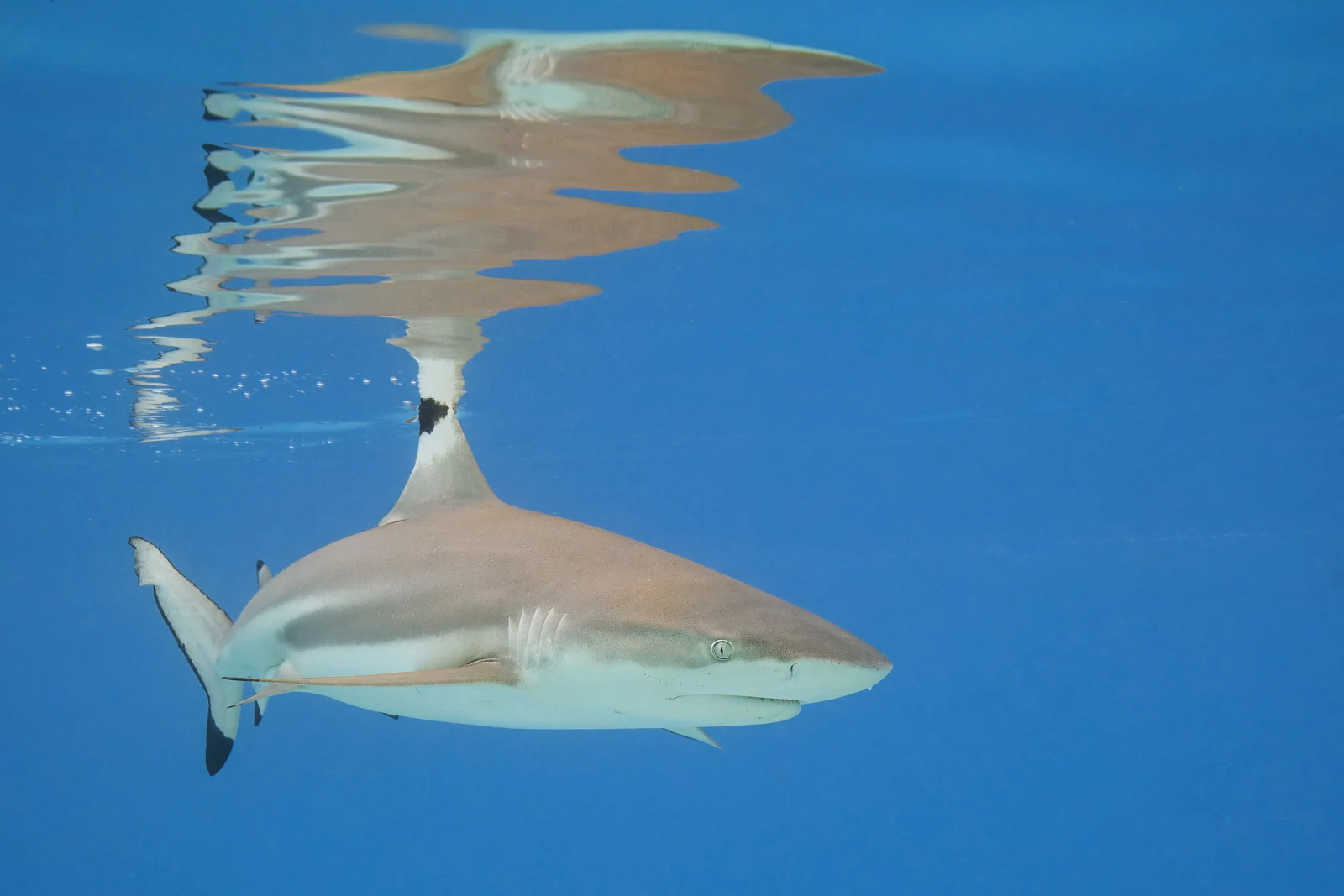
The blacktip reef shark, *Carcharhinus melanopterus*, inhabits shallow tropical marine waters of the Indo-Pacific, commonly around coral reefs. Its back is yellow-brown to grey and its underside white. Dark markings are especially distinct at the first dorsal-fin tip and lower tail lobe; a pale band can outline the dorsal marking. Smaller dark tips may occur on other fins, so identification relies on a pattern across the animal rather than one black triangle. [1]
A short, rounded snout adds another useful feature. The species also lacks an interdorsal ridge, the raised line along the back between the dorsal fins. These traits are most useful when several are visible at once, and should not be inferred from a glimpse showing only a dorsal fin. [2]
Habitat narrows the possibilities
Blacktip reef sharks use reef flats, sandy shallows and reef edges, and tidal access can connect these habitats with mangroves. The setting supports an identification, but does not establish species by itself: other sharks may use shallow water, and the common name “blacktip” is applied to more than one species. In particular, the blacktip reef shark is distinct from *Carcharhinus limbatus*. [2] [1]
A practical checklist combines the tropical shallow-reef context with a dark first dorsal tip, its possible pale lower border, a black lower tail lobe and the rounded snout. A hypothetical fin-only view over a reef flat would confirm neither the lower tail marking nor snout shape. It could justify a tentative description of a dark-tipped shark, but too few characters are visible for a confident species label. [1] [2]
Visibility can further weaken the checklist. Turbidity, viewing angle and underwater color shifts may conceal or alter the appearance of the markings. Habitat and multiple visible traits should support an identification; a missing mark in poor viewing conditions is not strong evidence that the shark is a different species. [1] [2]
Prey and a locally rooted life
The diet includes bony fishes, crustaceans, cephalopods and other mollusks. This range describes a predator taking varied prey around reef and shallow-water environments. A species-wide prey list identifies food categories, but it does not mean that each category contributes equally to the meals of every animal or population. [2]
Tracking studies summarized by the museum found strong local site fidelity and relatively small home ranges. These results help explain why sightings may repeatedly occur around a particular reef area. They do not mean that every shark stays on one reef throughout its life, and a regional tracking result should not be treated as a map of movement everywhere. [2]
Young and regional variation
Blacktip reef sharks bear live young, nourished through a yolk-sac placenta, and small litters are typical. Reproductive timing and gestation differ among studied regions, so a calendar reported for one population should not be presented as a universal schedule. [2]
Shallow habitat, fin markings and body form together provide a useful identification framework, but its reliability depends on what is actually visible. A clear view of several features is stronger evidence than a place name or an isolated fin tip. Local site fidelity can explain repeated encounters around a reef, while allowing for movements beyond that area. [1] [2]
Sources & further reading
Have a correction or a source to suggest? Send a note →