
Reading path: Unusual marine body plans →
Questions to keep separate
| Question or feature | Explanation | What it does not establish |
|---|---|---|
| Dive accession | Links footage to vehicle, location, depth, time and accompanying observations. [1] | No verified accession for the clip captioned Japan 1991 was established. |
| Colony anatomy | Connected specialized zooids can move, feed and capture prey; their arrangement can change. [2] | A frame does not show lifespan or every zooid’s function. |
| Scale reference | Scaling lasers or a calibrated object can support a distance estimate. [1] | A partial frame, changing perspective or reference at a different plane undermines total-length claims. |
| Size comparison | MBARI gives Erenna sirena a maximum length of 45 cm; a Ningaloo Apolemia colony was estimated at 150 feet. [2] [3] | Neither figure measures or identifies the unverified Japanese footage. |
First establish which dive produced the clip
A caption such as “Japan, 1991” is a claim about provenance, not proof of provenance. The specific clip described that way has not been tied to a verified primary dive accession. Without the original record, its date, location, depth, species and viewing history remain unconfirmed; repeating those details as settled metadata would give the image more evidentiary weight than it has.
For Japanese deep-sea imagery, JAMSTEC’s J-EDI archive is a useful place to investigate. Its documentation describes searching imagery using keywords, classification and imaging metadata, with associated dive and environmental information. An original dive identifier can connect a clip to the vehicle, location, depth, time and observations recorded around it. That chain matters: a visually similar animal in an archive would not, by itself, prove that it is the animal in an unattributed clip. The existence of the archive does not establish that this particular accession has been found. [1]
Measure a colony, not a silhouette
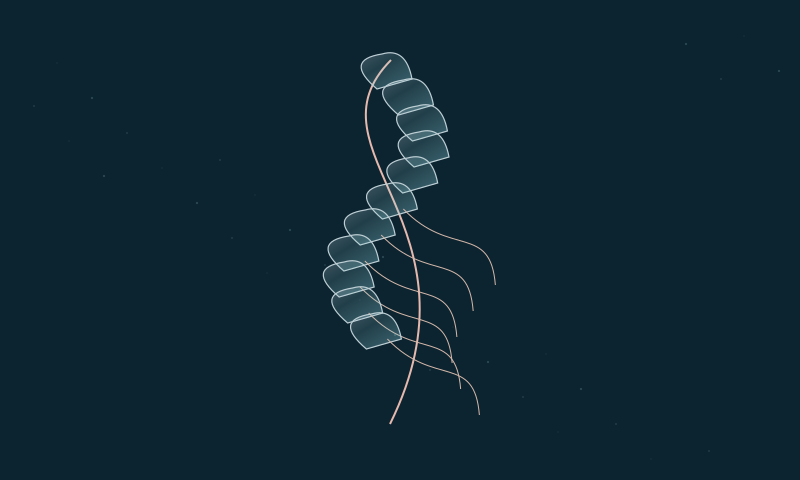
A siphonophore is a colonial cnidarian: its body consists of connected, specialized zooids, rather than one squid-shaped animal. Some zooids pulse to propel the colony; others carry feeding or prey-capture structures. The colony’s outline can change as it moves through water or deploys and retracts tentacles, so a single frame may capture a temporary configuration rather than a fixed body length. [2]
Even if the animal is entirely visible, the camera’s field of view and perspective affect apparent dimensions. If the colony extends beyond the frame, the image supplies only a visible span, not its full extent. A floating tentacle or a camera movement can also make one part appear disproportionately long. Darkness does not supply a scale. A defensible distance estimate needs scaling lasers or another calibrated object visible in the same scene; camera distance and orientation still matter when interpreting that scale. [1]
A useful evidence-reading exercise is to list what one frame directly shows—visible parts, their arrangement and any scale markers—separately from what it cannot show, such as the unseen end of the colony or an unrecorded dive depth. Then ask whether the full animal stayed in frame and whether the scale reference shares its plane. If either answer is no, a precise total-length claim is unsupported.
Keep extraordinary comparisons attached to their records
Large siphonophore colonies are possible, but the word “siphonophore” alone does not imply enormous size. MBARI reports that the angler siphonophore Erenna sirena reaches up to 45 centimeters and lives at 1,600–2,400 meters, where it takes small fish. That measured species-specific description is a useful counterexample to assuming all members of the group share one scale. [2]
A separate 2020 expedition report from abyssal canyons off Ningaloo described an Apolemia colony estimated at 150 feet. It was a different observation at a different place, and the estimate belongs to that record. It cannot be transferred to a purported Japanese clip or used to authenticate one. The comparison is instructive precisely because the scale difference is so large: species, identification and measurement evidence must accompany a size figure. [3]
Separate observations from conclusions
A verified image could support claims about visible anatomy and, with usable calibration and coverage, a measured span. It cannot alone establish how long the colony lived or identify the function of every zooid. Nor does a dramatic silhouette establish that the animal was seen only twice, that it was at 800 meters, or that it belonged to a named species. Those claims need records beyond the image.
The careful conclusion for an unlinked clip is narrow: it appears to show an animal described as a siphonophore, while the caption’s date, Japanese location, depth and size remain unverified. Finding the original accession would let readers test those details; calibrated footage would then be needed to estimate dimensions. Until both are available, the verified Ningaloo estimate is a comparison, not a measurement of this animal.
Sources & further reading
Have a correction or a source to suggest? Send a note →