
Reading path: Unusual marine body plans →
Questions to keep separate
| Question or feature | Explanation | What it does not establish |
|---|---|---|
| Colony growth | A colony begins from one fertilized egg and adds specialized zooids by budding. [1] | The species-specific reproductive method may remain unknown. |
| Length records | Praya dubia is reported up to 40 m; an Apolemia colony was estimated at about 150 ft. [2] [3] | These measurements do not establish age or a growth rate. |
| Longevity | The reviewed sources provide no defensible numerical lifespan. [2] [1] | Absence of a value here does not prove no study anywhere exists. |
| Measurement challenge | Fragile colonies can break, complicating tracking and identification. [3] | Colony persistence and individual zooid lifespan are separate measures. |
One colony, many specialized zooids
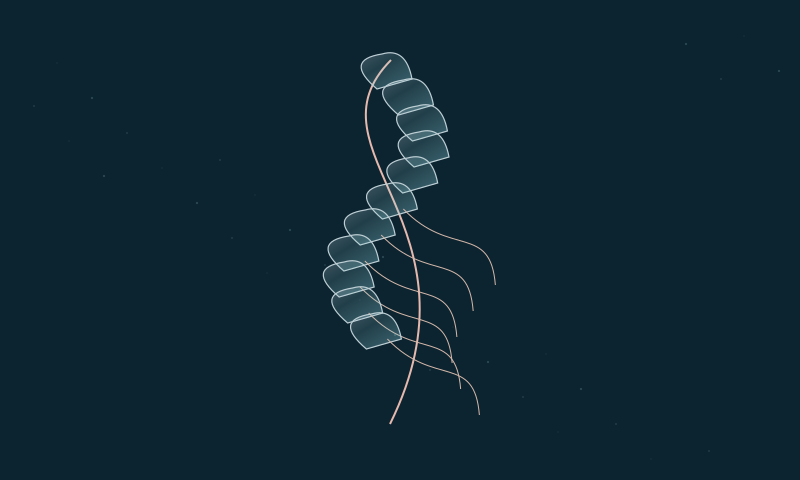
A siphonophore colony begins from a fertilized egg and grows through budding. The resulting zooids are specialized parts of one colony: different zooids contribute to feeding, digestion, propulsion, and reproduction. Clonal budding therefore does not mean unrelated adult animals gathered together in the water. [1] [2]
This organization makes the word “lifespan” ambiguous. It could mean how long the colony persists, how long one zooid remains functional, or how long a reproductive stage lasts. Those are different biological measurements. In some siphonophore groups a reproductive stage can detach, and reproductive arrangements differ among groups; a detail from one form cannot be assigned to all of them. [1] [2]
Length is not a clock
Monterey Bay Aquarium reports that Praya dubia can reach 40 meters while having a body about the thickness of a broomstick. A 2020 Ningaloo canyon expedition report estimated an Apolemia colony at approximately 150 feet. These are length claims for different taxa and contexts; they do not show how many years either colony had been growing. [2] [3]
For a clearly hypothetical evidence exercise, suppose a photograph with a scale supports a colony length of 40 meters. That measurement still cannot be converted into years without a validated growth rate and information about damage and losses. A colony may grow, lose sections, or regenerate; a long form is not a timestamp. [2]
What observations would answer the age question?
A numerical lifespan would require evidence that links a known starting point to elapsed time or validates an age method against known-age colonies. The supplied institutional and expedition accounts describe anatomy, colony development, and remarkable lengths, but establish no defensible numerical lifespan. That is the appropriate answer from these records; it does not prove that no study anywhere has ever addressed the question. [2] [1] [3]
Fragility makes such measurement difficult. Colonies can break into pieces, complicating collection, identification, and long-term tracking. Observers must also distinguish the colony’s continuity from the persistence of particular zooids. Without those links, neither a length record nor a striking image establishes the age of the colony. [3] [2]
Do not merge species into one life history
Praya dubia, the Ningaloo Apolemia colony, and Marrus orthocanna illustrate different siphonophore records. The Aquarium of the Pacific describes a colony developing from a fertilized egg by budding, while noting that the reproductive method for that species remains unknown. That account cannot fill the longevity gap or settle reproduction for other siphonophores. [1]
Claims that giant siphonophores routinely live 100–200 years, or are immortal, need a primary ageing study that the reviewed sources do not provide. Likewise, the estimated 150-foot length in the Ningaloo report is not an age measurement, and the approximately 40-meter Praya figure should not be treated as the same colony or species. [3] [2]
Sources & further reading
Have a correction or a source to suggest? Send a note →