
Reading path: Unusual marine body plans →
Questions to keep separate
| Question or feature | Explanation | What it does not establish |
|---|---|---|
| Locomotion | Beating cilia in rows propel this ctenophore through midwater. [1] | A still image cannot establish the movement that produced a shimmer. |
| Rainbow combs | Moving cilia scatter illumination into rainbow colors. [2] | The effect is not, by itself, evidence of bioluminescence. |
| Red stomach | Red tissue can appear dark where red wavelengths are scarce, concealing luminous prey. [1] | Artificial ROV light changes the animal’s photographic appearance; detailed diet remains unknown. [3] |
| Reported range | MBARI reports 250–1,500 m and up to 16 cm; the aquarium reports 400–1,000 m and up to 15 cm. [1] [3] | Rounded institutional ranges are not exact boundaries. |
Comb rows are moving cilia
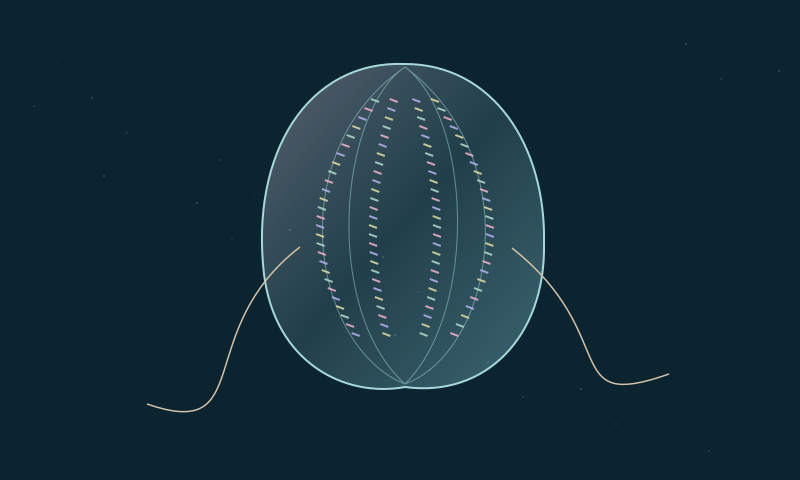
The bloody-belly comb jelly, Lampocteis cruentiventer, is a ctenophore, a group distinct from true jellyfish. Rows of beating cilia, often called comb rows, propel it through midwater. Its recognizable rainbow shimmer is not necessarily light made by the animal: light scattered by moving cilia can separate into colors. NOAA describes this effect in footage illuminated by an ROV. [1] [2]
That distinction matters when reading a video. If a rainbow band shifts with the comb rows under the vehicle’s lamp, the appearance is consistent with an optical interaction between light and moving cilia. It is not evidence by itself that the jelly is bioluminescent. A separate glow from prey in the stomach is a different phenomenon. [2]
A red stomach in a dim habitat
The animal’s stomach is red while much of its body is translucent. At depth, red wavelengths are scarce; red tissue therefore appears dark and can help conceal the stomach and luminous prey inside it. The proposed camouflage and an ROV image showing a conspicuously red animal are compatible: artificial white illumination restores wavelengths that are scarce in the animal’s ambient environment. [1] [3]
As a hypothetical comparison, imagine the same red material photographed first under broad white ROV light and then under illumination lacking red wavelengths. It would look red in the first image and much darker in the second. The comparison illustrates why camera color does not directly reproduce how the animal appears in deep-water ambient light. [1]
Read size and depth as reported ranges
MBARI gives a maximum length of 16 centimeters and an observed depth range of 250–1,500 meters. Monterey Bay Aquarium gives a maximum of 15 centimeters and a range of 400–1,000 meters. These are different rounded institutional summaries, not exact physiological boundaries; neither supports a claim that the animal cannot occur just beyond a stated endpoint. [1] [3]
MBARI reports the species across the North Pacific, from Canada to Baja California and Japan, and describes it in twilight-zone midwater, including oxygen-minimum waters. The species was scientifically described by MBARI researchers in 2001. The broad distribution does not mean every location or depth has been equally sampled. [1]
Keep the prey question open
The red stomach’s concealment function is described, but MBARI lists the diet as unknown. That leaves an important distinction: evidence about where luminous prey may be hidden does not provide a confident, species-by-species menu. Avoid turning an explanation of stomach color into a specific feeding list. [1]
When evaluating an image, separate three observations: the animal’s pigment, the rainbow effect on the comb rows, and any light attributable to prey. Note whether the video uses vehicle illumination, and avoid treating a dramatic color rendering as a direct record of natural ambient appearance. The footage can show anatomy and movement while leaving the exact diet and natural color contrast unresolved. [2] [3]
Sources & further reading
Have a correction or a source to suggest? Send a note →